

Inflammation and Aging: What Patients and Clinicians Need to Know
Elizabeth Vogstrom, PA-C
evoyouthful Clinical Team
Discover the role of inflammation in aging and how you can reduce its impact. Learn practical steps to enhance your longevity today!
Inflammation and Aging: What Patients and Clinicians Need to Know
Chronic, low-grade inflammation is a causal, modifiable driver of biological aging, and the scientific community now recognizes it as one of the most important levers in longevity medicine. The term for this process is inflammaging, coined by gerontologist Claudio Franceschi to describe the persistent, sterile immune activation that accumulates across decades and quietly accelerates organ damage, cognitive decline, cardiovascular disease, and frailty. The role of inflammation in aging is not passive background noise. It is a self-reinforcing cycle that compounds over time, and the good news is that it can be measured, tracked, and meaningfully reduced.
Your most practical first step: request a high-sensitivity C-reactive protein (hs-CRP) test and, if available, an IL-6 level at your next clinical visit, then review the results with a clinician who can help you prioritize lifestyle changes based on your personal inflammatory profile.
Three immediate actions:
- Measure: Ask your clinician for hs-CRP and IL-6 as a baseline inflammatory panel.
- Lifestyle first: Prioritize a Mediterranean-style diet, consistent resistance and aerobic exercise, and seven to nine hours of sleep per night.
- Escalate when needed: If markers remain elevated despite lifestyle changes, or if you have multiple age-related conditions, seek a geroscience-informed clinician for a comprehensive evaluation.
Table of Contents
- What is inflammaging, and why does it matter clinically?
- How do cells and tissues generate chronic inflammation with age?
- Which signaling pathways drive inflammaging at the molecular level?
- How does chronic inflammation accelerate specific age-related diseases?
- Which biomarkers can you use to measure inflammaging?
- What does the evidence actually show: animal studies versus human trials?
- How can you reduce chronic inflammation? An evidence-graded action plan
- When should you see a clinician, and what should you expect?
- What are the open questions in inflammaging research?
- Key Takeaways
- A clinician’s perspective on inflammaging in practice
- evoyouthful offers a personalized path to lower your inflammatory burden
- Useful sources and further reading
What is inflammaging, and why does it matter clinically?
Inflammaging refers to chronic, low-grade, systemic inflammation that increases with age in the absence of active infection or injury. Unlike the acute inflammation that resolves a wound or clears a pathogen, inflammaging is persistent immune activation that never fully switches off. Circulating inflammatory markers stay elevated, immune cells remain partially activated, and tissues experience a slow, sustained assault.
The distinction between acute and chronic inflammation matters enormously in clinical practice:
- Acute inflammation is protective, time-limited, and resolves cleanly. It is the body doing its job.
- Chronic low-grade inflammation is dysregulated, persistent, and destructive. It is the body stuck in a low-level alarm state.
- Inflammaging is the age-specific form of chronic inflammation, shaped by decades of cellular damage, immune remodeling, and environmental exposure.
Franceschi introduced the term in the early 2000s, and geroscience has since elevated inflammaging to a recognized hallmark of aging. Critically, population biology evidence shows that chronic inflammation is not an inevitable consequence of getting older. Developmental exposures, diet, microbiome composition, and psychosocial stress all shape an individual’s lifelong inflammatory setpoint. That means inflammaging is a marker of resilience failure and a potential causal factor in disease, not simply an unavoidable feature of a long life.
How do cells and tissues generate chronic inflammation with age?
The cellular machinery behind inflammaging involves several converging processes, each capable of sustaining and amplifying the others.

Senescent cells and SASP. As cells accumulate damage, some enter a state called senescence rather than dying. These cells stop dividing but remain metabolically active, secreting a cocktail of pro-inflammatory cytokines, chemokines, and proteases known as the senescence-associated secretory phenotype (SASP). SASP factors do not stay local. They circulate systemically, induce senescence in neighboring cells, and impair immune clearance, creating a self-reinforcing vicious cycle that drives tissue inflammation long before clinical disease appears.
DAMPs and inefficient clearance. Damaged or dying cells release damage-associated molecular patterns (DAMPs), molecular signals that the innate immune system reads as danger. With age, the clearance of cellular debris becomes less efficient, so DAMP signaling persists. The immune system stays activated even when no pathogen is present.
Mitochondrial dysfunction. Aging mitochondria produce excess reactive oxygen species (ROS) and can leak mitochondrial DNA into the cytoplasm. Both are potent activators of innate immune pathways, particularly the NLRP3 inflammasome and cGAS-STING, which translate mitochondrial stress into inflammatory cytokine production.
Gut microbiome dysbiosis. The gut microbiome shifts substantially with age, losing beneficial species and gaining pro-inflammatory ones. This dysbiosis increases systemic exposure to inflammatory metabolites and compromises the gut barrier, allowing bacterial products like lipopolysaccharide (LPS) to enter circulation and trigger immune activation throughout the body.
The mechanism flow looks like this:
- Cellular damage or stress → DAMP release and SASP secretion
- Innate immune activation → cytokine production (IL-6, TNF-α, IL-1β)
- Tissue dysfunction and impaired repair → further cellular damage
- Failed immune clearance of senescent cells → amplification of SASP
- Systemic low-grade inflammation → organ and metabolic decline
Pro Tip: If you are working with a clinician on an anti-inflammaging plan, ask specifically about gut health assessment. Microbiome dysbiosis is one of the most modifiable drivers of systemic inflammation, yet it is rarely included in standard metabolic panels. A stool microbiome analysis can reveal actionable targets that a blood panel alone will miss.
Which signaling pathways drive inflammaging at the molecular level?
Understanding the key pathways helps explain both why inflammaging is so persistent and why certain interventions work.
NF-κB is the central transcriptional hub of inflammatory gene expression. When activated by DAMPs, cytokines, or oxidative stress, NF-κB drives production of IL-6, TNF-α, IL-1β, and other mediators. Senescent cells show constitutively elevated NF-κB activity, which is a primary reason SASP is so difficult to suppress without clearing the senescent cells themselves.
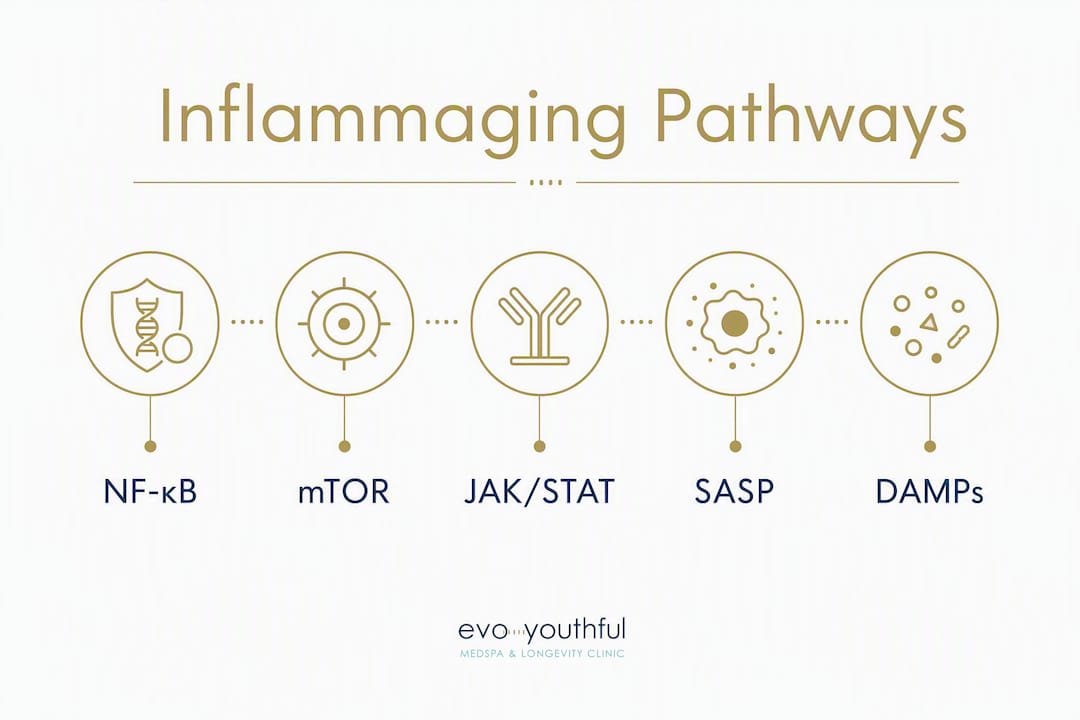
NLRP3 inflammasome is a multiprotein complex that responds to sterile danger signals, including uric acid crystals, cholesterol crystals, and mitochondrial ROS. Once activated, NLRP3 cleaves pro-IL-1β into its active form, driving the sterile inflammation characteristic of metabolic disease and atherosclerosis. NLRP3 activation increases with age and is directly linked to metabolic dysfunction and frailty.
Key cytokines: IL-6, TNF-α, and IL-1β. These three are the most clinically relevant inflammatory mediators in aging:
- IL-6 rises consistently across adulthood and correlates with frailty, morbidity, and mortality in older adults. It is the most widely used inflammaging marker in research.
- TNF-α promotes muscle catabolism and insulin resistance, contributing directly to sarcopenia and metabolic syndrome.
- IL-1β drives fever, acute-phase responses, and, chronically, joint destruction and vascular inflammation.
mTOR and JAK/STAT cross-talk. The mechanistic target of rapamycin (mTOR) pathway regulates cell growth, autophagy, and immune function. Overactive mTOR suppresses autophagy, allowing damaged cellular components to accumulate and fuel inflammation. Rapamycin (sirolimus) inhibits mTOR and has shown lifespan extension in animal models. The JAK/STAT pathway transmits cytokine signals intracellularly; JAK inhibitors are already approved for inflammatory diseases and are under investigation for aging-related applications. These pathways represent the clearest current therapeutic entry points for pharmacologic inflammaging intervention.
How does chronic inflammation accelerate specific age-related diseases?
The consequences of inflammaging are not abstract. They map directly onto the conditions most likely to affect your health and independence after 50.
Alzheimer’s disease and cognitive decline. Neuroinflammation, driven by activated microglia and elevated IL-6 and TNF-α in brain tissue, accelerates amyloid plaque formation and tau pathology. Chronic systemic inflammation also compromises the blood-brain barrier, allowing peripheral inflammatory signals to reach the central nervous system. Elevated inflammatory markers correlate with higher risk of age-related pathologies, including cognitive impairment.
Cardiovascular disease. Inflammation is not just a bystander in atherosclerosis. It actively drives plaque formation, promotes plaque instability, and increases the risk of rupture and acute coronary events. CRP and IL-6 are independent predictors of cardiovascular events in large prospective cohorts, above and beyond traditional lipid markers.

Sarcopenia and frailty. TNF-α and IL-6 directly suppress muscle protein synthesis and promote muscle catabolism. Chronically elevated cytokines reduce the regenerative capacity of muscle stem cells (satellite cells), accelerating age-related muscle loss. Frailty, the clinical syndrome of reduced physiologic reserve, is strongly predicted by elevated inflammatory markers in longitudinal studies.
Metabolic disease. Adipose tissue, particularly visceral fat, is a major source of pro-inflammatory cytokines in older adults. This “metaflammation” drives insulin resistance, impairs glucose metabolism, and creates a feedback loop where metabolic dysfunction worsens inflammation. IL-6, IL-18, and CRP rise with obesity and degenerative disease, and the relationship is bidirectional.
Key finding: In large prospective cohort studies, older adults with persistently elevated IL-6 levels show significantly higher rates of disability, hospitalization, and all-cause mortality compared to those with lower levels, independent of baseline disease status.
Which biomarkers can you use to measure inflammaging?
Measuring inflammaging requires moving beyond a standard CBC. The following markers provide clinically useful information, each with specific strengths and limitations.
| Marker | Availability | What it indicates | Limitations |
|---|---|---|---|
| hs-CRP | Standard clinical lab | Systemic inflammation; cardiovascular risk | Rises with any infection or injury; non-specific |
| IL-6 | Specialty/reference lab | Frailty risk, immune activation, inflammaging severity | Diurnal variation; less standardized across labs |
| TNF-α | Specialty/reference lab | Muscle catabolism, NF-κB activation | Short half-life; difficult to measure reliably |
| IL-1β | Research/specialty lab | NLRP3 activation, metabolic inflammation | Very low circulating levels; high assay variability |
| Fibrinogen | Standard clinical lab | Acute-phase response, cardiovascular risk | Rises with many conditions; less specific |
| GlycA | Specialty lab (NMR panel) | Composite glycoprotein inflammation index | Less widely available; not yet standard of care |
| DNA methylation clocks | Research/commercial labs | Biological vs. chronological age | Expensive; interpretation still evolving |
| Proteomic/metabolomic panels | Research/commercial labs | Multi-omic biological age index | High cost; limited clinical validation |
Composite and emerging biomarkers, including DNA methylation clocks, glycomics, and proteomics, can better index biological age and inflammaging than any single marker. For most patients, hs-CRP and IL-6 remain the most practical starting point.
Pro Tip: For meaningful longitudinal tracking, collect samples at the same lab, at the same time of day (morning, fasting), and never within two weeks of an acute illness or vaccination. A single elevated reading means little; a trend across three or more time points is what guides clinical decisions. Personalized medicine starts with consistent, comparable data.
What does the evidence actually show: animal studies versus human trials?
The gap between preclinical promise and human clinical reality is one of the most important things to understand before making decisions about anti-inflammaging therapies.
Preclinical findings are compelling. Multiple animal studies demonstrate lifespan and healthspan extension with interventions targeting inflammation, including mTOR inhibition with rapamycin, senolytic drugs, and genetic knockouts of key inflammatory mediators. In mice, these interventions consistently reduce inflammatory burden, improve physical function, and extend median lifespan.
Human evidence is more limited, but growing:
- Metformin has strong epidemiologic support from diabetic populations, where users show lower rates of cancer, cardiovascular disease, and all-cause mortality compared to non-users. The TAME (Targeting Aging with Metformin) trial is the first large randomized trial designed specifically to test metformin as a geroprotector in non-diabetic older adults, with results anticipated in coming years.
- Rapamycin (sirolimus) and its analogs (rapalogs) have shown immune-rejuvenating effects in small human trials, including improved vaccine response in older adults. Long-term safety data in healthy aging populations remain limited, and rapamycin carries real risks including immunosuppression, metabolic effects, and impaired wound healing.
- Senolytics (dasatinib + quercetin) have been tested in early-phase human trials for conditions including idiopathic pulmonary fibrosis and diabetic kidney disease. Results show biological signals of senescent cell clearance, but sample sizes are small and long-term safety in healthy adults is not established.
Translational reviews consistently call for standardized endpoints and larger randomized trials before widespread adoption of geroprotectors. The preclinical data justifies optimism and continued research. It does not yet justify self-prescribing experimental therapies outside of clinical supervision.
The translation problem is real. Mice are short-lived, inbred, and raised in controlled environments. Human aging is shaped by decades of variable exposures, genetics, and comorbidities. An intervention that extends mouse lifespan by 25% may have a very different effect profile in a 60-year-old human with metabolic syndrome and a history of infections.
How can you reduce chronic inflammation? An evidence-graded action plan
Lifestyle interventions have the strongest and most consistent human evidence. Pharmacologic options are promising but require clinical supervision.
Lifestyle interventions: first-line and evidence-backed
- Mediterranean or plant-forward diet: Consistently reduces CRP and IL-6 in randomized trials. Emphasizes olive oil, fatty fish, legumes, vegetables, and whole grains. For deeper guidance on plant-based approaches, plant-based inflammation support practices offer practical, evidence-oriented strategies.
- Omega-3 fatty acids: EPA and DHA supplementation reduces circulating IL-6 and TNF-α in meta-analyses of randomized trials. Aim for a clinically supported amount of combined EPA/DHA daily from fish oil or algae-based sources.
- Resistance and aerobic exercise: Both modalities independently lower inflammatory markers. Resistance training specifically counteracts sarcopenia-related inflammation. Aim for at least 150 minutes of moderate aerobic activity and two resistance sessions per week.
- Sleep: Seven to nine hours per night. Chronic short sleep (under six hours) elevates CRP and IL-6. Sleep quality matters as much as duration.
- Smoking cessation: Smoking is a direct driver of NF-κB activation and systemic oxidative stress. Cessation reduces inflammatory markers within weeks.
- Stress management: Chronic psychosocial stress activates the HPA axis and sympathetic nervous system, both of which upregulate NF-κB and cytokine production. Mindfulness-based stress reduction (MBSR) has shown modest but consistent reductions in CRP in randomized trials.
- Vitamin D (when deficient): Correcting vitamin D deficiency reduces inflammatory markers in several trials. Test 25-OH vitamin D before supplementing; target 40–60 ng/mL.
- Probiotics and prebiotics: Emerging evidence supports microbiome-targeted interventions for reducing gut-derived systemic inflammation. Herbal and botanical approaches to inflammation also show promise as complementary strategies, though human trial evidence varies by compound.
Clinical and pharmacologic options
Lifestyle changes reduce inflammatory markers most reliably across populations; pharmacologics are adjuncts, not replacements, and require clinical oversight.
| Intervention | Mechanism of action | Human evidence strength | Availability | Safety/side effects | Study stage/use-case |
|---|---|---|---|---|---|
| Metformin | AMPK activation, mTOR inhibition, NF-κB suppression | Moderate (epidemiologic; TAME trial ongoing) | Prescription | GI upset, B12 depletion, lactic acidosis | Established for T2D; investigational for aging |
| Rapamycin (sirolimus) | mTOR inhibition, autophagy induction | Early human (immune rejuvenation trials) | Prescription | Immunosuppression, metabolic effects, wound healing | Early human; not standard for healthy aging |
| Dasatinib + quercetin | Senolytic: clears senescent cells | Pilot human trials (small N) | Dasatinib: Rx; quercetin: OTC | Dasatinib: cytopenias, fluid retention; quercetin: generally well tolerated | Early human; trial-stage for aging indications |
| BHRT (estrogen/testosterone) | Modulates immune responses, reduces NF-κB activity | Moderate (observational + RCTs for specific outcomes) | Prescription | Varies by hormone, route, and individual; requires monitoring | Established for hormone deficiency; adjunct for inflammaging |
Sequencing your approach:
- Start with lifestyle changes for at least three to six months before considering pharmacologic options.
- Retest hs-CRP and IL-6 after three months of consistent lifestyle intervention to assess response.
- If markers remain elevated and you have multiple risk factors, consult a clinician about supervised pharmacologic options.
- Never self-prescribe rapamycin, dasatinib, or metformin for anti-aging purposes without clinical evaluation and monitoring.
When should you see a clinician, and what should you expect?
Some situations call for professional evaluation rather than self-directed lifestyle changes alone.
Seek a clinician if you experience:
- Persistently elevated hs-CRP (above 3.0 mg/L on two or more occasions, not explained by acute illness)
- IL-6 levels above the upper reference range on repeat testing
- Two or more age-related conditions (cardiovascular disease, metabolic syndrome, cognitive changes, sarcopenia)
- Rapid or unexplained functional decline
- Interest in supervised pharmacologic or hormonal interventions
What to bring to your appointment:
- Recent lab results: hs-CRP, IL-6 (if available), metabolic panel, lipid panel, HbA1c, complete blood count
- Current medication and supplement list
- A symptom inventory covering energy, cognitive function, sleep quality, physical performance, and body composition changes
- Family history of cardiovascular disease, dementia, or autoimmune conditions
What a comprehensive inflammaging evaluation looks like:
A geroscience-informed clinician will typically integrate hormone review (including estrogen, testosterone, DHEA, and thyroid), metabolic evaluation (insulin sensitivity, adipokines, body composition), immune marker panel (hs-CRP, IL-6, and possibly TNF-α or fibrinogen), gut health assessment, and a personalized intervention plan. Hormone evaluation and BHRT are often part of this picture, since estrogen and testosterone both modulate inflammatory pathways and decline significantly with age.
Pro Tip: Before starting BHRT or any experimental therapy, ask your provider three specific questions: What monitoring schedule will you use? What are the stopping criteria if my markers worsen? And what is the evidence base for this intervention in someone with my specific profile? A clinician who cannot answer these questions clearly is not the right partner for this work.
What are the open questions in inflammaging research?
The field has made remarkable progress, but significant gaps remain. Understanding them helps you set realistic expectations and make informed decisions about emerging therapies.
Current limitations:
- Most geroprotector trials (rapamycin, senolytics) are small, short-term, and conducted in specific disease populations, not healthy aging adults.
- Inflammaging phenotypes vary widely across individuals and populations. A single biomarker threshold does not apply universally.
- Causality in humans is difficult to establish. Elevated IL-6 correlates with frailty, but whether lowering IL-6 prevents frailty at scale remains an open question.
- Standardized composite biomarkers for inflammaging do not yet exist in routine clinical practice, though multi-omic panels are advancing rapidly.
Promising directions:
- Transcriptomic and proteomic clocks that capture biological age more precisely than single markers, enabling earlier and more personalized intervention.
- Senolytic clinical trials expanding to larger populations and longer follow-up periods, with dasatinib + quercetin and newer compounds in the pipeline.
- Sex differences in inflammaging: Estrogen’s regulatory role on immune responses means women and men have different inflammatory trajectories across the lifespan. Supervised hormone therapy can alter inflammatory profiles in medically appropriate candidates, and sex-stratified trial designs are beginning to capture this.
- Microbiome-targeted interventions: Precision probiotic and prebiotic strategies, fecal microbiota transplantation research, and dietary fiber optimization are all active areas with growing human trial data.
- Environmental and psychosocial factors: Air pollution, chronic stress, and socioeconomic adversity all elevate inflammatory setpoints. Research into how these exposures interact with genetic and epigenetic factors is expanding, with implications for personalized prevention strategies.
These gaps matter practically: they are why clinical supervision, longitudinal monitoring, and evidence-first decision-making are not optional extras but the foundation of responsible anti-inflammaging care.
Key Takeaways
Inflammaging is a causal, measurable, and modifiable driver of biological aging, and the most effective approach combines baseline inflammatory testing, consistent lifestyle intervention, and clinician-guided escalation when markers remain elevated.
| Point | Details |
|---|---|
| Inflammaging is causal, not incidental | Chronic low-grade inflammation actively drives Alzheimer’s, CVD, sarcopenia, and metabolic disease, not just correlates with them. |
| Measure before you manage | Baseline hs-CRP and IL-6 testing gives you a personal inflammatory profile to track over time and guide intervention priorities. |
| Lifestyle has the strongest human evidence | Mediterranean diet, omega-3s, exercise, and sleep consistently reduce inflammatory markers in randomized trials. |
| Pharmacologic options need clinical supervision | Metformin, rapamycin, and senolytics show promise but carry real risks; none should be self-prescribed for anti-aging purposes. |
| evoyouthful offers a multidisciplinary path | The clinic integrates hormone evaluation, metabolic assessment, peptide therapy, and advanced biomarker review into a personalized inflammaging plan. |
A clinician’s perspective on inflammaging in practice
The most common mistake I see in patients who come in concerned about aging is treating inflammation as a single number to fix rather than a system to understand. A CRP of 4.2 mg/L means something very different in a 55-year-old woman with untreated sleep apnea and a sedentary lifestyle than it does in a 62-year-old man who exercises regularly but carries significant visceral adiposity. The number is the starting point, not the answer.
What I find most clinically useful is building a picture across multiple domains simultaneously: inflammatory markers, hormone status, metabolic function, gut health, and sleep quality. These systems talk to each other constantly. Estrogen, for example, has meaningful regulatory effects on NF-κB activity and immune cell function, which is one reason women often see inflammatory markers shift at perimenopause even when nothing else in their lifestyle has changed. Addressing that hormonal shift, when clinically appropriate and properly monitored, can be a meaningful part of an anti-inflammaging strategy, not a cosmetic afterthought.
The evidence also tells us that early, proactive intervention changes trajectories. Patients who address elevated inflammatory markers in their 50s, before clinical disease is established, have far more options and far better outcomes than those who wait for a diagnosis to prompt action. The goal is not to chase a perfect biomarker panel. It is to reduce the cumulative inflammatory burden over time, protect organ function, and preserve the physical and cognitive capacity that makes life worth living at every decade.
evoyouthful offers a personalized path to lower your inflammatory burden
Knowing your inflammatory markers is one thing. Having a clinical team that knows what to do with them is another. At evoyouthful in Wayzata, MN, a comprehensive first appointment goes well beyond a standard wellness visit. The team integrates advanced inflammatory marker review, hormone evaluation (including bioidentical hormone replacement therapy for appropriate candidates), peptide therapy protocols, nutrigenomics testing, and cognitive support through ExoMind TMS, all within a single coordinated care model.

For patients who have already done the reading and want a clinician who will meet them at that level, evoyouthful is built for exactly that conversation. You will leave your first visit with a clear picture of your inflammatory status, a prioritized intervention plan, and a monitoring schedule that tracks your progress over time. Schedule your consultation at evoyouthful.com and take the first concrete step toward a measurably lower inflammatory burden.
Useful sources and further reading
- Aging and Inflammation, Cold Spring Harbor Perspectives in Medicine: A comprehensive review of inflammaging as both biomarker and causal factor; best used for mechanisms, sex differences, and BHRT context.
- Three Common Assumptions About Inflammation, Aging, and Health That Are Probably Wrong, PNAS: Population biology perspective challenging the inevitability of inflammaging; essential for understanding heterogeneity and modifiability.
- Inflammation and Aging: Signaling Pathways and Intervention Therapies, Signal Transduction and Targeted Therapy (Nature): Detailed molecular pathway review covering SASP, NF-κB, NLRP3, and therapeutic targets; best for mechanisms and intervention evidence.
- Inflammaging: A New Immune-Metabolic Viewpoint for Age-Related Diseases, Nature Reviews Endocrinology: Foundational paper linking gut microbiome dysbiosis and metabolic inflammation to aging; best for microbiome and metabolic disease sections.
- Inflammaging: Triggers, Molecular Mechanisms, Immunological Consequences, Sex Differences, and Cutaneous Manifestations, Frontiers in Immunology: Recent review covering IL-6, CRP, and sex-specific inflammatory trajectories; best for biomarker and sex-difference discussions.
- Source of Chronic Inflammation in Aging, PMC/NIH: Reviews cellular sources of age-related inflammation including mitochondrial dysfunction and DAMPs; best for mechanisms section.
- Chronic Inflammation and Its Impact on Aging, University of Florida Physiology: Accessible translational overview of how chronic inflammation affects organ systems; useful for patient-facing context.
Recommended
Ready to Start?
Schedule a Consultation
Have questions about what you just read? Our team is here to help.