

Healthy Aging Explained: What It Means After 40
Elizabeth Vogstrom, PA-C
evoyouthful Clinical Team
Discover what healthy aging explained truly means. Learn habits that enhance your healthspan for a vibrant life after 40.
Healthy Aging Explained: What It Means After 40
Healthy aging is defined as the process of preserving physical, mental, and social well-being to maintain independence and quality of life as you grow older. The clinical term for this concept is “healthspan,” which measures the years you live in good health rather than simply the total years you live. Understanding what is healthy aging explained in practical terms matters most for people in their 40s, 50s, and 60s, because the habits you build now shape the decades ahead. Science confirms that aging well is not a matter of luck. It is the direct result of choices made consistently over time.
What does research reveal about healthy aging?
Healthspan is the defining measure of good aging, and the global data on it is genuinely encouraging. More than 80% of the increase in global life expectancy from 2000 to 2021 represents years lived in good health, not years lived with disability. That means the world is not just living longer. It is living better.
“The 70s are now considered the new 60s physically, and the new 50s cognitively.” Studies tracking birth cohorts from 2000 to 2022 show broad improvements in both physical and cognitive function across aging populations worldwide.
This shift is not accidental. It reflects decades of better nutrition, more access to preventive care, and growing awareness of how lifestyle choices affect biology. The biological mechanisms behind aging include mitochondrial function, oxidative stress, and hormonal changes, all of which respond to the choices you make daily. Aging is not a fixed trajectory. It is a process you can actively influence.
Healthy aging extends beyond the absence of disease. It emphasizes functional ability, cognition, and social well-being as the true markers of a life lived well. This reframing is important because it shifts the goal from simply avoiding illness to actively building capacity.
Which lifestyle habits best support healthy aging in midlife?
Physical activity is the single most studied and most effective tool for extending healthspan. National guidelines recommend 150 minutes of moderate or 75 minutes of vigorous aerobic activity per week, plus 100 minutes of resistance training. These targets are not arbitrary. They reflect the minimum needed to preserve muscle mass, bone density, and cardiovascular health starting around age 50.

Nutrition plays an equally direct role. Most Americans consume only 16 grams of fiber per day, well below the recommended 25–30 grams. Higher fiber intake reduces the risk of major chronic diseases by 15–30%. A Mediterranean-style eating pattern, rich in vegetables, legumes, whole grains, and healthy fats, consistently ranks among the most evidence-backed approaches to supporting metabolic and cardiovascular health as you age.
The following habits form the foundation of healthy aging in midlife:
- Aerobic exercise: Aim for brisk walking, cycling, or swimming at least five days per week.
- Resistance training: Lift weights or use resistance bands at least twice per week to protect muscle and bone.
- Fiber-rich diet: Prioritize vegetables, beans, whole grains, and fruit at every meal.
- Sleep hygiene: Target 7–9 hours of quality sleep per night to support cellular repair and cognitive function.
- Preventive screenings: Stay current with blood pressure, cholesterol, blood sugar, and cancer screenings.
- Stress management: Practice daily stress reduction through mindfulness, time in nature, or structured breathing.
- Social connection: Maintain close relationships and community involvement, both of which independently predict better health outcomes.
Pro Tip: Building a sustainable self-care routine does not require perfection. Consistency in small daily actions compounds into measurable health gains over years.
How can you overcome common misconceptions about aging?
The most damaging myth about aging is that fatigue, brain fog, and muscle loss are simply inevitable. They are common, but they are not fixed. Fatigue and brain fog are often linked to cellular changes, including mitochondrial sluggishness and oxidative stress, that respond directly to exercise, nutrition, and stress management. Treating these symptoms as permanent leads people to stop trying. That is the real risk.
Here are four misconceptions worth replacing with more accurate thinking:
- “It’s too late to start.” Research shows that lifestyle changes starting at 50+ can still gain nearly a decade of healthy, functional years. The biology responds at any age.
- “Healthy aging means having no health problems.” Many people live well with chronic conditions. Healthy aging means maintaining function and quality of life despite disease, not the absence of it.
- “Muscle loss is unavoidable.” Accelerated muscle and bone loss in the 60s is real, but resistance training is the primary tool to counter it. You do not have to accept decline as a default.
- “Mental sharpness just fades.” Cognitive decline is influenced by sleep, social engagement, physical activity, and brain health support. These are all modifiable factors.
Pro Tip: If you are experiencing persistent fatigue or brain fog, explore clinical fatigue solutions that address both lifestyle and underlying physiological causes.
What practical steps can you take now to promote healthy aging?
Starting today matters more than starting perfectly. The pace of biological aging can be influenced by lifestyle choices beginning in middle age, potentially gaining nearly a decade of healthy years. That is not a small return on investment.
Daily habits that build long-term function
Walking 30 minutes daily, eating a fiber-rich breakfast, and going to bed at a consistent time are not glamorous interventions. They are, however, the ones with the strongest evidence behind them. Building muscle through resistance training in your 50s specifically delays functional decline and reduces fall risk, two of the biggest contributors to lost independence in later life.
Preventive care as a non-negotiable
Preventive screenings and vaccinations are not optional extras. Sleep and preventive care collectively reduce the healthspan gap by mitigating years lived with chronic disability. Staying current with blood pressure checks, cholesterol panels, colorectal cancer screening, and flu and shingles vaccines directly reduces your risk of the conditions that most commonly erode quality of life after 60.
Comparing approaches to healthy aging by life area
| Life area | Lower-effort approach | Higher-impact approach |
|---|---|---|
| Physical fitness | Occasional walking | Structured aerobic plus resistance training weekly |
| Nutrition | Reducing junk food | Mediterranean-style diet with 25–30g fiber daily |
| Sleep | Going to bed earlier | Consistent sleep schedule with 7–9 hours nightly |
| Mental health | Reducing stress when possible | Daily mindfulness practice plus regular social engagement |
| Preventive care | Seeing a doctor when sick | Annual screenings and staying current with vaccines |
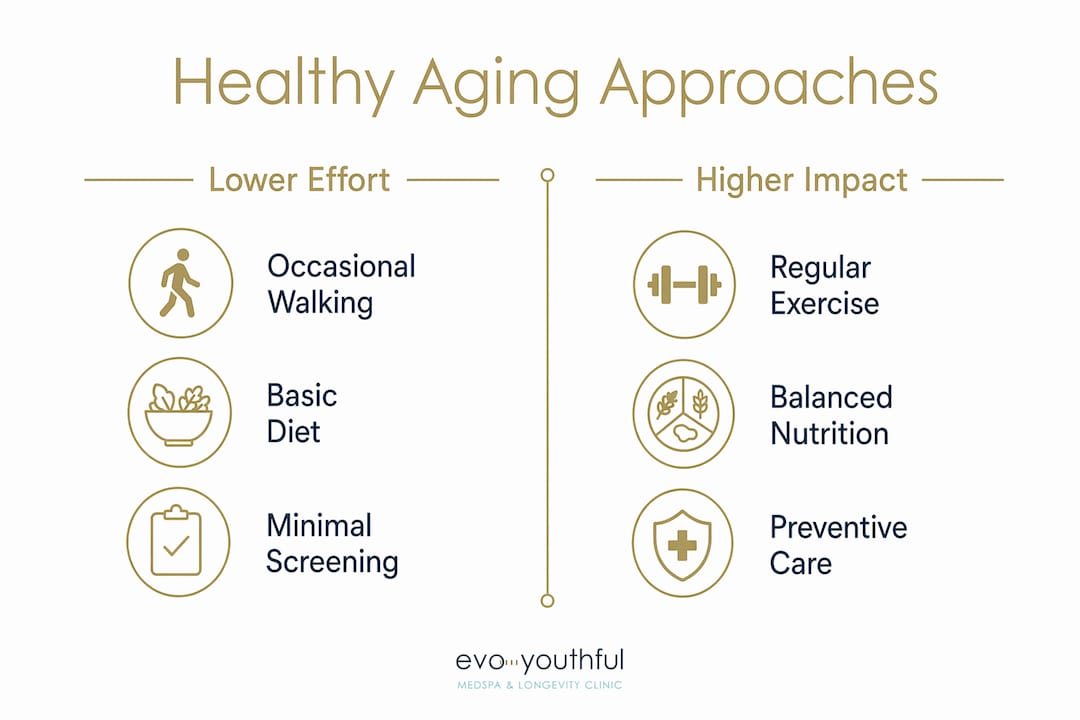
Social engagement and mental stimulation deserve equal attention alongside physical habits. Loneliness is associated with accelerated cognitive decline. Activities like learning a new skill, joining a group fitness class, or volunteering provide both mental stimulation and social connection in one. A proactive wellness approach that addresses all three dimensions, physical, mental, and social, produces better outcomes than focusing on any single area alone.
For a broader view of how these habits fit together, the anti-aging approach guide from evoyouthful covers how middle-age habits extend active years and reduce the risk of rapid decline.
Key Takeaways
Healthy aging is defined by healthspan, the years you live in good health, and it is directly shaped by consistent lifestyle habits in physical activity, nutrition, sleep, and preventive care.
| Point | Details |
|---|---|
| Healthspan over lifespan | Over 80% of recent life expectancy gains represent years lived in good health, not years with disability. |
| Exercise is non-negotiable | Aerobic and resistance training together preserve muscle, bone, and cardiovascular function starting at 40. |
| Nutrition drives biology | Reaching 25–30g of fiber daily reduces chronic disease risk by 15–30% compared to the average American intake. |
| Myths block progress | Fatigue, brain fog, and muscle loss are common but modifiable. Starting healthy habits at 50+ still yields significant gains. |
| Preventive care closes the gap | Sleep, screenings, and vaccinations collectively reduce years lived with chronic disability. |
What I’ve learned about aging that most people get wrong
By Elizabeth Vogstrom, PA-C
The patients who age best are rarely the ones who do everything perfectly. They are the ones who stop waiting for the right moment and start doing something consistent. That observation has held up across years of clinical practice.
The cultural narrative around aging still leans toward inevitability. People come in expecting to be told that what they are feeling is just part of getting older. Fatigue, weight gain, mental fog, reduced drive. And yes, biology changes. But the degree to which those changes define your daily life is far more within your control than most people realize.
What I find genuinely exciting about the current science is that the 70s are now tracking closer to what the 60s looked like a generation ago, physically and cognitively. That is not a coincidence. It reflects real population-level changes driven by lifestyle. The people making those gains are not outliers with exceptional genetics. They are people who prioritized sleep, stayed active, ate reasonably well, and kept their social lives intact.
The piece most people underestimate is social connection. Physical habits get all the attention, but isolation accelerates cognitive decline in ways that no supplement or treatment can fully reverse. Staying connected is not a soft recommendation. It is a clinical one.
If you are in your 40s or 50s and reading this, the window you have right now is genuinely valuable. The habits you build in this decade will determine your function in the next two. That is not meant to create pressure. It is meant to create clarity about what is actually at stake and what is still possible.
— Elizabeth Vogstrom, PA-C
Personalized support for healthy aging at evoyouthful
Healthy aging is not a single intervention. It is a plan built around your biology, your goals, and where you are right now.

evoyouthful, located in Wayzata, MN, offers clinically grounded therapies designed to support healthspan at every level. Bioidentical hormone replacement therapy addresses the hormonal shifts that drive fatigue, weight changes, and reduced vitality in midlife. ExoMind cognitive support targets brain health and neural function for people who want to stay sharp as they age. Every treatment plan at evoyouthful starts with a thorough consultation to match the right therapies to your specific needs. Schedule a consultation to build a personalized plan that extends your healthspan.
FAQ
What is healthy aging in simple terms?
Healthy aging is the process of maintaining physical, mental, and social well-being as you grow older, with the goal of preserving independence and quality of life. It focuses on healthspan, the years lived in good health, rather than total lifespan.
At what age should you start healthy aging habits?
The most effective time to start is in your 40s, but research confirms that beginning in your 50s or later still produces meaningful gains, potentially adding nearly a decade of healthy, functional years.
What is the difference between lifespan and healthspan?
Lifespan is the total number of years you live. Healthspan is the number of those years spent in good physical and cognitive health. More than 80% of recent global life expectancy gains represent healthspan gains, not years lived with disability.
Can you reverse muscle loss after 50?
Resistance training after 50 directly counters muscle and bone loss. Building muscle in your 50s delays functional decline and reduces fall risk, two of the primary causes of lost independence in later life.
Does healthy aging mean having no chronic conditions?
No. Many people age well while managing chronic conditions. Healthy aging means adapting to age-related changes while maintaining function, independence, and participation in daily life.
Recommended
- Why Proactive Wellness Prevents Decline as You Age | evoyouthful Blog
- Holistic Anti-Aging Approach: Your Complete 2026 Guide | evoyouthful Blog
- What Is Metabolic Health? A Guide for Adults 30–60 | evoyouthful Blog
- Brain Health & Cognitive Function | Treatments in Wayzata, MN | evoyouthful Wayzata, MN
Ready to Start?
Schedule a Consultation
Have questions about what you just read? Our team is here to help.