

Personalized Medicine: What It Means for Your Care
Elizabeth Vogstrom, PA-C
evoyouthful Clinical Team
Discover personalized medicine: what it means for your care. Tailored treatments that consider your unique genetics, environment, and lifestyle.
Personalized Medicine: What It Means for Your Care
Personalized medicine tailors prevention, diagnosis, and treatment to your unique biology rather than applying a single protocol to every patient. According to the Cleveland Clinic, this approach uses information about your genes, environment, and lifestyle to predict which strategies will work best for which groups of people. It’s a meaningful shift from the “one-size-fits-all” model that has defined mainstream medicine for generations, and it’s increasingly shaping how clinics like evoyouthful approach regenerative and aesthetic care.
Table of Contents
- What does personalized medicine mean in modern healthcare?
- Why “precision medicine” is the preferred term
- How genetics, environment, and lifestyle work together
- How personalized medicine applies to regenerative and aesthetic treatments
- How you can engage actively with your personalized treatment plan
- Key Takeaways
What does personalized medicine mean in modern healthcare?
Personalized medicine, often called precision medicine, is the practice of using biological data to match patients with the treatments most likely to help them. The U.S. National Library of Medicine describes it as an approach that accounts for individual variability in genes, environment, and lifestyle. Rather than guessing which therapy might work, providers use measurable biological signals to narrow the field.
Key elements that define this approach include:
- Biomarkers: Measurable biological indicators, from blood protein levels to genetic variants, that signal how a patient is likely to respond to treatment
- Genetic profiling: DNA analysis that reveals inherited traits affecting disease risk and drug metabolism
- Proteomics and metabolomics: Broader molecular data that improve stratification and timing of care beyond genetics alone
- Patient stratification: Grouping patients with shared biological characteristics to identify which therapies work best for each group
- Evidence-based treatment selection: Choosing therapies backed by clinical evidence for a specific patient profile, not just the average population
The National Human Genome Research Institute describes personalized medicine as using a patient’s genetic profile to guide decisions in prevention, diagnosis, and treatment. Genomics, in particular, provides a molecular window into the differences between individuals that standard diagnostics simply cannot see.
Why “precision medicine” is the preferred term
The U.S. National Research Council prefers “precision medicine” over “personalized medicine” for a specific reason: the word “personalized” can imply that every patient receives a completely unique, custom-built treatment. That’s not how it works in practice, and setting that expectation can lead to disappointment.
Here’s the practical distinction:
- Personalized medicine suggests bespoke, individual-level care for each person
- Precision medicine reflects the scientific reality: treatments are targeted to subgroups of patients who share biological markers, not engineered from scratch for each individual
- Stratified medicine is another term used in clinical literature to describe this group-based targeting approach
- Both terms are used interchangeably in everyday conversation, but precision medicine is now the preferred clinical and research standard
The NCBI explains it well: the difference today is that more factors and patient characteristics are considered when assigning someone to a treatment group. The science has advanced; the fundamental logic of grouping patients by shared biology has not changed. Understanding this distinction helps you set realistic expectations when exploring personalized treatment options.
How genetics, environment, and lifestyle work together
No single data point tells the full story. Genetics provides the molecular foundation, but your environment and daily habits shape how those genes express themselves. The Precision Medicine Initiative specifically advocates for combining genomic data with environmental and lifestyle factors to achieve meaningful outcomes.

Think of it this way: two people can carry the same genetic variant and respond very differently to the same therapy, because one exercises regularly, sleeps well, and manages stress, while the other does not. Lifestyle factors like diet, sleep, activity level, and stress are not secondary considerations. They’re integral to treatment planning.
Common tools and tests used in this integrated approach include:
- DNA analysis and genetic sequencing
- Blood-based biomarker panels (hormones, inflammatory markers, metabolic indicators)
- Proteomic and metabolomic testing for deeper molecular insight
- Lifestyle and environmental health assessments
Precision medicine complements standard care rather than replacing it. Classical biomarkers like blood pressure and cholesterol still matter; molecular data adds a layer of specificity that makes treatment decisions sharper.
How personalized medicine applies to regenerative and aesthetic treatments
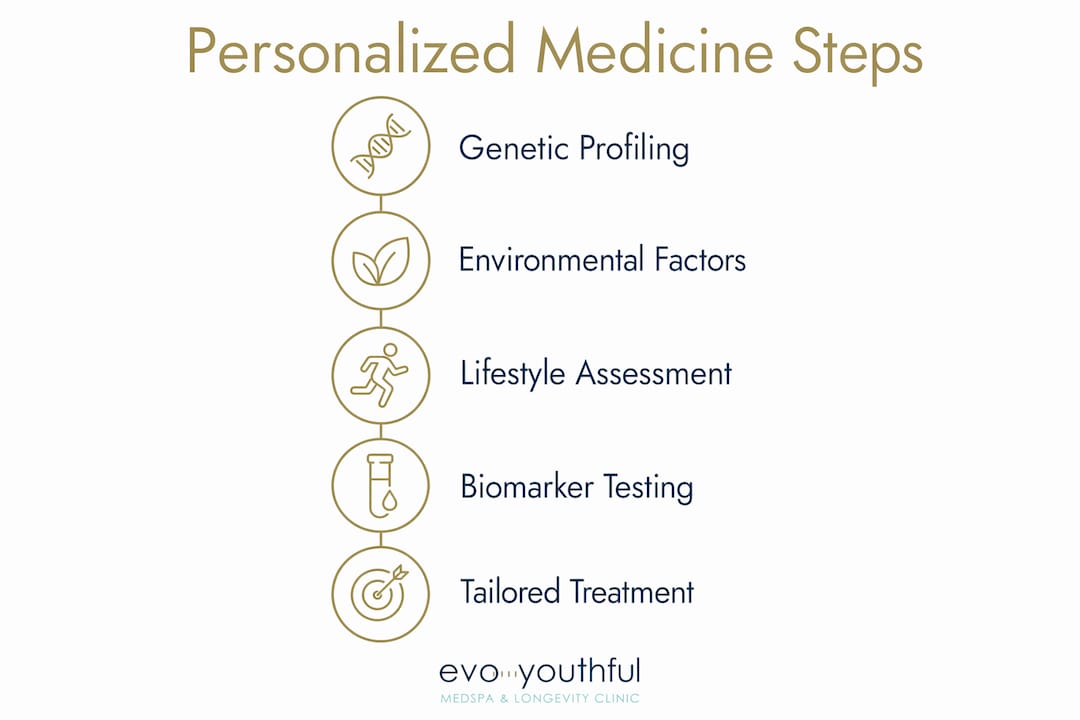
This is where the science becomes directly relevant to you. At evoyouthful, the principles of precision medicine guide how regenerative and aesthetic therapies are selected and delivered. Elizabeth Vogstrom, PA-C brings clinical expertise to this process, ensuring that treatment recommendations reflect your individual biology, not a generic protocol.
Therapies that benefit most from a personalized approach include:
- Bioidentical hormone replacement therapy: Hormone levels are measured through biomarker testing before any protocol is designed, so dosing reflects your actual deficiency rather than an average range
- Peptide therapy: Peptide selection depends on your specific health goals, metabolic profile, and lifestyle factors
- PRF injections: Platelet-rich fibrin treatments use your own biological material, making them inherently patient-specific
- AgeJET plasma skin therapy: Skin rejuvenation protocols are adjusted based on skin type, tissue response, and treatment history
- Nutrigenomics: Genetic blueprint analysis guides nutritional and wellness recommendations at the cellular level
Limitations exist in this space. Not every aesthetic treatment has deep genomic research behind it yet, and the ethical use of genetic data requires careful privacy protections. Responsible providers obtain informed consent, explain what testing reveals and what it cannot, and never use genetic data beyond its intended clinical purpose.
Pro Tip: Before your first consultation, write down your health history, current medications, lifestyle habits, and specific goals. The more context you bring, the more precisely your provider can match therapies to your profile.
How you can engage actively with your personalized treatment plan
Precision medicine is a partnership. The science only works when you bring your full picture to the table. Active patient participation is not optional; it’s what separates a treatment plan that fits from one that merely approximates.
Practical steps to get the most from a personalized approach:
- Share your lifestyle honestly: Sleep patterns, stress levels, diet, and exercise habits all influence how your body responds to treatment
- Ask about your biomarker results: Understanding what your numbers mean helps you make informed decisions alongside your provider
- Discuss your values and priorities: What matters most to you, whether that’s energy, appearance, cognitive function, or pain relief, shapes which therapies make sense
- Set realistic expectations: Precision medicine improves the odds of a good outcome; it does not guarantee one
- Stay engaged between appointments: Lifestyle changes that support your treatment compound the clinical results over time
Patient education about the pros and cons of each option is central to shared decision-making. A good provider will walk you through what the evidence supports, where uncertainty remains, and how your personal values should factor into the final choice. That conversation is where truly personalized care begins.
Key Takeaways
Personalized medicine uses biomarkers, genetic data, and lifestyle factors to match patients with evidence-based treatments that fit their biology, not just the average population.
| Point | Details |
|---|---|
| Precision vs. personalized | “Precision medicine” is the preferred clinical term; it targets patient subgroups, not fully unique individual therapies. |
| Biomarkers drive decisions | DNA analysis, hormone panels, and molecular testing guide which therapies are selected and at what dose. |
| Lifestyle matters as much as genetics | Environmental and lifestyle factors are integral to treatment planning, not secondary considerations. |
| Regenerative care applies these principles | Therapies like BHRT, peptide therapy, and PRF injections are guided by individual biomarker profiles at evoyouthful. |
| Active participation improves outcomes | Sharing your health history, goals, and lifestyle with your provider is what makes precision medicine work in practice. |
Ready to see what a truly personalized treatment plan looks like for you? evoyouthful’s team in Wayzata, MN combines clinical expertise with advanced biomarker testing to design regenerative and aesthetic care around your biology.
Schedule a consultation and take the first step toward care that’s built for you, not the average patient.
Recommended
Ready to Start?
Schedule a Consultation
Have questions about what you just read? Our team is here to help.