

Why Proactive Wellness Prevents Decline as You Age
Elizabeth Vogstrom, PA-C
evoyouthful Clinical Team
Discover why proactive wellness prevents decline as you age. Learn how early action and personalized care can enhance your later years.
Proactive wellness is the practice of actively managing your health through early identification and prevention of risks before symptoms appear. Research shows 40–45% of dementia cases are preventable through sustained, multidomain interventions started in midlife, and cardiovascular prevention programs reduce mortality by 32% compared to reactive care. These numbers are not abstractions. They represent real outcomes that change the quality of your later years. Understanding why proactive wellness prevents decline means understanding that most age-related deterioration is not inevitable. It is the result of unmanaged risk factors that compound quietly over time. evoyouthful’s approach to personalized wellness is built on exactly this principle: act early, act consistently, and act with guidance.
Why proactive wellness prevents decline: the physical evidence
Physical decline follows a predictable pattern. Muscle loss, bone thinning, and cardiovascular deterioration progress silently for years before they cause noticeable symptoms. By the time most people seek care, the damage is already limiting their function and independence. Early intervention changes that trajectory entirely.
The U.S. POINTER trial, one of the largest lifestyle intervention studies conducted in older adults, provides compelling evidence. The structured, coached program reduced frailty and protected cognitive function more effectively than self-guided approaches across more than 2,100 participants over two years. That distinction matters. Having a structured plan with professional accountability produces measurably better outcomes than good intentions alone.

Chronic conditions like type 2 diabetes, hypertension, and osteoporosis share one critical feature: they are largely asymptomatic in their early stages. Waiting for symptoms means waiting until reversal is harder and management is more expensive. Early screening, baseline biomarker tracking, and lifestyle coaching give you the chance to intervene during the window when change is most effective.
| Outcome Area | Reactive Care | Proactive Care |
|---|---|---|
| Timing of intervention | After symptoms appear | Before symptoms develop |
| Frailty progression | Managed after onset | Slowed or prevented |
| Cardiovascular mortality | Standard risk | Up to 32% lower |
| Functional independence | Declines with age | Maintained longer |
| Cost of care | Higher long-term | Lower through prevention |
Pro Tip: Pair your annual physical with a baseline biomarker panel that includes muscle mass, bone density, and inflammatory markers. These numbers give you a personal baseline to track change over time, not just a snapshot of whether you are sick today.

How does proactive wellness prevent cognitive decline?
Cognitive decline is not a fixed outcome of aging. 40–45% of dementia cases are preventable when multidomain interventions begin in midlife. That statistic reframes the entire conversation around brain health. You are not simply waiting to see what happens. You are actively building or eroding your cognitive reserve with every lifestyle choice you make.
Cognitive reserve refers to the brain’s ability to compensate for damage by using alternative neural pathways. Managing key lifestyle factors such as sleep quality, diet, social connection, and cognitive challenges strengthens this reserve over time. The brain responds to stimulation and protection the same way muscle responds to exercise. Use it, protect it, and it holds up longer.
Social isolation deserves particular attention. Older adults with 5–6 meaningful social interactions weekly show 70% lower dementia rates than those who are socially isolated. Social isolation carries a population attributable fraction of 5% for dementia, making it one of the most modifiable risk factors available. That means building and maintaining real social connections is a clinical-grade brain health strategy.
Key proactive brain health habits supported by evidence include:
- Regular physical exercise: Aerobic activity increases blood flow to the brain and supports neuroplasticity.
- Quality sleep: Seven to nine hours of restorative sleep clears metabolic waste from the brain, including amyloid proteins linked to Alzheimer’s disease.
- Social engagement: Frequent, meaningful interaction with others reduces isolation-related cognitive risk.
- Mental stimulation: Learning new skills, reading, and problem-solving build cognitive reserve.
- Mediterranean-style diet: High intake of vegetables, healthy fats, and lean protein reduces neuroinflammation.
- Stress management: Chronic cortisol elevation damages the hippocampus, the brain’s memory center.
Addressing brain health proactively through structured programs and clinical support gives you the best chance of maintaining sharp cognitive function well into your later decades.
What sets proactive wellness apart from preventive or reactive care?
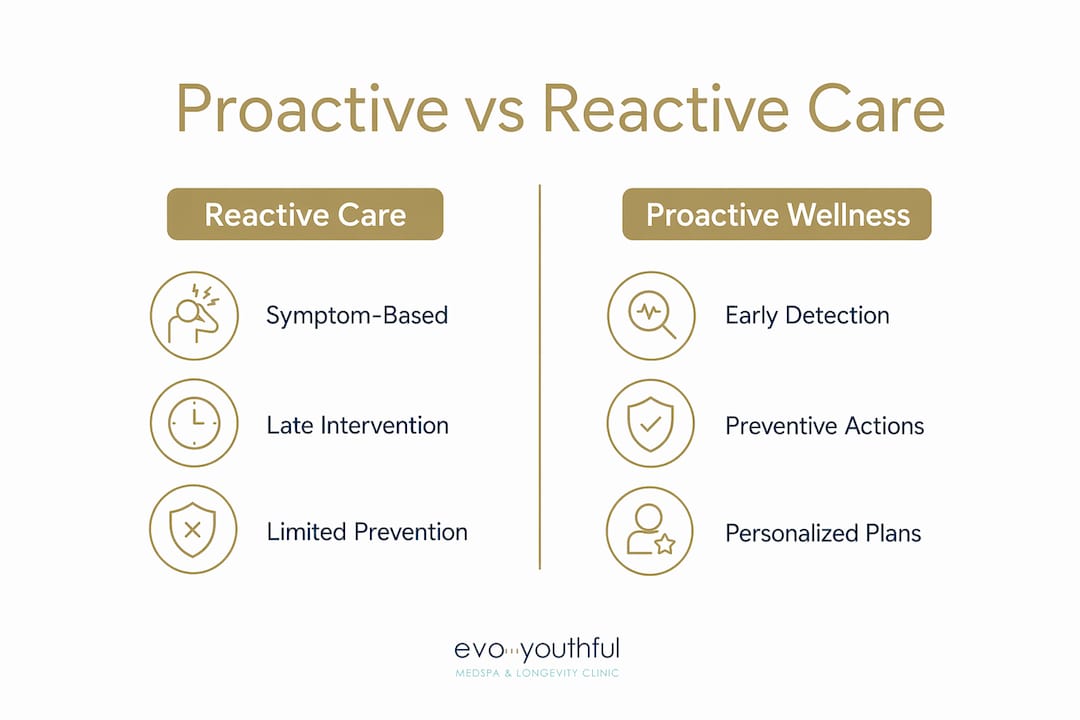
Proactive wellness, preventive care, and reactive medicine are three distinct models. Most people receive reactive care: a doctor treats a condition after it causes symptoms. Preventive care adds screenings and vaccines to catch disease earlier. Proactive wellness goes further by actively optimizing your health before any disease process begins.
The P4 medicine model, developed in systems biology research, defines this shift clearly. P4 medicine stands for Predictive, Preventive, Personalized, and Participatory. It uses longitudinal personal health data to detect disease during asymptomatic, reversible phases. This is not a future concept. Clinics applying P4 principles are already using biomarker tracking, genetic data, and lifestyle coaching to shift care from reaction to prediction.
Personal health data clouds compile your health metrics over time, allowing clinicians to spot subtle shifts in biomarkers before they cross into disease territory. A single lab result tells you where you are today. A longitudinal data cloud tells you which direction you are heading and how fast. That difference is what makes proactive care so powerful.
| Feature | Reactive Care | Preventive Care | Proactive Wellness |
|---|---|---|---|
| Entry point | Symptoms present | Scheduled screenings | Continuous monitoring |
| Goal | Treat disease | Detect disease early | Prevent disease onset |
| Personalization | Condition-based | Population-based | Individual data-driven |
| Patient role | Passive recipient | Periodic participant | Active, engaged partner |
| Outcome focus | Recovery | Early detection | Healthspan extension |
Pro Tip: Ask your clinician to track your biomarkers longitudinally rather than just flagging abnormal values. Trends within the “normal” range can reveal early decline years before a diagnosis is possible.
How can you implement proactive health strategies effectively?
Effective proactive wellness requires a multidomain approach. No single intervention protects your health across all systems. Targeting nutrition, exercise, social engagement, and cognitive stimulation simultaneously produces synergistic benefits that single-focus programs cannot replicate. The whole is genuinely greater than the sum of its parts here.
Accountability is the factor most people underestimate. Behavioral change programs with coaching produce better adherence and better outcomes than self-guided efforts. Knowing someone is tracking your progress, asking questions, and adjusting your plan changes your behavior in ways that willpower alone does not. This is why structured clinical programs consistently outperform self-help approaches in research.
Practical steps to build a proactive wellness plan include:
- Establish your baseline: Get a comprehensive health assessment including hormone levels, metabolic markers, body composition, and cognitive screening.
- Build a structured movement routine: Combine resistance training to preserve muscle mass with aerobic exercise to protect cardiovascular and brain health.
- Prioritize sleep hygiene: Set consistent sleep and wake times, limit screen exposure before bed, and address sleep disorders early.
- Eat for inflammation control: Reduce processed foods and increase vegetables, omega-3 fats, and fiber-rich whole foods.
- Schedule regular screenings: Do not wait for symptoms. Annual or biannual screenings catch silent progression early.
- Invest in social connection: Schedule regular time with friends, family, or community groups. Treat it as a health appointment.
- Work with a clinical team: A personalized plan guided by professionals who track your data over time produces the best outcomes.
Integrative health care models combine these domains into a single coordinated plan. At evoyouthful, treatments like bioidentical hormone replacement therapy and ExoMind cognitive support address the biological foundations that lifestyle changes alone cannot always correct. Hormonal imbalances, for example, accelerate muscle loss, cognitive fog, and fatigue. Correcting them restores the physiological environment in which healthy behaviors actually work.
Extending your healthspan, the years you live in good health rather than simply alive, is the measurable goal of every proactive wellness strategy. The gap between lifespan and healthspan is where most suffering occurs. Proactive wellness narrows that gap.
Key Takeaways
Proactive wellness prevents decline by addressing modifiable risk factors before symptoms appear, using structured programs, longitudinal health data, and multidomain lifestyle strategies to extend healthspan.
| Point | Details |
|---|---|
| Start before symptoms appear | Silent decline in muscle, bone, and cognition begins years before diagnosis. |
| Structured programs outperform self-guided efforts | Coached, multidomain programs like the U.S. POINTER trial reduce frailty and protect cognition. |
| Up to 45% of dementia is preventable | Midlife lifestyle interventions targeting sleep, diet, and social engagement reduce dementia risk significantly. |
| P4 medicine shifts care from reaction to prediction | Longitudinal biomarker tracking detects disease during reversible phases before symptoms develop. |
| Social connection is a clinical health strategy | Adults with 5–6 meaningful weekly interactions show 70% lower dementia rates than isolated peers. |
Why I believe the timing of your health decisions matters more than most people realize
Patients often come to me after years of managing symptoms rather than preventing them. They are not negligent. They simply received the message that healthcare is something you access when something goes wrong. That model costs people years of good health they did not have to lose.
What I have seen consistently is that the people who age best are not the ones with the best genetics. They are the ones who started paying attention early and kept showing up. They tracked their numbers, adjusted their habits when the data suggested it, and worked with a clinical team rather than guessing on their own. The biology of aging is not kind to passive approaches.
The shift from reactive to proactive thinking is not complicated, but it does require a change in how you relate to your own health. You are not a patient waiting for a diagnosis. You are a person managing a long-term asset. The earlier you start treating your health that way, the more of it you get to keep.
I also want to be direct about something the wellness industry often glosses over: lifestyle changes work best when the underlying physiology supports them. If your hormones are dysregulated, your sleep architecture is broken, or your cognitive function is already declining, willpower and good intentions will only take you so far. That is where clinical support makes the difference between effort and results.
— Elizabeth Vogstrom, PA-C
evoyouthful’s personalized approach to proactive health
evoyouthful in Wayzata, MN offers a clinical framework built around the principles covered in this article. Every plan starts with a thorough assessment of your current health status, including hormonal, metabolic, and cognitive markers.
From there, treatments like bioidentical hormone replacement therapy address the hormonal foundations of physical vitality and cognitive clarity. ExoMind cognitive support targets neural health directly for those concerned about brain aging. Nutrigenomics testing personalizes nutrition and supplementation to your genetic profile. Each treatment works as part of a coordinated plan, not as a standalone fix. Schedule a consultation with evoyouthful to build a proactive wellness plan tailored to where you are now and where you want to be.
FAQ
What is proactive wellness?
Proactive wellness is the practice of actively managing your health through early risk identification, lifestyle optimization, and clinical monitoring before symptoms or disease develop. It differs from reactive care, which addresses health problems only after they appear.
How does proactive wellness prevent cognitive decline?
Multidomain lifestyle interventions targeting sleep, diet, exercise, and social engagement can prevent 40–45% of dementia cases when started in midlife. These strategies build cognitive reserve, which delays the onset of decline.
What is the P4 medicine model?
P4 medicine stands for Predictive, Preventive, Personalized, and Participatory. It uses longitudinal health data to detect and address disease during reversible phases, shifting care from reaction to early intervention.
Why does social connection matter for brain health?
Older adults with 5–6 meaningful social interactions weekly show 70% lower dementia rates than socially isolated peers. Social engagement is one of the most modifiable and underutilized tools for protecting cognitive function.
How do I start a proactive wellness plan?
Begin with a comprehensive health assessment that includes hormone levels, metabolic markers, body composition, and cognitive screening. Work with a clinical team to build a structured, multidomain plan that includes exercise, nutrition, sleep, and regular biomarker tracking.
Recommended
- Holistic Anti-Aging Approach: Your Complete 2026 Guide | evoyouthful Blog
- Medspa & Longevity Clinic in Wayzata, MN | evoyouthful Wayzata, MN
- Browse Concerns | Face, Body & Wellness Treatments | evoyouthful Wayzata, MN
- Brain Health & Cognitive Function | Treatments in Wayzata, MN | evoyouthful Wayzata, MN
Ready to Start?
Schedule a Consultation
Have questions about what you just read? Our team is here to help.