

Oxidative Stress Explained: Causes, Effects, and Management
Elizabeth Vogstrom, PA-C
evoyouthful Clinical Team
Discover what oxidative stress is, its causes, effects, and how to manage it for better health and longevity. Take control today!
Oxidative Stress Explained: Causes, Effects, and Management
Oxidative stress is an imbalance between free radicals and antioxidants in your body, where oxidants outpace your defenses and can disrupt cell signaling or cause molecular damage, according to the NCI’s definition. Chronic oxidative stress is linked to accelerated aging and several long-term diseases, including cardiovascular disease, neurodegeneration, and cancer. Three things you can do right now:
- Stop or significantly reduce major exposures: smoking and excess alcohol are among the most modifiable drivers.
- Prioritize consistent sleep and regular moderate exercise, both of which support your body’s natural antioxidant systems.
- Talk to your clinician before starting antioxidant supplements — more is not always better, and high-dose supplementation can disrupt the very signaling it aims to protect.
Key Takeaways
Oxidative stress is a manageable imbalance between free radicals and antioxidants, and the most effective response combines consistent lifestyle changes with targeted clinical care when needed.
| Point | Details |
|---|---|
| Core definition | Oxidative stress occurs when free radicals outpace antioxidant defenses, disrupting cell signaling and causing molecular damage. |
| Modifiable causes | Smoking, excess alcohol, poor diet, obesity, and chronic inflammation are the most impactful drivers you can address. |
| Non-specific symptoms | Fatigue, brain fog, premature skin aging, and joint pain are common signs, but clinical evaluation is needed to confirm a redox connection. |
| Testing limitations | Direct ROS measurement is not clinically feasible; biomarkers like 8-OHdG and lipid peroxidation products require clinical interpretation, not isolated values. |
| Lifestyle first | Sleep, moderate exercise, weight management, and dietary quality typically outperform single supplements for restoring redox balance. |
| evoyouthful | Offers personalized evaluation, glutathione treatments, nutrigenomics testing, ExoMind cognitive support, BHRT, and peptide therapies in Wayzata, MN. |
Table of Contents
- What is oxidative stress explained at the cellular level?
- What causes oxidative stress: internal and external triggers
- Signs, symptoms, and long-term health effects linked with oxidative stress
- Can oxidative stress be tested? Biomarkers and their limits
- How to reduce and manage oxidative stress effectively
- How clinicians evaluate and address oxidative stress in practice
- evoyouthful offers personalized oxidative stress evaluation in Wayzata, MN
- Sources
What is oxidative stress explained at the cellular level?
Your cells produce reactive oxygen species (ROS) constantly, as a normal byproduct of breathing and metabolism. At low to moderate levels, ROS are actually useful. They act as chemical messengers, help your immune cells destroy pathogens, and support tissue repair. The problem starts when ROS production outpaces your body’s antioxidant defenses.
Antioxidants are molecules that neutralize free radicals before they cause damage. Your body makes several of them internally: superoxide dismutase (SOD), catalase, and the glutathione system are the main enzymatic defenders. You also get antioxidants from food, including vitamins C and E and polyphenols from plants.
Research published in PMC draws an important distinction between oxidative eustress and oxidative distress. Eustress is the physiological, low-level ROS activity your body needs for signaling and immune defense. Distress is the pathological excess that damages lipids, proteins, and DNA. The goal of care is never to eliminate ROS entirely — it is to restore redox homeostasis, the healthy balance between the two.
A simple way to picture the process: oxygen enters your cells → mitochondria and other enzymes produce ROS during metabolism → antioxidant defenses neutralize most of them → when defenses fall short, the excess ROS causes oxidative distress.
Key terms, briefly defined:
- ROS (reactive oxygen species): unstable molecules containing oxygen that react readily with other molecules in your cells.
- Antioxidant: a molecule that donates an electron to a free radical, stabilizing it without becoming harmful itself.
- Glutathione: your body’s most abundant internal antioxidant, produced in the liver and found in nearly every cell.
- Lipid peroxidation: a chain reaction in which ROS damage cell membrane fats, impairing cell function.
What causes oxidative stress: internal and external triggers
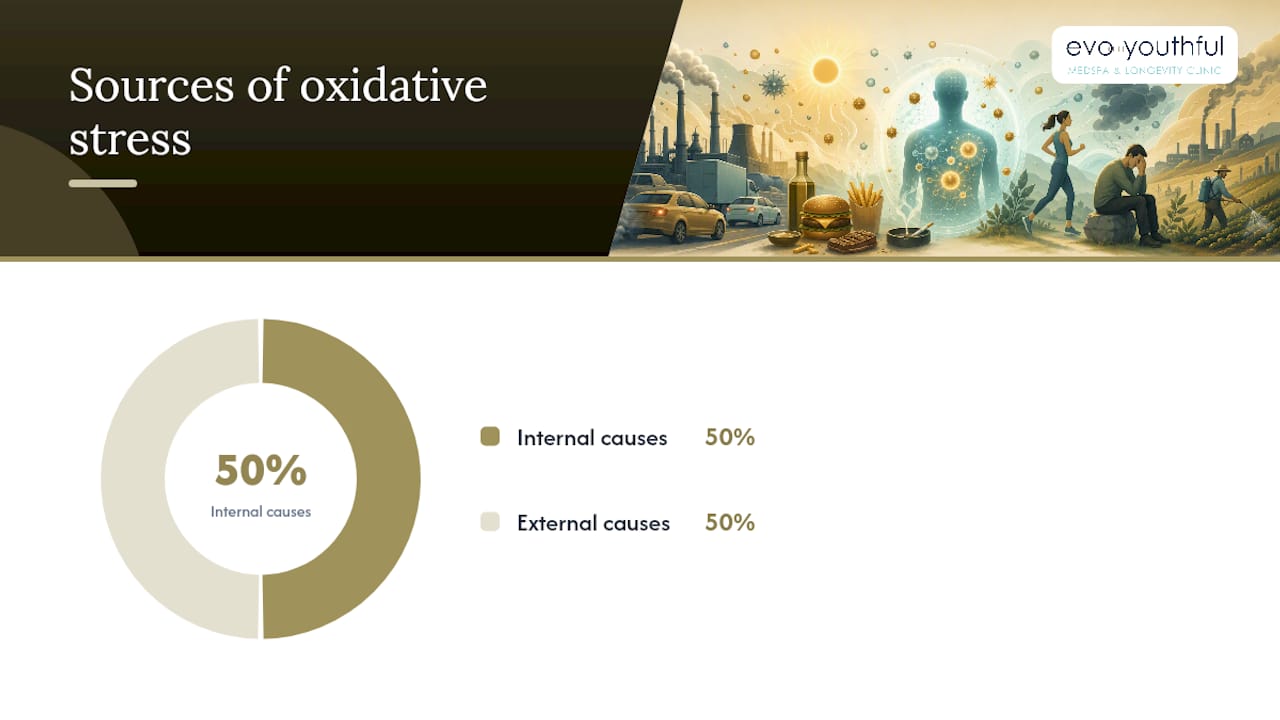
Oxidative stress has both endogenous (internal) and exogenous (external) sources, and the two often compound each other.
Internal (endogenous) causes:
- Normal aerobic metabolism, especially in mitochondria
- Chronic inflammation and immune activation
- Mitochondrial dysfunction
- Obesity and insulin resistance, which amplify ROS production
- Aging itself, as antioxidant enzyme activity naturally declines
- Chronic disease states that sustain inflammatory signaling
External (exogenous) causes:
- Cigarette smoke, one of the most potent exogenous oxidative stressors
- Air pollution and environmental toxins
- UV radiation from sun exposure
- Pesticide exposure
- Excess alcohol consumption
- Certain medications and radiation therapy
The NCI notes that obesity, poor diet, smoking, alcohol, radiation, and environmental toxins are all recognized contributors to long-term oxidative stress. Metabolic drivers like insulin resistance and chronic low-grade inflammation are particularly significant because they sustain ROS production around the clock, not just during a single exposure.
Pro Tip: A single unhealthy meal or an afternoon in the sun won’t push you into chronic oxidative distress. What matters is the pattern. Repeated, cumulative exposures over months and years are what shift the balance from manageable eustress to damaging distress. Focus on the habits, not the isolated incidents.
Signs, symptoms, and long-term health effects linked with oxidative stress
Oxidative stress does not announce itself with a specific, recognizable symptom. The Cleveland Clinic describes its physical signs as often non-specific, including:
- Persistent fatigue that doesn’t resolve with rest
- Brain fog or cognitive slowdown
- Muscle and joint pain
- Premature skin aging, including fine lines, loss of elasticity, and uneven tone
- Slowed recovery from injuries or illness
- Chronic, low-grade inflammation
These symptoms overlap with dozens of other conditions, which is exactly why they require clinical context to connect to oxidative stress. Fatigue, for example, could reflect thyroid dysfunction, poor sleep, anemia, or redox imbalance — and often several of these at once. Connecting symptoms to oxidative stress specifically requires evaluation, not just recognition.
The long-term disease associations are where the stakes become clearer. MDPI research links excess, deregulated ROS to cardiovascular disease, neurodegeneration (including Alzheimer’s and Parkinson’s disease), type 2 diabetes complications, certain cancers, and accelerated biological aging. These are not direct cause-and-effect relationships in every case, but oxidative distress is consistently present as a contributing mechanism across all of them.
A note on symptoms: Fatigue, brain fog, and skin changes are real and worth addressing. But symptoms alone do not confirm oxidative stress. A clinician can help you determine whether these signs reflect a redox imbalance, another underlying condition, or both.
Oxidative stress also affects different populations differently. Older adults face a natural decline in antioxidant enzyme activity, making them more vulnerable to distress. People with obesity or metabolic syndrome carry a higher baseline ROS burden. Those with heavy occupational exposures (to pollution, pesticides, or radiation) accumulate exogenous oxidative load on top of internal sources. Understanding your specific risk profile matters more than applying a one-size-fits-all approach. For a deeper look at how chronic inflammation and aging interact with these mechanisms, that connection is worth exploring.
Can oxidative stress be tested? Biomarkers and their limits
Direct measurement of short-lived free radicals is not clinically feasible. ROS molecules are too unstable and too short-lived to capture in a standard lab draw. Instead, clinicians rely on indirect biomarkers that reflect the damage ROS have caused or the capacity of antioxidant systems to respond.
According to Frontiers in Chemistry, commonly used markers include:
- Lipid peroxidation products (such as F2-isoprostanes and malondialdehyde): measure damage to cell membrane fats
- 8-OHdG (8-hydroxy-2’-deoxyguanosine): a marker of DNA oxidation
- Protein carbonyls: indicate oxidative damage to proteins
- Antioxidant enzyme activity (SOD, catalase, glutathione peroxidase): reflect your body’s defensive capacity
Popular consumer assays like ORAC and FRAP measure non-enzymatic antioxidant capacity in a test tube, but research has criticized these for not reflecting how antioxidant enzyme systems actually function inside the body. A high ORAC score on a food label tells you very little about your personal redox status.
Interpretation is the real challenge. Most biomarkers measure damage after it has occurred, not the imbalance itself. A single isolated value is rarely meaningful without serial measurements and clinical correlation. Results need to be read alongside your symptoms, exposures, metabolic health, and history.
Pro Tip: If you’re curious about oxidative stress testing, ask your clinician about biomarkers that are relevant to your specific symptoms and risk factors. Consumer test kits marketed without clinical correlation are not a reliable substitute for a supervised evaluation.
How to reduce and manage oxidative stress effectively
The strongest evidence supports a multi-modal approach: reduce exposures, optimize metabolic health, and use targeted clinical therapies when lifestyle changes alone are not enough. The Cleveland Clinic confirms that mitigation focuses on limiting exogenous triggers and making consistent lifestyle changes.
Core lifestyle steps, in order of impact:
- Stop smoking. Cigarette smoke is one of the most concentrated sources of exogenous ROS and depletes antioxidant defenses rapidly.
- Limit excess alcohol. Alcohol metabolism generates ROS directly in the liver and impairs glutathione production.
- Improve your diet. Whole foods, a variety of colorful vegetables and fruit, healthy fats (olive oil, fatty fish, nuts), and minimally processed options all support antioxidant capacity.
- Maintain a healthy weight. Obesity sustains chronic low-grade inflammation and elevated ROS production.
- Exercise regularly at moderate intensity. Exercise temporarily increases ROS but, over time, upregulates your body’s own antioxidant enzyme systems.
- Prioritize sleep. Poor sleep impairs cellular repair and antioxidant regeneration. Home recovery practices that support consistent rest are a practical starting point.
- Manage chronic stress. Psychological stress activates inflammatory pathways that feed ROS production.
- Reduce pollution and UV exposure where practical: use broad-spectrum SPF daily, and limit peak-hour outdoor activity in high-pollution environments.
Foods to emphasize vs. foods to limit:
| Emphasize | Limit |
|---|---|
| Berries (blueberries, strawberries) | Highly processed snack foods |
| Leafy greens (spinach, kale) | Fried foods with refined oils |
| Nuts and seeds | High-sugar refined carbohydrates |
| Fatty fish (salmon, sardines) | Excess alcohol |
| Olive oil | Charred or heavily processed meats |

On supplements: Large-scale clinical trials using single, high-dose antioxidant supplements generally showed no significant benefit and in some cases raised safety concerns. Vitamin E megadoses, beta-carotene in smokers, and isolated antioxidant cocktails have all underperformed or caused harm in controlled trials. The reason is biological: indiscriminate antioxidant supplementation can suppress the very ROS signaling your cells depend on for normal function.
Targeted clinical approaches are different. Therapies that support glutathione production or use specific peptides to address localized redox imbalances, guided by biomarker testing and clinical oversight, represent a more precise strategy than off-the-shelf supplements.
Pro Tip: Improving metabolic health — sleep quality, body weight, glycemic control, and regular movement — typically yields larger gains against oxidative distress than any single superfood or supplement. Build the foundation first.
How clinicians evaluate and address oxidative stress in practice
Clinicians consider oxidative stress when symptoms, risk factors, or disease progression suggest a redox imbalance that may be contributing to a patient’s condition. The evaluation is systematic, not a single test.
A typical clinical approach includes:
- Comprehensive history and exposure review: identifying smoking history, diet quality, occupational exposures, medication use, and metabolic health markers
- Targeted biomarker testing: selecting markers relevant to the patient’s presentation (lipid peroxidation, 8-OHdG, antioxidant enzyme panels) rather than ordering every available assay
- Addressing treatable root causes: managing chronic inflammation, insulin resistance, or metabolic dysfunction that sustains ROS production
- Considering supervised antioxidant or peptide therapy: when lifestyle optimization alone is insufficient, targeted clinical therapies may be appropriate under medical supervision
- Monitoring outcomes: serial biomarker measurements and symptom tracking to assess whether the intervention is working
MDPI research supports this approach, noting that advanced clinical strategies combine lifestyle and metabolic optimization with selective use of therapies supporting glutathione pathways or peptide-based interventions for systemic or localized redox imbalances that diet alone may not correct.
Clinicians emphasize that the goal is redox homeostasis, not antioxidant dominance. Excess antioxidant supplementation can interfere with physiological signaling and cause harm without proper clinical oversight. Treatment focuses on root causes and measurable clinical benefit, not on maximizing antioxidant intake. — PMC, Oxidative Stress: Concept and Some Practical Aspects
Many redox biomarkers are adjunctive tools, not standalone diagnostics. A positive result guides clinical thinking; it does not replace a full evaluation. Readers who want to understand how early clinical intervention fits into this picture will find that timing matters considerably.
A clinician’s perspective on realistic expectations
Oxidative stress is manageable, but there is no single step that resolves it. What actually works is a consistent, individualized plan built on a thorough assessment of your history, labs, and lifestyle. Small changes compound meaningfully over time, especially when they address the metabolic and environmental drivers that sustain ROS production day after day. If you’re experiencing symptoms that may reflect a redox imbalance, a supervised evaluation can clarify whether targeted testing or clinical therapies are appropriate for your situation.
evoyouthful offers personalized oxidative stress evaluation in Wayzata, MN
If you’ve read this far and recognize your own symptoms in what’s described, a personalized clinical evaluation is the clearest next step. Generic supplement protocols and consumer test kits can’t replace a clinician who reviews your full picture.

At evoyouthful in Wayzata, MN, the team offers targeted services that directly address the metabolic and cellular drivers of oxidative distress:
- Glutathione treatments: direct support for your body’s primary internal antioxidant system
- Nutrigenomics DNA / Brain Balance: personalized genetic and metabolic testing to guide your individual management strategy
- ExoMind cognitive support: neurostimulation therapy for readers concerned about oxidative stress and brain health
- BHRT for metabolic balance: hormone optimization to address the metabolic drivers that amplify ROS production
- Clinical peptide therapies: supervised protocols targeting localized or systemic redox imbalances
Note: a personalized assessment is required before any treatment recommendation. Not every patient will need supplements or clinical therapies — the evaluation determines what’s appropriate for you.
Schedule a consultation at evoyouthful to discuss your symptoms, risk factors, and the testing options that make sense for your situation.
Sources
These sources are starting points. A clinician familiar with redox medicine should interpret any test results or treatment options in the context of your individual health history.
- Oxidative stress — Cleveland Clinic
- Oxidative Stress: Concept and Some Practical Aspects - PMC
- Oxidative stress: fundamentals and advances in quantification techniques — Frontiers
- Oxidative Stress in Health and Disease: Mechanisms and Therapeutic Perspectives — MDPI
- Definition of oxidative stress - NCI Dictionary of Cancer Terms
This article is general information, not a substitute for advice from a qualified doctor. Consult a qualified healthcare professional about your own circumstances before acting on anything here.
Recommended
Ready to Start?
Schedule a Consultation
Have questions about what you just read? Our team is here to help.