

The Functional Medicine Approach: A Clinic Guide
Elizabeth Vogstrom, PA-C
evoyouthful Clinical Team
Discover what the functional medicine approach is and how personalized care at Evoyouthful can restore your health and vitality. Explore now!
The Functional Medicine Approach: A Clinic Guide
The functional medicine approach is a patient-centered, systems-biology method that targets root causes of declining health rather than simply suppressing symptoms, with the goal of restoring function and extending health span, not just life span. The Institute for Functional Medicine (IFM) established the foundational frameworks clinicians use today, and evoyouthful in Wayzata, MN applies these principles directly, with Elizabeth Vogstrom, PA-C coordinating personalized care plans for aesthetic and longevity patients.
At its core, this approach prioritizes:
- Nutrition and therapeutic diet as the first line of intervention
- Sleep quality and stress resilience before adding clinical therapies
- Targeted lab testing guided by your individual history, not a standard panel
- Iterative, evolving treatment plans adjusted as your body responds
- Collaboration with conventional medicine for acute or complex needs
Table of Contents
- What is the functional medicine approach, and how does it differ from conventional care?
- Core principles that define how functional medicine works
- What to expect at your first functional medicine consultation
- Common treatment options in a functional medicine plan
- What the evidence supports, and where the limits are
- How to choose a qualified functional medicine practitioner
- How functional medicine integrates with aesthetic and regenerative care at evoyouthful
- Key Takeaways
- A clinician’s perspective on functional medicine in aesthetic practice
- Ready to start with a personalized functional medicine consultation at evoyouthful?
- Useful sources for further reading
What is the functional medicine approach, and how does it differ from conventional care?
Conventional medicine excels at acute care: diagnosing a broken bone, managing a cardiac event, prescribing antibiotics for a bacterial infection. What it does less well is address the slow, compounding dysfunction that precedes most chronic conditions. Functional medicine fills that gap.
| Feature | Functional Medicine | Conventional Medicine |
|---|---|---|
| Primary goal | Restore function; extend health span | Diagnose and treat disease; manage symptoms |
| Visit style | Extended intake; narrative-based history | Episodic, problem-focused visits |
| Sequencing | Foundations first, then targeted interventions | Symptom-driven prescriptions |
| Tools | Lifestyle, nutrition, targeted labs, nutraceuticals, clinical therapies | Pharmaceuticals, procedures, standard diagnostics |
| Collaboration | Complements conventional care; refers when needed | Primary care with specialist referrals |
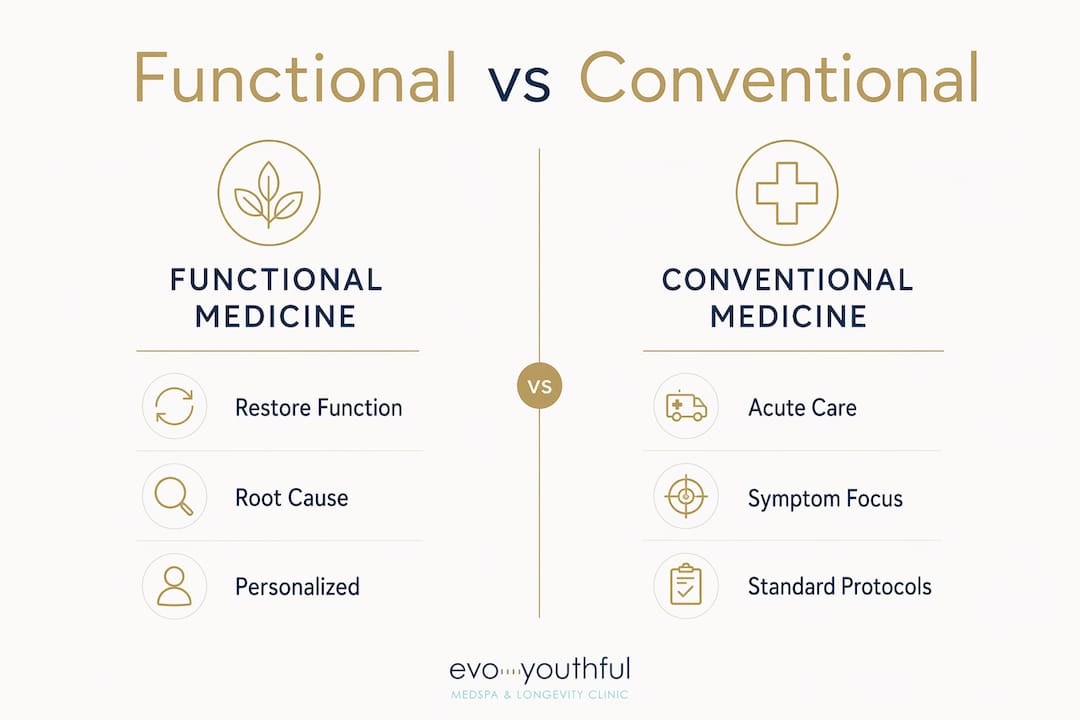
Functional medicine does not replace conventional care for urgent needs like surgery or acute infection. The two models work best together: conventional medicine handles the acute, functional medicine addresses the chronic and preventive.
Core principles that define how functional medicine works
Functional medicine is a patient-centered, systems-biology approach that seeks root causes of chronic illness rather than primarily suppressing symptoms. Several principles make that concrete in practice.
- Systems biology thinking: Clinicians examine gut-brain-immune-endocrine interactions rather than isolating a single organ. A thyroid symptom may trace back to gut permeability or chronic stress, not the thyroid alone.
- Biochemical individuality: Your genetics, environment, and life history create a unique physiological profile. Personalized care plans reflect that, not a one-size protocol.
- Stepwise sequencing: The iterative framework moves from foundational lifestyle changes to targeted lab testing to precise clinical interventions, reassessing at each stage.
- Multimodal toolkit: Nutrition, sleep, stress management, and exercise come first. Nutraceuticals, hormones, and regenerative therapies are added selectively, based on confirmed gaps.
- Health span as the target: The aim is positive vitality at the cellular level, not just the absence of disease.
Pro Tip: Apply the “Power before Protocol” principle from Functional Medicine University: build foundational capacity first — sleep, nutrition, stress resilience — before layering supplements or advanced therapies. Skipping this step wastes money and makes it harder to know what’s actually working.

What to expect at your first functional medicine consultation
The process begins before you walk in the door. Patients complete detailed electronic intake questionnaires covering medical, family, social, and lifestyle history. This pre-visit work shapes everything that follows.
During the first visit, you can expect:
- Extended one-on-one clinician time to review your full health timeline
- A focused physical exam aligned to your specific concerns
- Discussion of your health goals and readiness for lifestyle change
- An initial assessment of which foundational areas need attention first
- A plan for targeted lab testing, ordered strategically rather than as a broad sweep
Functional medicine practitioners rely on the medical timeline as a primary diagnostic tool. Many patients expect extensive lab work at the first visit; in practice, the narrative history often reveals more than any single panel. Testing follows the story, not the other way around.
Follow-up visits are iterative. Your clinician adjusts the plan based on how you respond, adding interventions only when the data and your progress support them. Meaningful improvement typically unfolds over weeks to months, not days. For fatigue, hormonal shifts, or metabolic concerns, that timeline is realistic and worth the investment.
Pro Tip: Come prepared to discuss life events, environmental exposures, prior treatments, and even significant stressors. That narrative is the single most revealing diagnostic tool your clinician has.
Common treatment options in a functional medicine plan
Functional medicine most often begins with diet, digestion, sleep, stress, and lifestyle changes. Clinical therapies are layered in only after confirming specific gaps or nonresponse to foundational work.
Foundational interventions:
- Therapeutic nutrition plans (anti-inflammatory, elimination, or nutrient-dense protocols)
- Sleep optimization strategies
- Stress management and nervous system support
- Targeted exercise prescriptions matched to your physiology
Targeted clinical supports:
- High-quality nutraceuticals based on confirmed deficiencies
- Bioidentical hormone replacement therapy (BHRT) when hormonal imbalances are clinically confirmed
- Peptide therapy to support tissue repair, metabolic function, and cellular signaling
- PRF injections as regenerative adjuncts to aesthetic procedures
- Prescription medications when clinically indicated
Precision tools, when appropriate:
- Nutrigenomics testing to personalize dietary recommendations based on your genetic profile — a nutrigenomics checklist can help you understand what to ask for
- Specialized metabolic panels and hormone profiles
- Drug-gene interaction testing to optimize medication choices
Sequencing matters. Adding peptide therapy or BHRT before addressing sleep deprivation or chronic inflammation reduces their effectiveness. The functional model treats sequencing as a clinical decision, not a menu selection.
What the evidence supports, and where the limits are
Lifestyle-based interventions, stepwise frameworks, and targeted testing have solid support for improving chronic symptom burden. Academic centers, including Cleveland Clinic, have embedded functional medicine programs that emphasize food-first strategies and collaborative care models. That institutional adoption reflects genuine clinical confidence in the foundations.
The limitations are real, though. Standardization varies across clinics. Some advanced tests and supplement protocols have mixed or emerging evidence for specific conditions. Not every intervention works for every patient, and the timeline for results requires patience.
Watch for these red flags:
- Clinics that promise rapid or guaranteed results
- Blanket “detox” protocols with no individualized rationale
- Shotgun testing ordered without a clear clinical question
- Pressure to purchase large supplement packages before your first results are reviewed
- Clinicians who dismiss conventional diagnostics or discourage specialist referrals
The functional medicine model is designed to work alongside conventional care, not around it. Acute problems still require conventional tools. A clinician who suggests otherwise is operating outside the model’s own principles.
Safety is built into the framework when it is applied correctly. Credentialed clinicians refer out for acute needs and use conventional diagnostics as part of the process. The body’s self-regulation capacity is the target — the clinician’s role is to remove obstacles and provide the right environment for that to happen.
How to choose a qualified functional medicine practitioner
Credentials matter, but they are not the whole picture. Look for an MD, DO, NP, or PA-C with additional training in systems-based medicine, IFM certification or equivalent continuing education, and a clear record of collaborating with specialists.
Questions to ask at your first consult:
- What does your intake process look like, and how long is the first visit?
- How do you sequence testing and interventions?
- Who coordinates my care if I need a specialist?
- How do you define and measure success for a patient like me?
- What does a typical follow-up schedule look like?
Quick red-flag checklist:
- ☐ Guaranteed cures or dramatic outcome promises
- ☐ No clear sequencing rationale for tests or supplements
- ☐ No collaboration with or referrals to conventional specialists
- ☐ Pressure to buy supplements before results are reviewed
- ☐ Clinician who cannot explain why a specific test is ordered for you
Personalized medicine at its best is transparent about what is known, what is being tested, and what the next decision point looks like. If a clinician cannot answer those questions clearly, keep looking.
How functional medicine integrates with aesthetic and regenerative care at evoyouthful
The functional medicine approach is not separate from aesthetic and regenerative care. At evoyouthful, it is the clinical logic that connects them.
Pre-procedure optimization: Addressing inflammation, sleep deficits, and nutritional gaps before AgeJET plasma skin therapy or injectable treatments improves healing, reduces downtime, and extends results. The body responds better when its foundational systems are supported.
Regenerative crossover: BHRT, peptide therapy, and PRF injections are not standalone procedures at evoyouthful. They are integrated into a broader functional plan that addresses the physiologic conditions driving aging, fatigue, hormonal decline, and cognitive changes. For patients interested in brain health and cognitive function, that integration includes neurostimulation options alongside lifestyle and hormonal support.
A schematic pathway looks like this:
- Evaluation: Detailed intake, medical timeline, targeted labs
- Foundations: Sleep, nutrition, stress management, movement
- Targeted intervention: BHRT, peptide therapy, PRF, or aesthetic procedures as clinically appropriate
- Reassessment: Iterative follow-up to measure response and adjust
Elizabeth Vogstrom, PA-C coordinates these pathways at evoyouthful, applying root-cause health optimization principles to each patient’s plan.
The functional approach changes what aesthetic care can accomplish. Procedures performed on a physiologically optimized patient produce better, longer-lasting results than the same procedures on someone whose hormones, sleep, and inflammation are unaddressed.
Pro Tip: If you are considering regenerative or aesthetic treatments, ask your clinician to assess your foundational health first. A holistic anti-aging approach that addresses the inside before the outside consistently produces more durable outcomes.
Key Takeaways
The functional medicine approach delivers its strongest results when foundational lifestyle factors are addressed before clinical therapies are added, and when care is coordinated by credentialed clinicians who collaborate with conventional medicine.
| Point | Details |
|---|---|
| Root-cause focus | Functional medicine targets physiologic dysfunction, not just symptoms, to restore health span. |
| Sequencing is clinical | Foundations (sleep, nutrition, stress) come before supplements, hormones, or regenerative therapies. |
| Intake depth matters | Detailed medical timelines and lifestyle history are the primary diagnostic tools, not lab panels alone. |
| Credential check | Look for MD/DO/NP/PA-C with IFM training and a clear referral network before committing to care. |
| evoyouthful integration | evoyouthful pairs functional medicine principles with BHRT, peptide therapy, PRF, and aesthetic treatments for optimized, lasting results. |
A clinician’s perspective on functional medicine in aesthetic practice
Most patients who come to a clinic like evoyouthful have already tried the standard routes. They have seen their primary care physician, had routine labs, and been told everything looks “normal.” What they know, and what the numbers don’t always capture, is that they don’t feel normal. That gap is exactly where functional medicine operates.
What I find most underestimated in this model is the power of sequencing. Patients often want to move straight to the most advanced intervention available, and I understand that impulse. But a peptide protocol or hormone therapy layered onto unresolved sleep dysfunction or chronic inflammation is working against itself. The foundational work is not a delay. It is what makes the clinical therapies actually land.
The other thing worth saying plainly: functional medicine does not promise to fix everything. What it does is give you a framework for understanding why your body is doing what it is doing, and a logical, stepwise path toward changing it. That transparency is what builds trust over time, and trust is what makes patients willing to do the harder foundational work that produces real results.
For patients combining aesthetic goals with longevity objectives, the integration at evoyouthful is genuinely different from a standard medspa visit. The procedures are the same. The clinical context around them is not.
Ready to start with a personalized functional medicine consultation at evoyouthful?
evoyouthful offers something specific: a functional medicine-informed consultation that connects your aesthetic and longevity goals to a clinically sequenced plan. Rather than booking a single procedure, you begin with a thorough intake, one-on-one time with Elizabeth Vogstrom, PA-C, and a clear set of recommended next steps based on your individual history and goals.
For patients whose goals include hormonal balance, cognitive clarity, tissue repair, or sustained aesthetic results, that starting point makes every subsequent treatment more effective. Whether your path leads to BHRT, peptide therapy, or a combination of regenerative and aesthetic modalities, the functional framework ensures your care is sequenced, not scattered.
Schedule your initial consultation at evoyouthful in Wayzata, MN, and come prepared with your medical timeline. That conversation is where the plan begins.
Useful sources for further reading
- Institute for Functional Medicine (IFM): The primary professional body defining functional medicine frameworks, training standards, and collaboration principles.
- Cleveland Clinic — What Is Functional Medicine?: Institutional overview of the patient-centered model, intake process, and food-first strategies from a leading academic medical center.
- The Permanente Journal — Functional Medicine Treatment Framework: Peer-reviewed support for the iterative, stepwise sequencing approach used in clinical practice.
- American Academy of Functional Medicine — Core Values: Defines health span, positive vitality, and the cellular-level optimization goals of the functional model.
- WebMD — Functional Medicine Doctors: Accessible overview of how functional medicine doctors differ in practice, visit style, and treatment planning.
- Dr. Michael Ruscio — What Is Functional Medicine?: Practical clinical perspective on realistic starting points, typical interventions, and honest expectations.
- Functional Medicine University: Source for the “Power before Protocol” sequencing principle and foundational capacity-building concepts.
- Stony Brook Medicine — What Is Functional Medicine?: Academic clinical resource on narrative diagnosis and the role of the medical timeline as a primary diagnostic tool.
This article is for general informational purposes only and does not constitute medical advice. Consult a qualified clinician for guidance specific to your health situation.
Recommended
Ready to Start?
Schedule a Consultation
Have questions about what you just read? Our team is here to help.