

Boutique Medical Clinic Evaluation Guide for 2026
Elizabeth Vogstrom, PA-C
evoyouthful Clinical Team
Discover the ultimate boutique medical clinic evaluation guide for 2026, helping you navigate services, pricing, and quality for informed choices.
Boutique Medical Clinic Evaluation Guide for 2026
A boutique medical clinic is defined as a private, membership-based practice that trades high patient volume for deep, relationship-centered care. Also called concierge medicine, this model gives you direct access to your physician, longer appointments, and a care plan built around your specific health goals rather than a 15-minute slot on a crowded schedule. This boutique medical clinic evaluation guide walks you through every factor that matters: services, pricing, quality indicators, and how these practices compare to traditional healthcare. Whether you are exploring this model for the first time or comparing specific clinics, you will finish this guide with a clear framework for making a confident, informed decision.
What does a boutique medical clinic evaluation guide actually cover?
A strong boutique clinic assessment starts with understanding what these practices offer and whether those offerings match your needs. Boutique clinics typically provide longer appointments of 30–60 minutes, compared to traditional providers who may see 25–30 patients daily. That difference in volume is the foundation of everything else.
Core services you should expect to find include:
- Primary and preventive care with longitudinal health management, not just reactive treatment
- Advanced diagnostics such as genetic testing, hormone panels, and metabolic assessments
- Wellness coaching covering nutrition, sleep, stress, and lifestyle optimization
- Aesthetic and regenerative treatments including skin rejuvenation, hormone therapy, and peptide protocols
- Care coordination connecting you with specialists while your primary provider stays involved
The best clinics also use technology well. Look for patient portals, secure messaging, and electronic medical records that give you real-time access to your own health data. Care coordination capabilities matter too. A clinic that can communicate directly with your cardiologist or endocrinologist adds real value beyond what a standalone practice offers.
One detail many patients overlook is whether specific services are included in the membership fee or billed separately. Some clinics bundle wellness coaching and preventive labs into the retainer. Others charge for each service individually.
Pro Tip: Ask every clinic you evaluate for a written list of what is and is not included in the membership fee before you sign anything. This single step prevents the most common source of billing surprises.
How to understand and compare boutique clinic pricing models
Boutique clinic pricing follows a retainer or membership structure, and the numbers vary more than most people expect. Retainer fees average about $135 per month, though programs at the higher end of the market can run several hundred dollars monthly. That fee buys access to the physician and a defined set of services.
What the retainer does not cover is equally important. Concierge membership fees typically exclude specialist appointments, hospital stays, emergency services, and some lab work, which may still be billed to your insurance. This means you need both a membership fee budget and active insurance coverage in most cases.
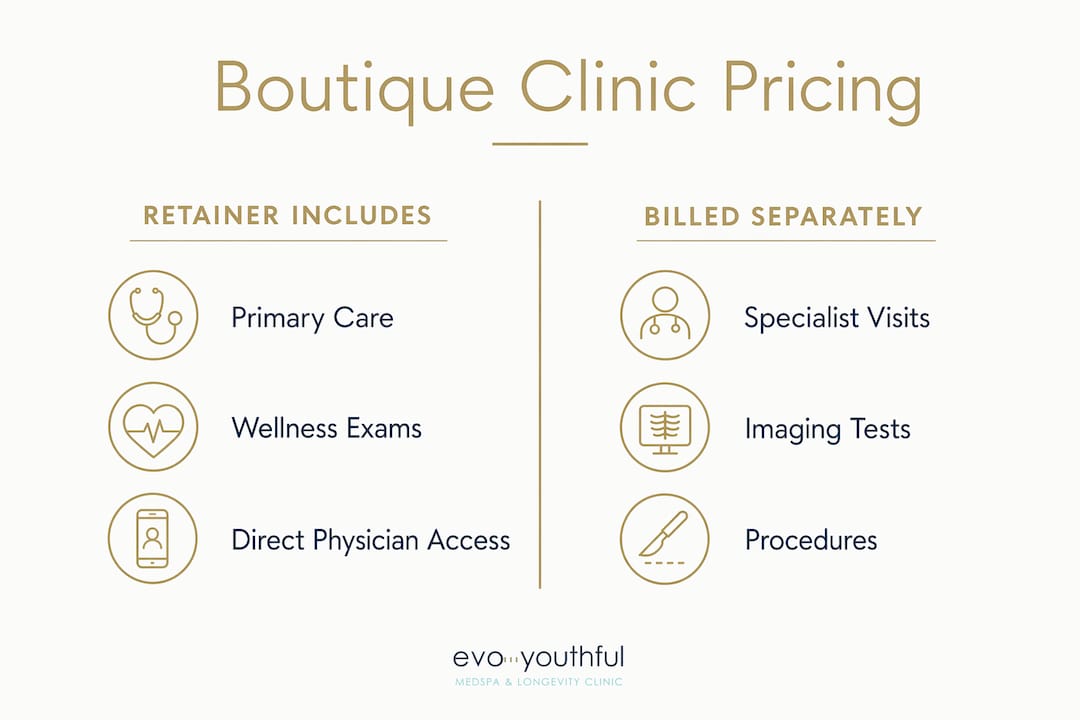
| Cost component | Typically included in retainer | Usually billed separately |
|---|---|---|
| Annual wellness exam | Yes | No |
| Preventive lab panels | Often included | Sometimes billed to insurance |
| Specialist referrals | No | Billed to insurance or self-pay |
| Imaging (MRI, X-ray) | No | Billed to insurance |
| Aesthetic treatments | Varies by clinic | Often billed separately |
| Emergency/hospital care | No | Billed to insurance |
Reading this table, the pattern is clear. The retainer covers access and primary care services. Everything downstream of that still runs through your existing coverage. Budget accordingly.
Pro Tip: Always ask about cancellation policies and whether the clinic prorates fees if you join mid-year. Some practices lock you into annual contracts with no refund provisions.
What quality indicators matter when assessing boutique clinics?
Quality in a boutique clinic goes well beyond a polished website and a warm waiting room. The indicators that actually predict good outcomes are structural and clinical.
Clinic stability depends on dedicated practice managers and multi-user electronic medical record systems rather than sole reliance on one owner-physician. A single-provider practice where one doctor handles both clinical care and all operations creates real continuity risk. If that physician leaves or becomes unavailable, your care can be disrupted with little warning.
Key quality indicators to verify before committing:
- Board certification of all physicians and licensed status of all clinical staff
- Multi-user EMR system that maintains your records independently of any single provider
- 24/7 physician access via phone, text, or email for questions and urgent concerns
- Appointment wait times of 1–3 days rather than the 2–4 weeks typical of hospital systems
- Patient testimonials that speak to communication quality, not just outcomes
- Transparent fee documentation provided in writing before enrollment
Boutique clinics offer 24/7 direct physician contact via phone, text, or email, along with same-day or next-day appointments. This access level reduces unnecessary urgent care and emergency room visits, which matters both for your health and your overall healthcare costs.
Patient testimonials are useful, but read them critically. Look for comments about how the clinic handled a problem or a complex situation, not just praise for the facility’s appearance. How a practice responds when something goes wrong tells you far more than how it performs when everything is routine.

Pro Tip: Schedule a consultation visit before enrolling. Use it to assess how the physician communicates, how staff respond to your questions, and whether the environment feels organized and professional. Your instincts during that visit are valid data.
How do boutique clinics compare to traditional healthcare providers?
The difference between boutique and traditional care is not just about amenities. It is a fundamentally different model of how medicine is practiced and delivered.
Boutique medicine shifts care from reactive acute treatment to proactive, long-term health management built on a relationship with one physician over time. Traditional hospital systems prioritize throughput and acute intervention. Neither model is universally better. They serve different patient needs.
| Feature | Boutique clinic | Traditional hospital system |
|---|---|---|
| Appointment length | 30–60 minutes | 10–15 minutes average |
| Wait time for appointment | 1–3 days | 2–4 weeks |
| Physician access | 24/7 direct contact | Through scheduling only |
| Care focus | Preventive, wellness, aesthetics | Acute, surgical, emergency |
| Emergency/ICU capability | None | Full infrastructure |
| Ideal patient profile | Preventive care, wellness, aesthetics | Complex surgery, high-risk conditions |
Boutique clinics excel in aesthetic refinements and personalized wellness, while large university hospitals are better equipped for high-risk or emergency care requiring onsite ICUs. This is not a limitation of boutique medicine. It is simply a different scope of practice.
If you are managing a chronic condition like hormonal imbalance, seeking personalized wellness planning, or pursuing aesthetic and regenerative treatments, a boutique clinic is likely the stronger fit. If you need cardiac surgery or trauma care, you need a hospital system. Many patients use both, maintaining a boutique primary care relationship while keeping access to a hospital network for acute needs.
Step-by-step approach to choosing the right boutique clinic
A structured evaluation process protects you from making a decision based on marketing alone. Follow these steps before committing to any membership.
- Define your health priorities. Write down your top three health goals. Are you focused on hormone balance, weight management, cognitive support, skin health, or general preventive care? Your goals should directly match the clinic’s core service offerings.
- Research local clinics and verify credentials. Check state medical board records for physician licensure and any disciplinary history. Confirm board certification in the relevant specialty.
- Request a full fee disclosure. Ask for a written breakdown of what the membership covers, what is billed separately, and what the cancellation terms are.
- Evaluate technology and access. Confirm the clinic uses a multi-user EMR system and offers 24/7 physician contact. Ask how after-hours calls are handled.
- Schedule a consultation. Treat this as a two-way interview. Assess communication style, staff responsiveness, and whether the physician listens before prescribing.
- Review patient feedback. Look beyond star ratings. Read written reviews for patterns in communication, billing transparency, and how the clinic handles concerns.
Red flags to avoid:
- Vague or verbal-only fee descriptions with no written documentation
- A single physician who also manages all clinic operations with no support staff
- No clear process for after-hours urgent questions
- Pressure to enroll before you have had time to review all terms
- No mention of how your records are maintained or transferred if you leave
Boutique practices offering services like genetic testing, hormone optimization, and personalized nutrition plans are a strong sign of a proactive, patient-centered model. These services signal that the clinic invests in early detection and long-term outcomes rather than transactional visits.
Pro Tip: Use the health assessment checklist at evoyouthful to clarify your health priorities before your first consultation. Arriving with a clear picture of your goals makes the evaluation conversation far more productive.
Key takeaways
A boutique medical clinic delivers the most value when you choose it based on verified quality indicators, transparent pricing, and a clear match between its services and your personal health goals.
| Point | Details |
|---|---|
| Verify fee transparency | Get a written breakdown of what is included and what is billed separately before enrolling. |
| Confirm clinic stability | Look for multi-user EMR systems and dedicated practice managers, not sole-provider operations. |
| Match services to your goals | Boutique clinics excel in preventive care, wellness, and aesthetics, not emergency or surgical care. |
| Use the consultation visit | Treat your first visit as an evaluation of communication quality, not just a tour of the facility. |
| Budget for both layers | Plan for the retainer fee plus active insurance coverage for labs, imaging, and specialist care. |
What I have learned from evaluating boutique clinics firsthand
By Elizabeth Vogstrom, PA-C
The single biggest mistake I see patients make is choosing a boutique clinic based on aesthetics and marketing language. A beautiful space and a compelling website are easy to produce. What is harder to fake is a physician who listens, a staff that follows through, and a billing process that matches what was promised at enrollment.
I have seen patients leave excellent traditional practices for boutique clinics that looked impressive but lacked the operational infrastructure to deliver consistent care. The red flag I watch for most closely is single-provider dependency. When one physician runs both the clinical and administrative sides of a practice, you are one burnout or career change away from losing your entire care relationship.
The clinics I trust most are the ones that are transparent about their limitations. A good boutique provider will tell you directly when a condition requires hospital-level resources. That honesty is a quality marker, not a weakness. Patients benefit most from boutique models when they seek long-term preventive care and strong physician partnerships rather than episodic treatment of acute conditions. That framing should guide your entire evaluation process.
My advice: go into every consultation with your written health goals, your budget, and three direct questions about billing, after-hours access, and record management. The answers will tell you everything you need to know.
— Elizabeth Vogstrom, PA-C
Personalized care at evoyouthful in Wayzata, MN
evoyouthful brings the boutique medical clinic model to Wayzata, MN with a treatment menu built around your individual biology and wellness goals.

From bioidentical hormone replacement therapy and ExoMind cognitive support to peptide therapy, pelvic floor treatments, and physician-curated skin rejuvenation, every service at evoyouthful is designed to address root causes rather than surface symptoms. The team works with you to build a personalized care plan, not a one-size-fits-all protocol. If you are ready to experience what relationship-based, preventive care actually feels like, schedule a consultation with evoyouthful and take the first step toward care that is genuinely built around you.
FAQ
What is a boutique medical clinic?
A boutique medical clinic, also called a concierge practice, is a membership-based healthcare model where patients pay a retainer fee for personalized care, longer appointments, and direct physician access. The model prioritizes preventive health management over high-volume, reactive treatment.
How much does a boutique clinic membership typically cost?
Retainer fees average around $135 per month, though costs vary widely by clinic and service range. Labs, imaging, and specialist visits are usually billed separately to insurance.
How do I know if a boutique clinic is high quality?
Look for board-certified physicians, a multi-user EMR system, 24/7 physician access, and written fee documentation. Clinic stability indicators like dedicated practice managers and robust record systems are stronger quality signals than marketing materials.
Is a boutique clinic right for me if I have a chronic condition?
Boutique clinics are well suited for managing chronic conditions like hormonal imbalances, metabolic issues, and cognitive concerns through preventive and personalized care. For high-risk surgical or emergency needs, you will still need access to a hospital system alongside your boutique provider.
What questions should I ask during a boutique clinic consultation?
Ask about what the membership fee covers, how after-hours urgent questions are handled, how your records are maintained, and what the cancellation policy is. These four questions reveal more about a clinic’s operational quality than any brochure will.
Recommended
Ready to Start?
Schedule a Consultation
Have questions about what you just read? Our team is here to help.