
Physician Led Sun Damage Treatment Plan for Appearance Conscious Adults
Elizabeth Vogstrom, PA-C
evoyouthful Clinical Team
A physician led multimodal approach to treating sun damage: medical screening, prescription retinoids, in office resurfacing, injectables, and maintenance...
Physician Led Sun Damage Treatment Plan for Appearance Conscious Adults
The best sun damage treatment is a physician-led, multi-modal plan, not a single procedure. Substantial improvement in pigment, texture, and fine lines is achievable, though full cellular reversal is not. Effective plans pair a prescription retinoid with in-office resurfacing, such as AgeJET Plasma or RF microneedling, and add volume restoration where needed. Start with a medical consult and a skin cancer screening before booking anything cosmetic.
TL;DR:
- Combining a prescription retinoid with in-office resurfacing and volume restoration is most effective, and a comprehensive skin exam before treatment is essential.
- Flat pigment and fine lines respond well to topical treatments and light therapies, but coarse wrinkles and laxity require resurfacing or injectables for noticeable improvement.
- Laser and light-based treatments vary in downtime and results, with ablative lasers offering the most dramatic gains but requiring longer recovery.
- Proper pre- and post-care, especially sun protection, is crucial to maintain results and avoid pigmentation issues after procedures.
- A personalized, sequenced treatment plan, established through a thorough skin assessment, yields better outcomes than relying on a single device or technique.
Table of Contents
- What Sun Damage Looks Like and What Can Realistically Be Improved
- Treatment Categories Doctors Use: A Quick Map
- Laser and Light-Based Resurfacing: Types, Outcomes, and Downtime
- Chemical Peels and Microdermabrasion: Matching Depth to Goals
- Microneedling, RF Microneedling, and PRF: Collagen Induction Explained
- Injectables: Fillers and Neuromodulators as Part of a Rejuvenation Plan
- Topical Medical-Grade Treatments: Retinoids, Antioxidants, and Pigment Therapies
- Combining Treatments: Sequencing, Timeline, and What Affects Cost
- How to Choose a Clinic and Clinician: Exact Questions and Red Flags
- Maintenance and Prevention: Sunscreen, Clothing, and Long-Term Upkeep
- Author and Clinic Perspective: Building an Individualized Sun-Damage Plan
- The Gap Between What Sun-Damage Marketing Promises and What Actually Works
- Ready for a Personalized Sun Damage Recovery Plan?
- Sources
What Sun Damage Looks Like and What Can Realistically Be Improved
Photoaging shows up in layers, and each layer responds differently to treatment. Sun damage destroys collagen at a structural level, which is why some signs fade with skin care and others need a device or a needle to budge.
- Flat pigment changes (age spots, mottled discoloration) often respond well to topicals and light-based treatments.
- Fine wrinkles and rough texture improve with retinoids, peels, and microneedling.
- Coarse wrinkles, skin laxity, and deep folds usually need resurfacing or volume replacement to see real change.
- Telangiectasias (visible broken capillaries) are among the most stubborn signs and resist most topical approaches, according to the American Academy of Dermatology.
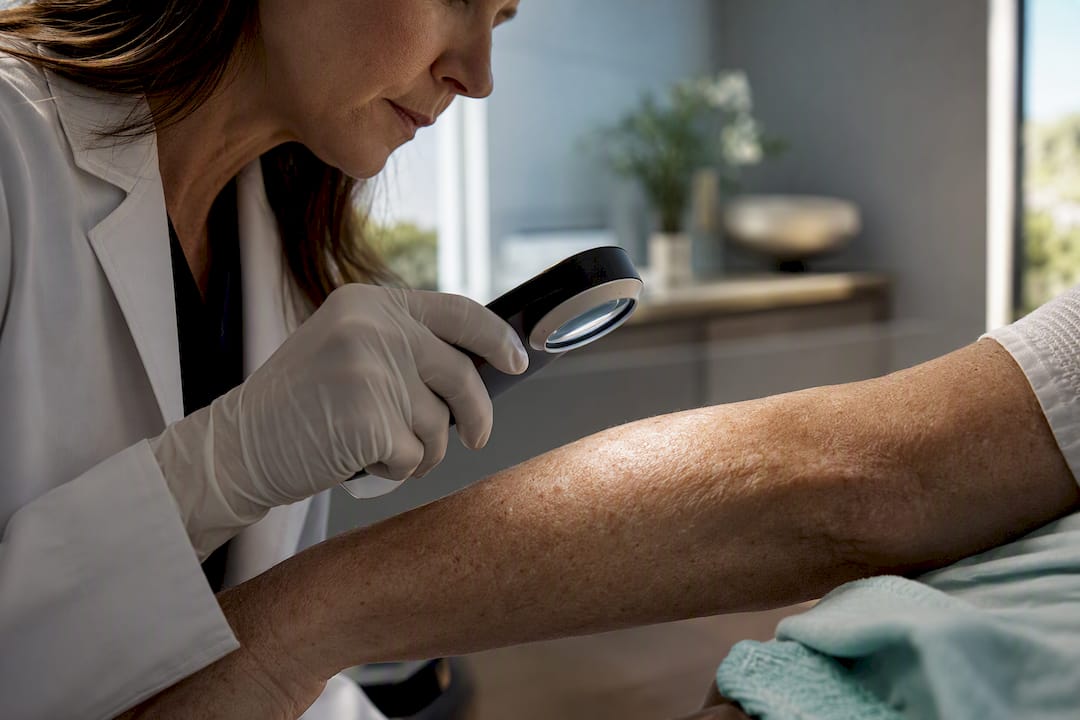
Before any cosmetic work begins, a clinician should check for actinic keratoses or suspicious lesions. Cosmetic improvement and cancer screening are not separate errands. They happen in the same visit.
Treatment Categories Doctors Use: A Quick Map
Dermatology providers pull from six main categories to build a plan, and knowing the map helps you understand why your provider recommends a combination instead of one fix.
- Topical medical-grade agents — prescription retinoids, antioxidants, and pigment-correcting ingredients that prime the skin.
- Exfoliative chemical peels — controlled acid application that resurfaces the top layers.
- Energy-based resurfacing — fractional lasers, IPL, and RF microneedling that stimulate collagen at depth.
- Collagen induction devices — traditional and RF-assisted microneedling, often paired with PRF.
- Injectables — neuromodulators and fillers for lines and volume loss that resurfacing cannot fix.
- Lesion-directed therapies — cryotherapy, topical 5-fluorouracil (5-FU), imiquimod, or photodynamic therapy for actinic keratoses.
Single treatments tend to plateau because each one addresses a narrow slice of the damage. The American Academy of Dermatology notes that combining retinoids, resurfacing, and injectables addresses fine lines, pigment, and volume together, while structural changes like telangiectasias remain more resistant regardless of the combination.
Laser and Light-Based Resurfacing: Types, Outcomes, and Downtime
Ablative lasers remove the outer skin layer entirely and deliver the most dramatic pigment and texture correction, at the cost of a longer recovery. Nonablative and fractional devices leave the surface largely intact while creating microscopic injury zones beneath it. Fractional technology works by delivering microbeams into the dermis, which triggers coagulation and prompts new tissue growth. IPL and BBL target red and brown pigment specifically and work well for sun spots and mild redness with almost no downtime.
- Ablative fractional — best for coarse wrinkles and deep texture; 5 to 10 days of downtime.
- Nonablative fractional — moderate texture and pigment gains; one to three days of redness.
- IPL/BBL — flat pigment and mild redness; no real downtime, but typically 3 to 5 sessions.
Pro Tip: Deeper microthermal columns produce more remodeling, but they also raise the risk of pigment complications on darker skin tones, so device settings should be matched to your skin type, not a one-size protocol. Providers who offer AgeJET Plasma Skin Therapy typically adjust energy delivery for exactly this reason.
Chemical Peels and Microdermabrasion: Matching Depth to Goals
Peel strength should match the depth of damage, not the calendar you’d like to keep. Superficial peels need almost no downtime and suit mild pigment and dullness. Medium peels reach further and handle moderate sun spots and texture, with five to seven days of visible peeling. Deep peels rebuild more dramatically but require real recovery time and closer monitoring.
- Superficial peels — glycolic or salicylic acid; little to no downtime.
- Medium peels — TCA-based; noticeable peeling for about a week.
- Microdermabrasion — mechanical exfoliation for mild texture; minimal risk, modest results.
- Dermabrasion — a deeper mechanical resurfacing for significant scarring, used far less often today.
Aftercare determines whether you end up with even results or new pigment problems. Strict sun avoidance and gentle barrier support for several weeks after any peel lower the risk of both hypopigmentation and hyperpigmentation.
Microneedling, RF Microneedling, and PRF: Collagen Induction Explained
Microneedling works by creating controlled micro-injuries that trigger the skin’s own wound-healing response, which rebuilds collagen and can improve pigment and fine lines together in a way most topicals alone cannot. Adding radiofrequency energy to the needles, as with Exion fractional RF microneedling, pushes remodeling deeper without the longer downtime of an ablative laser.
- Standard microneedling — best for surface texture and early pigment irregularity.
- RF microneedling — reaches deeper layers for laxity and moderate scarring.
- PRF injections — adds concentrated growth factors from your own blood to accelerate healing and support collagen production.
Pro Tip: Most collagen induction plans call for a course of three to six sessions spaced four to six weeks apart, with a single maintenance visit roughly once a year after that. PRF injections are often layered into that same appointment rather than booked separately.
Injectables: Fillers and Neuromodulators as Part of a Rejuvenation Plan
Resurfacing rebuilds skin quality, but it does not restore lost volume or stop a muscle from creasing skin every time you smile. That is the job of injectables. Neuromodulators soften the dynamic lines caused by repeated muscle movement, while fillers replace volume lost to years of collagen breakdown, particularly around the cheeks and temples.
- Neuromodulators (like Botox or Dysport) — soften forehead lines and crow’s feet; results last three to four months.
- Dermal fillers — restore cheek and temple volume; results typically last six to eighteen months depending on the product.
- Sequencing — injectables usually follow resurfacing once swelling has resolved, for a natural, staged result rather than an overdone one.
Proper screening may lead providers to space treatments around the resurfacing schedule rather than stacking them all in one visit.
Topical Medical-Grade Treatments: Retinoids, Antioxidants, and Pigment Therapies
Prescription tretinoin outperforms over-the-counter retinol because it is a more potent, direct form of vitamin A rather than a precursor the skin has to convert. For pigment, hydroquinone remains a strong option under medical supervision, with tranexamic acid and azelaic acid as alternatives for patients who cannot use it long-term. Vitamin C and other topical antioxidants help protect against future UV-driven damage while supporting the skin barrier alongside these active ingredients.
- Prescription tretinoin — faster, deeper collagen stimulation than OTC retinol.
- Hydroquinone or alternatives — targeted pigment correction under medical guidance.
- Vitamin C serums — daily antioxidant defense that pairs well with SPF.
Visible change from a consistent topical regimen typically takes 8 to 12 weeks, and none of it holds up without daily sunscreen underneath it.
Combining Treatments: Sequencing, Timeline, and What Affects Cost
A well-sequenced plan protects your investment and your downtime tolerance. Most physician-led programs follow a similar order.
- Prep phase (4 to 8 weeks) — prescription topicals condition the skin and reduce post-procedure pigment risk.
- Resurfacing phase — laser, RF microneedling, or peels address texture and pigment over several sessions spaced weeks apart.
- Refinement phase — injectables add volume and soften lines once resurfacing has fully healed.
- Maintenance phase — periodic touch-ups and continued topicals sustain the result.
Cost varies mainly by device type, the number of sessions needed, and provider experience. A course of RF microneedling or plasma resurfacing costs more per session than a superficial peel, but often needs fewer total visits to reach the same visible endpoint. More experienced injectors or laser specialists often charge more per session, which may correlate with fewer complications and more predictable results.
How to Choose a Clinic and Clinician: Exact Questions and Red Flags
Ask direct questions before you book anything. Confirm the provider is board certified, ask to see real before-and-after galleries, and find out exactly which device model will be used, since results vary meaningfully between brands within the same category.
- Is the provider or supervising physician board certified?
- Will someone screen my skin for actinic keratoses or suspicious lesions before treatment?
- What device is being used, and how many sessions does a realistic plan involve?
- What is the written aftercare protocol, and who do I call if something looks wrong?
Pro Tip: A price that looks too low for laser or RF microneedling is the fastest red flag in this field. Board-certified providers carry more medical training and screen for skin cancer before cosmetic work, which reduces complication risk in ways a discount clinic often cannot match. Walk away from any provider who cannot answer the device question specifically.
Maintenance and Prevention: Sunscreen, Clothing, and Long-Term Upkeep
Every procedure above loses ground fast without daily protection behind it. Prevention through consistent, layered sun protection remains the single most effective strategy available, and it costs far less than any laser session.
- Apply a dedicated facial SPF daily, then layer a broad-spectrum SPF 50 on top for real outdoor exposure.
- Reapply every two hours outdoors, since most people apply far less than the labeled amount.
- Add UV-protective clothing and a wide-brim hat for extended sun exposure.
- Schedule an annual full-body skin exam, and return for touch-up procedures on the schedule your provider sets.
Pro Tip: Layering products, a moisturizer with SPF underneath a dedicated sunscreen, closes the gap between labeled protection and what most people actually apply.
Author and Clinic Perspective: Building an Individualized Sun-Damage Plan
Elizabeth Vogstrom, PA-C, approaches sun-damage correction as a sequencing problem first and a device problem second. The order of operations, prep, resurfacing, refinement, maintenance, matters as much as which technology gets used.
At evoyouthful, that sequencing draws on a specific set of tools rather than a single default treatment.
- Exion fractional RF microneedling for deeper collagen remodeling.
- PRF injections to support healing between sessions.
- Physician-curated medical-grade skin care to extend results between visits.
A medical consult and a lesion screen come first, before any device gets discussed.
The Gap Between What Sun-Damage Marketing Promises and What Actually Works
Most marketing around sun damage sells a single hero device, a new laser, or a new serum, as if photoaging were one problem with one fix. It isn’t. The research is fairly consistent on this point: superficial signs like flat pigment and fine lines respond well to almost any reasonable approach, while structural damage like telangiectasias and deep laxity resists nearly everything short of resurfacing or injectables done well and done in sequence.
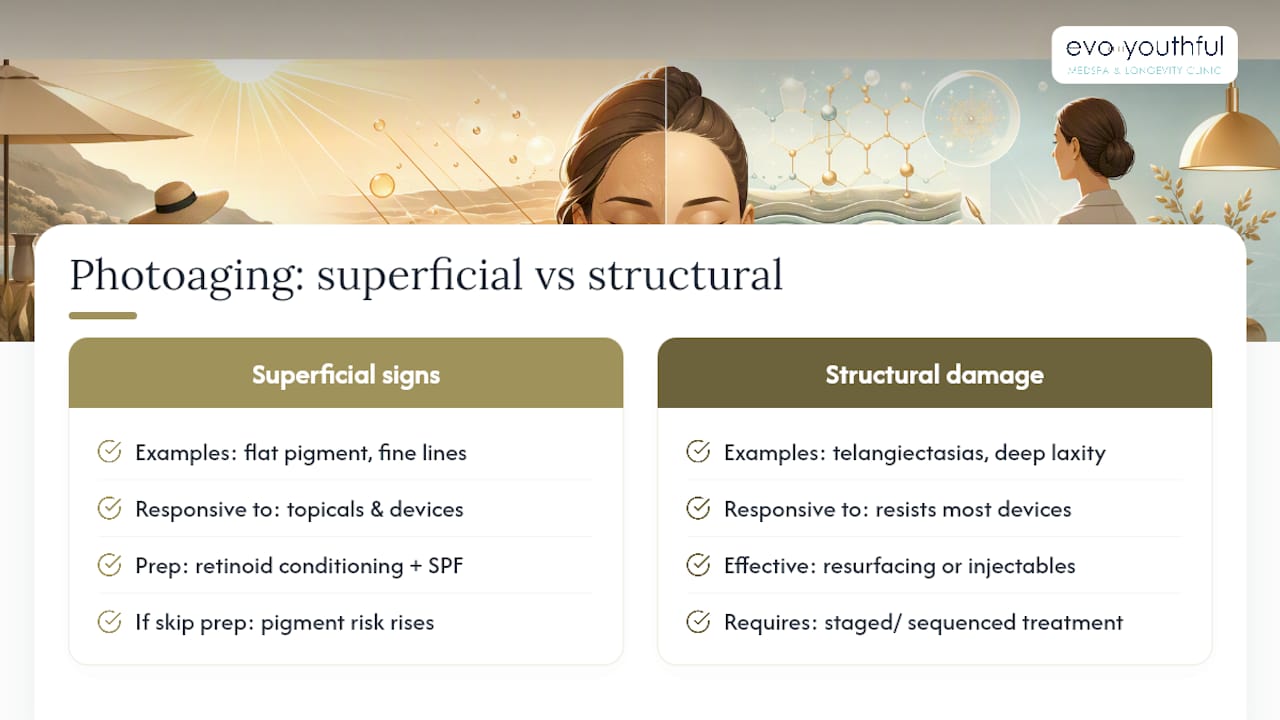
Where I think most patients go wrong is skipping the prep phase. Jumping straight to a laser without weeks of retinoid conditioning beforehand raises pigment risk and often produces a less even result, not a faster one. The unglamorous part, daily SPF layering and a consistent topical regimen, is what actually protects the money spent on procedures. Skip that step and you are rebooking the same laser session in eighteen months instead of two years.
If you take one thing from this, prioritize the screening visit over the treatment menu. A plan built after a proper skin exam, sequenced instead of stacked, outperforms whatever device is trending this year.
— Elizabeth Vogstrom, PA-C
Ready for a Personalized Sun Damage Recovery Plan?
Reading about resurfacing options is one thing. Getting a plan built around your specific skin tone, damage pattern, and schedule is another. Some clinics approach sun damage with a medical consult and lesion screening first, followed by a sequenced combination of in-office resurfacing and curated skin care rather than a single generic treatment.
The clinic’s AgeJET Plasma Skin Therapy and RF microneedling options are built for exactly the texture, pigment, and laxity concerns covered above, and they’re paired with a physician-curated skincare line to help maintain results between visits. If a broader antioxidant strategy is part of your plan, evoyouthful’s glutathione treatments support cellular health from the inside as well. The next step is straightforward: book a consultation, get screened, and leave with a sequenced plan instead of a guess.
This article is general information, not a substitute for advice from a qualified doctor. Consult a qualified healthcare professional about your own circumstances before acting on anything here.
Sources
- American Academy of Dermatology — How dermatologists treat sun-damaged skin
- UR Medicine — Treating aged or sun-damaged skin
- Jefferson Health — Can You Repair or Reverse Sun Damage?
Recommended
Ready to Start?
Schedule a Consultation
Have questions about what you just read? Our team is here to help.