

Why Proximity to a Clinic Matters for Your Health
Elizabeth Vogstrom, PA-C
evoyouthful Clinical Team
Discover why proximity to clinic matters for your health. Learn how distance affects care-seeking and outcomes. Choose wisely for better health!
Proximity to a clinic is one of the strongest predictors of whether a person seeks care, follows through with treatment, and achieves better health outcomes. The concept is formally called “healthcare accessibility,” and it covers far more than just map distance. Travel time, road conditions, transportation options, and appointment availability all shape whether a nearby clinic is truly within reach. Research consistently shows that travel barriers reduce care-seeking in measurable ways. Understanding why proximity to clinic matters gives you a real advantage when choosing where to receive care.
Why proximity to a clinic matters: the 15-minute threshold
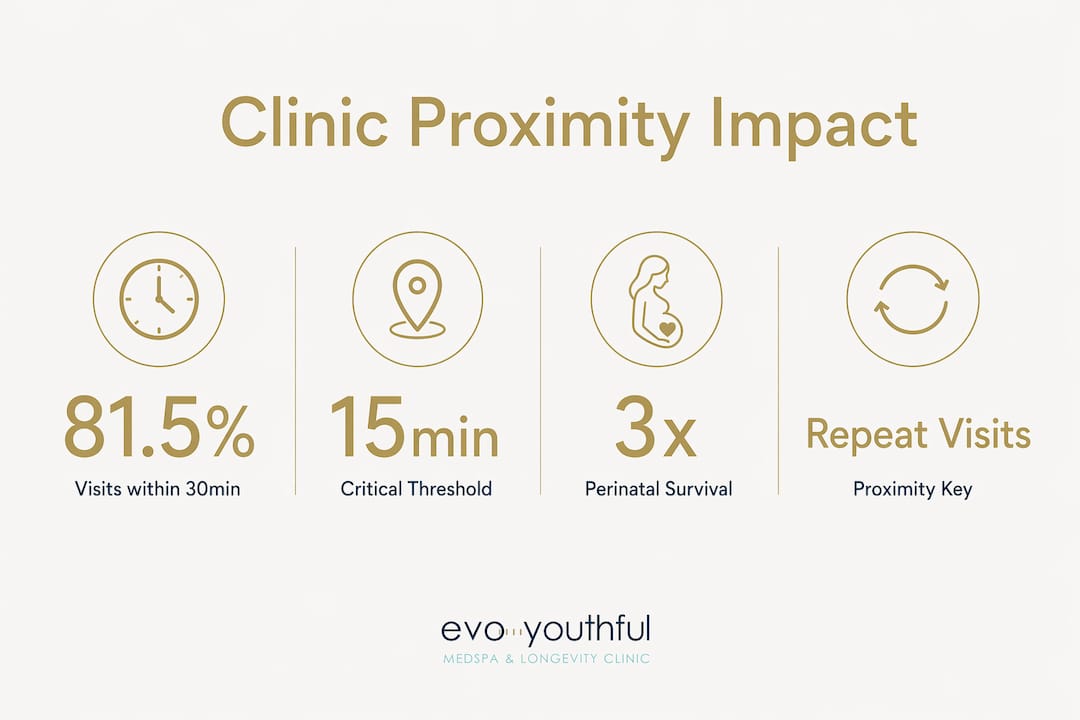
The behavioral impact of travel time is sharper than most people expect. Travel durations over 15 minutes significantly reduce perceived healthcare access and professional health-seeking behavior. That means a clinic just 20 minutes away can already start to feel like a barrier, especially for routine appointments that feel optional in the moment.
Online health resources partially compensate when travel is difficult. Patients may search symptoms or consult telehealth platforms rather than visit in person. But digital access does not replace the physical exam, lab work, or hands-on treatment that many conditions require.
Travel patterns in the United States reflect this reality. 81.5% of ambulatory visits occur within 30 minutes of home. The median travel time for primary care is 12.7 minutes, and for specialty care it rises to 17.1 minutes. Outside metropolitan areas, that specialty care median climbs to 41.8 minutes, which helps explain why rural patients consistently show lower rates of preventive care and follow-up.

Pro Tip: When evaluating a new clinic, time your actual drive during the hours you would typically attend appointments. Rush-hour travel can double a map estimate and shift a “nearby” clinic into a genuine barrier.
The importance of clinic location becomes clearest when you consider repeated visits. A single appointment is manageable at almost any distance. A treatment plan requiring weekly visits for three months is a different calculation entirely. Even one additional travel barrier increases missed visits and weakens long-term adherence.
Here are the key ways travel time shapes healthcare behavior:
- Routine care avoidance: Patients skip preventive screenings and annual checkups when travel feels inconvenient.
- Delayed acute care: Minor symptoms go unaddressed until they become serious, raising treatment complexity.
- Reduced follow-up: Post-procedure or post-diagnosis follow-up rates drop when the clinic is far away.
- Medication gaps: Patients who miss appointments are more likely to run out of prescriptions or skip dose adjustments.
Geographic distance vs. real-world access: what the map misses
Straight-line distance is a poor measure of true healthcare access. Real-world travel routes and conditions affect whether a clinic is clinically “close” far more than map distance alone. Road quality, traffic patterns, transit frequency, and seasonal conditions all determine how long a trip actually takes.
A geospatial study from rural Ghana illustrates this gap clearly:
- Apparent proximity: 95% of communities appeared within 5 kilometers of a health facility on standard GIS maps.
- Actual travel time: Poor road quality caused travel times to exceed 70 minutes despite that short geographic distance.
- Practical outcome: Patients who looked “close” on paper faced the same access barriers as those living much farther away.
- Planning implication: Health systems that rely on distance metrics alone systematically underestimate how many people lack real access.
“Straight-line distance benchmarks can mislead planners and patients when infrastructure slows travel and accessibility is effectively reduced.” — BMC Primary Care
This principle applies in American suburban and urban settings too. A clinic two miles away with no direct bus route, limited parking, and a 45-minute wait for rideshare service is not functionally close. The benefits of nearby clinics only materialize when the path to the clinic is genuinely navigable.
Transportation availability compounds the issue for specific populations. Older adults without reliable car access, patients managing chronic fatigue or pain, and individuals with caregiving responsibilities all face higher effective distances than their zip codes suggest. Healthcare facility capacity and throughput also affect practical access. A clinic that is geographically close but perpetually overbooked offers limited real-world benefit.
How clinic proximity affects clinical outcomes
The impact of clinic proximity on health outcomes is most visible in time-sensitive situations. A meta-analysis examining perinatal care found that travel times under 30 minutes are associated with significantly better perinatal survival outcomes, with a threefold higher survival rate compared to longer travel times. That single data point captures the stakes clearly.
| Condition type | Proximity impact | Key risk of delayed access |
|---|---|---|
| Obstetric emergencies | High | Threefold increase in mortality risk beyond 30 min |
| Chronic disease management | High | Missed visits reduce medication adherence and monitoring |
| Acute primary care | Moderate | Minor conditions escalate without timely intervention |
| Preventive screenings | Moderate | Lower screening rates increase late-stage diagnoses |
| Aesthetic and wellness care | Lower urgency, but adherence still matters | Multi-session treatments lose effectiveness without consistency |
Chronic conditions amplify the impact of proximity over time. A patient managing a hormonal imbalance, metabolic condition, or pelvic floor disorder needs consistent, repeated care. Location’s impact compounds over repeated-care regimens, affecting adherence and continuity well beyond the first appointment. Missing one session in a bioidentical hormone replacement therapy protocol or a pelvic floor treatment series can set back progress significantly.
Pro Tip: For any treatment requiring multiple sessions, calculate the total travel burden across the full protocol before committing. A clinic 25 minutes away for a 12-session plan means 10 hours of driving. A clinic 10 minutes away cuts that to 4 hours.
Quality of care and proximity must be weighed together. Shorter travel times matter most in contexts where delays affect clinical risk, but choosing a closer clinic that offers inferior care is not the right answer. The goal is finding a provider that combines clinical quality with genuine geographic convenience.
Access speed vs. continuity of care: a real tradeoff
Healthcare access is not just about where care is available. It is also about when. Policies improving same-day or next-day access can reduce wait times, but they sometimes reduce relational continuity by routing patients to whichever provider is available rather than their established clinician.
This tradeoff shows up in how patients make clinic choices:
- Proximity wins for routine care: Patients consistently choose closer clinics for primary care, even when a slightly farther option offers a preferred provider.
- Continuity wins for complex care: For chronic disease management, mental health, or multi-step treatment protocols, patients tolerate longer travel to maintain a trusted provider relationship.
- Urgency overrides both: In acute situations, the nearest available clinic wins regardless of prior preferences.
- Resources shape tolerance: Older adults tolerate about 68 minutes of travel time on average for primary care when they have reliable car access. Without it, that tolerance drops sharply.
The practical strategy is to prioritize proximity for high-frequency, lower-complexity care and accept more travel for specialized treatments you need infrequently. For wellness and regenerative medicine protocols requiring regular visits, a clinic within 15–20 minutes of home or work is the clearest path to consistent adherence and better results.
Key Takeaways
Clinic proximity directly shapes whether patients seek care, follow through with treatment, and achieve better health outcomes across both acute and chronic conditions.
| Point | Details |
|---|---|
| The 15-minute threshold | Travel times over 15 minutes measurably reduce health-seeking behavior and appointment adherence. |
| Map distance misleads | Real access depends on road quality, transit, and traffic, not straight-line distance. |
| Outcomes improve under 30 minutes | Perinatal survival rates are threefold higher when travel time stays under 30 minutes. |
| Chronic care amplifies proximity impact | Repeated treatment regimens make even small travel barriers compound into significant missed care. |
| Balance proximity with quality | Choose the closest clinic that meets your clinical needs, not just the nearest one available. |
What I’ve learned about proximity that most patients overlook
By Elizabeth Vogstrom, PA-C
After years of working in clinical settings, the pattern I see most often is this: patients underestimate how much travel friction erodes their commitment to a treatment plan. They sign up enthusiastically, attend the first two or three appointments, and then life intervenes. A long drive becomes the reason to reschedule, and reschedule again. Before long, the protocol is abandoned.
What surprises most people is that this is not a willpower issue. It is a logistics issue. Clinically meaningful proximity depends on realistic travel routes and timing, not the number on a map. I have seen patients drive 45 minutes each way for a weekly treatment and burn out by week six. I have also seen patients 10 minutes away complete full 12-week protocols with remarkable results.
The other thing most articles miss is how much chronic care amplifies this effect. A single cortisone injection or a one-time consultation is forgiving of distance. A bioidentical hormone replacement therapy protocol, a pelvic floor therapy series, or a multi-session aesthetic treatment is not. The cumulative travel burden becomes part of the treatment itself, and it either supports your success or quietly undermines it.
My advice: before you commit to any multi-session treatment plan, drive to the clinic at the time of day you would actually attend. Not on a Sunday afternoon. On a Tuesday at 5:30 PM. That drive is the real answer to whether this clinic fits your life.
— Elizabeth Vogstrom, PA-C
evoyouthful in Wayzata: care that fits your schedule and your life
evoyouthful is located in Wayzata, MN, a suburban setting that keeps travel times manageable for patients across the greater Minneapolis area. The clinic is designed for people who take their health seriously and need a provider they can actually get to consistently.

The treatment menu at evoyouthful reflects the kind of care that benefits most from proximity. Bioidentical hormone replacement therapy requires regular monitoring and dose adjustments. Emfemme 360 and peptide therapy both deliver results through consistent, repeated sessions. When the clinic is close, you show up. When you show up, the treatment works. Schedule a consultation with evoyouthful to find out which treatments fit your goals and your location.
FAQ
How far is too far to travel for a clinic?
Travel times over 15 minutes measurably reduce health-seeking behavior, and most U.S. patients complete ambulatory visits within 30 minutes of home. For multi-session treatment plans, staying within 15–20 minutes gives you the best chance of completing the full protocol.
Does distance affect health outcomes, or just convenience?
Distance directly affects clinical outcomes. Perinatal survival rates are threefold higher when travel time stays under 30 minutes, and missed visits from travel barriers reduce adherence to chronic disease management across all condition types.
Why does map distance not equal real access?
Road quality, traffic, transit availability, and clinic capacity all shape actual travel time. A GIS study in rural Ghana found that 95% of communities appeared within 5 kilometers of a clinic, yet actual travel times exceeded 70 minutes due to poor roads.
Does proximity matter more for some treatments than others?
Proximity matters most for treatments requiring repeated visits. Single appointments are forgiving of distance, but repeated-care regimens amplify the negative impact of travel barriers on adherence and long-term outcomes.
Can same-day access policies replace the need for a nearby clinic?
Same-day access policies improve timeliness but can reduce relational continuity by routing patients to available providers rather than established ones. Travel distance still influences clinic choice even when rapid access is available, because patients weigh convenience alongside appointment speed.
Recommended
- Intimate Wellness | Treatments in Wayzata, MN | evoyouthful Wayzata, MN
- Browse Concerns | Face, Body & Wellness Treatments | evoyouthful Wayzata, MN
- What Is Integrative Health Care: A Complete Guide | evoyouthful Blog
- Brain Health & Cognitive Function | Treatments in Wayzata, MN | evoyouthful Wayzata, MN
Ready to Start?
Schedule a Consultation
Have questions about what you just read? Our team is here to help.