

What Is Integrative Health Care: A Complete Guide
Elizabeth Vogstrom, PA-C
evoyouthful Clinical Team
Discover what integrative health care is and how it combines conventional medicine with complementary therapies for holistic wellness.
Integrative health care is defined as a coordinated, evidence-informed approach that combines conventional medicine with complementary therapies to treat the whole person, addressing mind, body, and spirit together. Unlike standard clinical visits focused on a single complaint, this model asks why a symptom exists, not just what it is. Institutions like the Mayo Clinic and the World Health Organization both recognize integrative medicine as an interdisciplinary framework that goes beyond disease management to restore balance across physical, emotional, and social well-being. If you have ever felt that a prescription alone did not address the full picture of your health, integrative care is built precisely for that gap.
What is integrative health care and its core components?
Integrative health care synthesizes conventional and complementary medicine into a unified, evidence-informed framework that targets biological, psychological, social, and behavioral health simultaneously. This is the formal definition used in peer-reviewed literature, and it matters because it separates integrative care from wellness trends with no clinical grounding.
The core components fall into three broad categories.
Conventional medicine provides the diagnostic foundation: lab work, imaging, pharmaceuticals, and surgical options when needed. Complementary therapies layer on top of that foundation rather than replacing it. Common examples include acupuncture, nutritional medicine, mindfulness-based stress reduction, massage therapy, and movement practices like yoga or tai chi. Lifestyle medicine ties both together by addressing nutrition, physical activity, sleep quality, and stress management as clinical tools, not afterthoughts.

Interdisciplinary collaboration is what makes the model work. A patient managing Type 2 diabetes might work with a primary care physician, a registered dietitian, a behavioral health counselor, and an acupuncturist, all sharing information and coordinating toward the same goal. The WHO framework for integrative medicine explicitly emphasizes this therapeutic relationship as central to restoring balance, not just controlling numbers on a lab panel.
| Approach | Focus | Example Therapies |
|---|---|---|
| Conventional Medicine | Diagnosis and symptom management | Pharmaceuticals, surgery, imaging |
| Complementary Therapies | Supporting healing alongside conventional care | Acupuncture, nutrition, mindfulness |
| Lifestyle Medicine | Root cause prevention through daily habits | Exercise, sleep, stress reduction |
Pro Tip: Before your first integrative consultation, write down every supplement, therapy, and lifestyle habit you currently practice. Shared decision-making works best when your provider has the full picture from the start.
How does integrative care differ from alternative medicine?
The distinction between integrative and alternative medicine is one of the most misunderstood points in health care, and the confusion carries real safety implications.
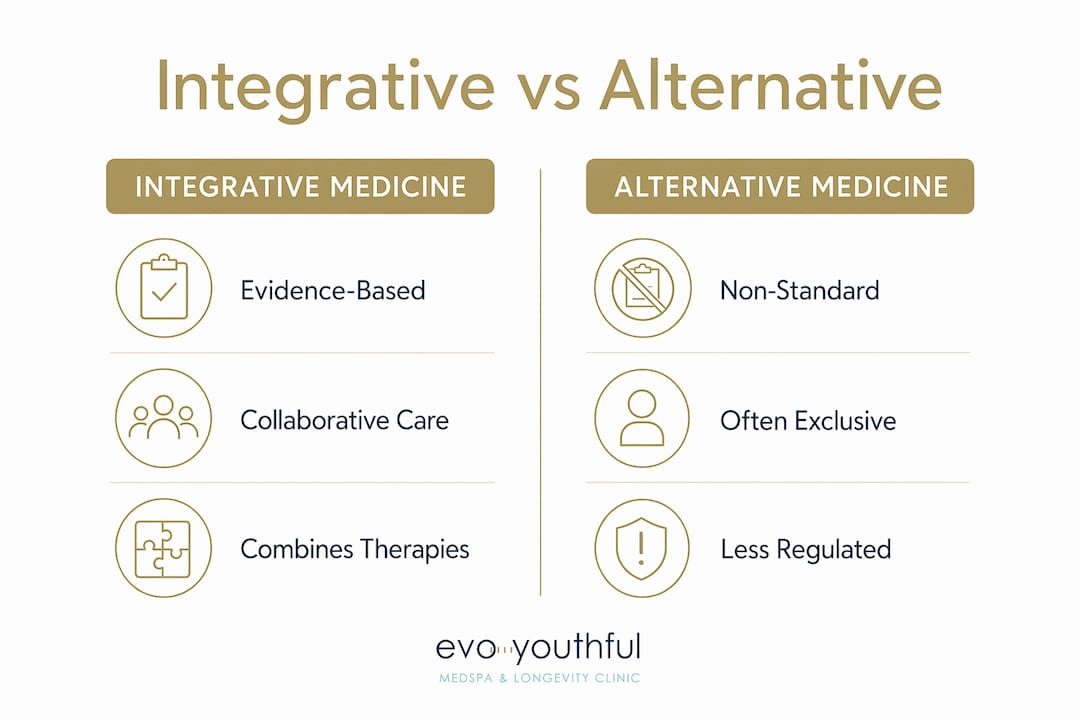
Alternative medicine is used instead of conventional treatment. Integrative medicine is used alongside it. That single word difference changes everything about how therapies are selected, tested, and monitored. Validated complementary practices within an integrative model are rigorously tested against conventional standards before they are recommended. An alternative approach may skip that vetting entirely.
Here is how the three models compare:
- Conventional medicine focuses on diagnosing and treating disease through pharmaceuticals, surgery, and standardized protocols. It excels at acute care but often addresses symptoms rather than root causes.
- Alternative medicine replaces conventional treatment with non-mainstream therapies. It carries higher risk when used for serious conditions because it bypasses evidence-based diagnosis and monitoring.
- Integrative medicine coordinates both worlds. It keeps the diagnostic rigor of conventional care while adding evidence-based complementary therapies that address the whole person.
Patient safety is the clearest argument for the integrative model. A person managing cancer, for example, benefits from chemotherapy guided by oncology while also receiving acupuncture for nausea and mindfulness training for anxiety. Replacing chemotherapy with herbs alone is alternative medicine. Using herbs and mindfulness to support chemotherapy outcomes is integrative medicine. The integrative medicine definition is grounded in that coordination, not in rejection of conventional care.
What are the proven benefits of integrative health care?
The benefits of integrative health are most clearly documented in chronic disease management, where conventional medicine alone often falls short of long-term improvement.
Coordinated, multi-modal care plans that combine nutrition, mental health support, and physical activity produce measurably better outcomes than isolated therapies. Research shows that integrated interventions can influence gene expression within months, increasing the activity of protective genes while decreasing inflammation-linked gene activity. That is not a wellness claim. That is a measurable biological shift.
| Condition | Integrative Approach | Documented Benefit |
|---|---|---|
| Type 2 Diabetes | Nutrition + movement + stress reduction | Improved glycemic control and reduced medication reliance |
| Parkinson’s Disease | Exercise + acupuncture + conventional medication | Improved motor function and quality of life |
| Depression | Mindfulness + therapy + medication when indicated | Reduced symptom severity and relapse rates |
| Chronic Pain | Physical therapy + mind-body techniques + medication | Lower pain scores and reduced opioid dependence |
Economic outcomes also support the model. Lifestyle interventions in integrative models can help prevent up to 75% of U.S. healthcare costs by addressing root causes rather than managing downstream symptoms. Fewer hospitalizations, reduced specialist visits, and lower pharmaceutical costs follow when patients address the conditions driving their chronic illness.
Success in integrative care depends on adherence to multi-modal, coordinated therapies targeting root causes, often requiring patient lifestyle changes and sustained engagement. Single interventions rarely produce lasting change. The model works because it stacks multiple evidence-based inputs simultaneously.
Pro Tip: Integrative care is not a quick fix. Patients who commit to the full plan, including nutrition changes, movement, and mental health support, see the strongest long-term results. Treat it as a sustained practice, not a one-time treatment.
How is integrative health care applied in practice?
Understanding what integrative health care looks like in a real clinical setting helps set accurate expectations and prepares you to get the most from it.
The first difference you will notice is time. Initial integrative consultations typically last 60–90 minutes, far longer than a standard primary care visit. Practitioners use that time to build a comprehensive health timeline covering not just symptoms but lifestyle habits, environmental exposures, emotional stressors, and social factors. That depth of history is what makes personalized care plans possible.
The process then follows what researchers call the three C’s of integrative care: communication, coordination, and collaboration. Each element plays a specific role:
- Communication means every provider on your care team shares information openly. Your nutritionist knows what your physician prescribed. Your mental health counselor understands your physical diagnoses.
- Coordination means your care plan is built as a unified strategy, not a collection of separate appointments. Therapies are sequenced and timed to reinforce each other.
- Collaboration means you are an active partner in the plan. You are not a passive recipient of instructions. You help shape the goals, report what is working, and adjust alongside your providers.
This shift from passive patient to active health partner is one of the most significant structural changes integrative care makes. It demands more from you, and it delivers more in return.
Fragmented healthcare systems are the primary barrier to this model. When specialists operate in silos and do not communicate, patients receive conflicting advice and redundant treatments. Integrative health care addresses fragmentation by building coordination into the structure of care itself, not leaving it to chance or patient initiative.
Pro Tip: Prepare a detailed health timeline before your first integrative appointment. Include past diagnoses, medications, supplements, major life stressors, and sleep patterns. The more context your provider has, the more precise your care plan will be.
Key takeaways
Integrative health care works because it coordinates evidence-based conventional medicine with complementary therapies, targeting root causes across mind, body, and lifestyle to produce outcomes that neither approach achieves alone.
| Point | Details |
|---|---|
| Clear definition matters | Integrative care combines conventional and complementary therapies; it does not replace standard medicine. |
| Three core components | Conventional medicine, complementary therapies, and lifestyle medicine form the foundation of integrative care. |
| Proven chronic disease benefits | Multi-modal plans improve outcomes in diabetes, Parkinson’s, depression, and chronic pain with documented biological changes. |
| The three C’s drive results | Communication, coordination, and collaboration between providers and patients are what make integrative care work. |
| Patient engagement is non-negotiable | Long-term adherence to the full care plan, not single interventions, determines success in integrative health. |
Why i think most people misread what integrative care actually demands
By Elizabeth Vogstrom, PA-C
Most patients come to integrative care expecting a gentler version of conventional medicine. They want fewer side effects and more natural options. That is a reasonable starting point, but it misses what makes this model genuinely different.
What I have observed in practice is that integrative care asks more of patients than conventional care does. A standard visit ends with a prescription and a follow-up date. An integrative plan ends with a nutrition protocol, a movement schedule, a stress management practice, and a set of follow-up labs. The patient carries real responsibility for outcomes. That is not a criticism. It is the mechanism.
The patients I see make the most progress are the ones who treat their care plan like a professional commitment. They track their sleep, they show up to their mindfulness sessions, and they communicate changes to their care team promptly. The ones who struggle tend to engage with one piece of the plan and expect it to carry the whole load.
The other misconception I encounter regularly is that integrative care is for people who distrust conventional medicine. That framing is backwards. The strongest integrative outcomes I have seen come from patients who fully embrace their conventional diagnoses and then ask what else can be done. They are not rejecting their physician’s recommendations. They are building on them.
If you are exploring brain health support or intimate wellness concerns, the integrative lens is worth understanding before you choose any single treatment. Knowing how therapies coordinate changes how you evaluate your options.
— Elizabeth Vogstrom, PA-C
Personalized integrative wellness at Evoyouthful
Evoyouthful brings integrative principles into clinical practice at its Wayzata, MN wellness clinic, combining regenerative therapies with personalized care plans designed around your full health picture.

If hormonal imbalance is affecting your energy, mood, or cognitive clarity, Evoyouthful’s bioidentical hormone replacement therapy addresses root causes using hormones that match your body’s natural chemistry. For patients exploring peptide therapy or cognitive support through ExoMind TMS, every treatment is coordinated within a broader wellness strategy rather than offered in isolation. Evoyouthful’s approach reflects the three C’s of integrative care: your providers communicate, your plan is coordinated, and you are a full partner in every decision. Schedule a consultation to build a care plan that treats you as a whole person.
FAQ
What is the integrative medicine definition in clinical terms?
Integrative medicine is an evidence-based, interdisciplinary approach that combines biomedical knowledge with complementary and lifestyle therapies to treat the whole person across biological, psychological, social, and behavioral dimensions. It is recognized by institutions including the WHO and Mayo Clinic as distinct from both conventional and alternative medicine.
How does integrative health care differ from conventional medicine?
Conventional medicine focuses on diagnosing and treating disease through pharmaceuticals and standardized protocols. Integrative health care keeps that diagnostic foundation and adds evidence-based complementary therapies and lifestyle interventions that address root causes and overall well-being.
What are the most common integrative health care practices?
The most common integrative health care practices include acupuncture, nutritional medicine, mindfulness-based stress reduction, physical movement therapies, and behavioral health counseling, all coordinated alongside conventional medical treatment.
How long does an integrative health care consultation typically take?
Initial integrative consultations typically last 60–90 minutes because practitioners need a comprehensive health history covering lifestyle, environment, emotional health, and symptoms to build an effective personalized care plan.
Is integrative health care covered by insurance?
Coverage varies widely by insurer and state. Some complementary therapies like acupuncture and nutritional counseling are increasingly covered, but many integrative services remain out of pocket. Checking with your specific plan before scheduling is the most reliable approach.
Recommended
- Intimate Wellness | Treatments in Wayzata, MN | evoyouthful Wayzata, MN
- Brain Health & Cognitive Function | Treatments in Wayzata, MN | evoyouthful Wayzata, MN
- Browse Concerns | Face, Body & Wellness Treatments | evoyouthful Wayzata, MN
- Hormone Imbalance | Treatments in Wayzata, MN | evoyouthful Wayzata, MN
Ready to Start?
Schedule a Consultation
Have questions about what you just read? Our team is here to help.