

Why High Earners Prioritize Wellness: The Strategic Case
Elizabeth Vogstrom, PA-C
evoyouthful Clinical Team
Discover why high earners prioritize wellness as strategic capital for better decision-making, longevity, and financial security in the face of illness.
Why High Earners Prioritize Wellness: The Strategic Case
High earners treat wellness as strategic capital because it preserves the cognitive and physical capacity that drives their income, gives them measurable control over biological outcomes, and functions as a hedge against the financial and personal costs of serious illness. Three forces shape this priority: health as an operating asset, biological self-determination, and proactive risk management. The AXA Longevity Mindset Study 2026 found that a large majority (85–94%) of respondents are actively investing in longevity-focused healthcare, with average annual spend at £9,793 in the UK, €11,100 in France, and €15,300 in Germany, signaling a structural shift, not a trend.
- Health as operating capital: Decision quality, stamina, and cognitive clarity are the raw materials of high-income performance.
- Biological control: Affluent individuals increasingly pay for agency over their own physiology through advanced diagnostics, personalized protocols, and specialist access.
- Risk management: Early detection and concierge access shorten time-to-treatment, reducing the probability that a health event derails a business, a career, or a family.
Table of Contents
- Why high earners prioritize wellness as a business asset
- How these motivations show up in daily routines and program choices
- Which clinical services do high earners most commonly seek?
- How to build a clinical wellness program: timelines and costs
- What should you ask when choosing a clinical wellness provider?
- A clinician’s perspective on designing programs for high earners
- Key Takeaways
- Our perspective at evoyouthful
- Useful sources and further reading
Why high earners prioritize wellness as a business asset
Each of the three drivers above changes how wealthy individuals spend, who they hire, and which clinical services they seek.
Health as operating capital is the most direct framing. Forbes describes a CEO’s health as the critical fuel powering every downstream decision in an organization, comparing it to the fissile material in a nuclear reaction: when it degrades, everything dependent on it degrades too. Executives who internalize this logic stop treating annual physicals as a checkbox and start treating biomarker panels, sleep scores, and VO2 max as performance metrics.
Biological control is the status shift that private banking has noticed most clearly. Julius Baer and Global Private Banker report that high-net-worth individuals are reallocating spending away from visible luxury goods toward longevity investments. The logic, as one luxury strategist put it, is that health is the one asset that makes every other luxury possible.
Risk management is where financial advisors are now paying attention. Fast Company frames it plainly: burnout erodes clarity, stress stifles innovation, and declining energy cuts productivity. Ignoring well-being while building wealth is one of the costliest decisions a leader can make. Private banks are responding by embedding healthspan planning into wealth advisory, treating longevity as a financial planning variable alongside estate and succession planning.
Pro Tip: The corporate wellness ROI data consistently shows that accountability structures, not exotic interventions, drive the largest gains. Before adding advanced therapies, confirm the fundamentals — sleep, strength training, and nutrition — are tracked and consistent.
How these motivations show up in daily routines and program choices
The three drivers translate into specific behaviors. Health-as-capital thinking produces dashboards: VO2 max testing, continuous glucose monitoring, and quarterly biomarker panels. Risk-management thinking produces cadence: scheduled advanced screenings rather than reactive appointments. Biological-control thinking produces teams: a coordinating clinician who aggregates data from specialists rather than leaving the patient to synthesize it alone.
Common program components among high earners include:
- Wearable biometric tracking (heart rate variability, sleep staging, activity load)
- Quarterly comprehensive biomarker panels covering hormones, metabolic markers, and inflammation
- Scheduled recovery blocks: massage, cold therapy, or structured deload weeks
- Concierge physician or PA-C as a central coordinator
- Annual or semi-annual full-body imaging and cardiovascular screening
- Wellness retreats used as reset points and protocol recalibration
HowMillionairesLive describes this as running wellness like an operation, with a standing roster of specialists and centralized data feeding coaching decisions. The clinic’s role is coordination and measurement, not just treatment delivery.
| Behavior | Driver | Adoption signal |
|---|---|---|
| Quarterly biomarker panels | Risk management / early detection | 85–94% actively investing in longevity-focused healthcare (AXA 2026) |
| Concierge / coordinating clinician | Health as operating capital | Private banking embedding healthspan in wealth plans |
| Cross-border care access | Biological control / specialist access | Measurable share seeking longevity care abroad (AXA 2026) |
| Bundled membership programs | Convenience and accountability | Membership models bundling testing, coaching, and recovery |

Which clinical services do high earners most commonly seek?
The categories high earners prioritize span prevention, optimization, and repair. The clinical intent behind each is distinct, and understanding that distinction helps you choose where to start.
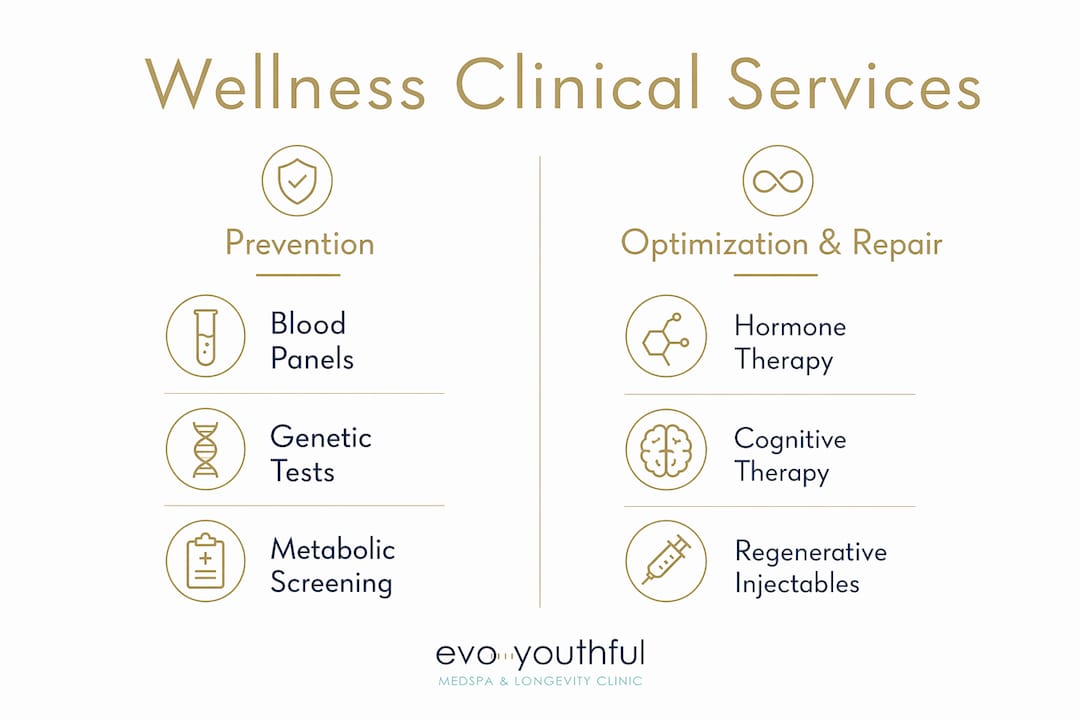
Advanced diagnostics form the foundation: comprehensive blood panels, genetic analysis, metabolic testing, and cardiovascular screening. The goal is detecting early signals of disease before symptoms appear, sometimes decades ahead of a traditional clinical presentation.
Bioidentical hormone replacement therapy (BHRT) addresses symptomatic hormonal deficits and testosterone optimization. Measurement is straightforward: baseline labs, symptom tracking, and follow-up panels at defined intervals. evoyouthful’s BHRT program follows this protocol, using lab-guided dosing to restore balance rather than guessing.
Cognitive therapies, including TMS-based treatments like ExoMind, target cognitive resilience, mood regulation, and neural performance. For executives under sustained pressure, maintaining decision-making capacity is as important as physical fitness.
Regenerative injectables such as PRF injections use the body’s own growth factors to support tissue repair and skin renewal. These sit firmly in the evidence-based category, with measurable outcomes tracked over treatment cycles.
Body composition and sculpting programs address metabolic health and muscle preservation, both of which correlate with long-term healthspan. Emsculpt NEO is one example of a non-surgical option that builds muscle and reduces fat simultaneously.
Genomic and nutrigenomic testing personalizes nutrition and supplementation to an individual’s genetic profile. evoyouthful offers nutrigenomics DNA testing as part of its optimization pathway.
A note on experimental vs. evidence-based care: the most effective programs distinguish clearly between interventions with strong clinical evidence and those that are exploratory. Ask your provider which category each recommended therapy falls into, and what the measurement criteria are for success.
How to build a clinical wellness program: timelines and costs
A well-designed clinical wellness program moves through four phases. Rushing past the baseline phase is the most common mistake.
- Weeks 0–2: Baseline diagnostics. Comprehensive labs, hormone panels, cardiovascular screening, body composition, and cognitive baseline. This data drives every subsequent decision.
- Months 1–3: Initial interventions. Targeted therapies begin based on baseline findings — BHRT, peptide therapy, sleep protocols, or cognitive support as indicated.
- Months 3–12: Optimization and measurement. Follow-up panels confirm response. Protocols are adjusted. VO2 max, sleep scores, and biomarker trends are tracked against defined targets.
- Annually: Deep diagnostic review. Full reassessment, imaging where indicated, and protocol recalibration for the next year.
The major cost drivers are specialist time and concierge access, advanced diagnostics, regenerative procedures, and maintenance visit frequency. Proactive wellness consistently costs less over a decade than reactive treatment for conditions that early detection would have caught. A meaningful share of high earners also factor in travel costs when accessing specialists or diagnostics not available locally, a pattern the AXA Longevity Mindset Study 2026 documents across multiple countries.
One planning gap worth noting: many affluent individuals are diligent about daily wellness but fewer integrate it with long-term care or financial planning for longevity. Building an annual review cadence with both your clinician and your financial advisor closes that gap.
What should you ask when choosing a clinical wellness provider?
Prioritize clinics that demonstrate measurable protocols, board-level medical oversight (MD or DO), credentialed staff including PA-Cs and RNs, and transparent outcomes reporting. Credentials matter, but so does the culture of measurement.
Questions to ask at your first consultation:
- What baseline tests do you run before recommending any therapy?
- Who coordinates my care across specialists, and how is that data centralized?
- What are the measurable goals for each intervention, and over what timeline?
- What are your complication rates for the procedures you recommend most often?
- How do you distinguish evidence-based therapies from experimental ones in your protocols?
Red flags to watch for: vague outcome claims with no measurement criteria, reluctance to disclose staff credentials or complication rates, and high-pressure upsells during an initial consultation. A clinic confident in its protocols welcomes your questions.
Credential signals to look for include concierge medicine access or a coordinating clinician model, published or clearly described protocols, and explicit informed-consent practices that explain both benefits and risks before any procedure begins.
A clinician’s perspective on designing programs for high earners
At evoyouthful, the approach to high-earner wellness programs starts with one principle: measure first, treat second. Elizabeth Vogstrom, PA-C, leads clinical programming with a team-based model that mirrors the coordination structure high earners already use in their businesses.
The typical pathway begins with a comprehensive diagnostic intake, moves into targeted therapies matched to lab findings and patient goals, and is governed by a defined monitoring schedule. No protocol is static. Results at the three-month mark reshape the next phase.
Safety and evidence standards are non-negotiable in this work. The most sophisticated clients are also the most vulnerable to expensive interventions with thin evidence bases. Part of our role is helping people distinguish between what is clinically supported and what is, as one expert put it, “luxury theatre.” The fundamentals — sleep, strength, nutrition, hormonal balance — remain the highest-return interventions. Advanced therapies amplify a strong foundation; they do not replace one.
Key Takeaways
High earners prioritize wellness because it preserves the cognitive and physical capacity that generates their income, gives them measurable control over biological outcomes, and reduces the financial risk of preventable illness.
| Point | Details |
|---|---|
| Health as operating capital | Cognitive clarity and stamina are performance inputs; track them like business metrics. |
| Biological control drives spending | Affluent individuals pay for agency: advanced diagnostics, specialist access, and personalized protocols. |
| Risk management is the financial frame | Early detection and concierge access reduce time-to-treatment and protect income continuity. |
| Measure before you treat | Baseline diagnostics in weeks 0–2 determine every subsequent clinical decision. |
| Fundamentals deliver the highest ROI | Sleep, strength, nutrition, and hormonal balance outperform exotic interventions without a strong foundation. |
Our perspective at evoyouthful
What we see consistently is that the most successful programs are the least dramatic. The clients who arrive with a clear set of labs, a defined list of goals, and realistic timelines tend to get the best results. Bring your most recent bloodwork, a short list of what you want to improve (energy, cognition, body composition, hormonal balance), and any constraints on your schedule or travel. That information lets us build a program that fits your life, not a generic protocol.

If you are ready to start, evoyouthful’s clinical team in Wayzata, MN is available for an initial consultation. Explore our full treatment menu to see which services align with your goals before your first visit.
This article is general health information, not medical advice. Consult a qualified clinician and review current clinical guidelines for your individual situation.
Useful sources and further reading
- AXA Longevity Mindset Study 2026 — Cross-country data on longevity spending and adoption rates among affluent individuals.
- Forbes: Why Smart CEOs Treat Their Health Like a Corporate Balance Sheet — Leadership framing connecting executive health to organizational performance.
- Global Private Banker: The Wealthy Are Spending Less on Status — Private banking perspective on the structural shift from luxury goods to longevity investment.
- Fast Company: A Wealth Journey Without Health Is a Risky Venture — Business-leader framing of health neglect as financial risk.
- Muscle & Fitness: Longevity Is the New Luxury — Cultural and market signals on the status shift to biological control.
- evoyouthful clinic blog — Clinic-level education on diagnostics and root-cause optimization.
- For clinical efficacy of specific interventions (TMS, BHRT, peptide therapy), consult peer-reviewed sources via PubMed and the NIH National Library of Medicine.
Recommended
Ready to Start?
Schedule a Consultation
Have questions about what you just read? Our team is here to help.