

Resilience Medicine for Patients: What to Expect
Elizabeth Vogstrom, PA-C
evoyouthful Clinical Team
Discover what resilience medicine is and how it empowers patients to adapt and thrive amid health challenges. Embrace better care today!
Resilience Medicine for Patients: What to Expect
Resilience medicine is a clinical approach that helps patients strengthen their capacity to absorb, adapt to, and transform in response to health stressors. Whether you are managing a chronic condition, recovering from intensive treatment, or noticing that your body is not bouncing back the way it once did, this approach focuses on building functional capacity rather than simply suppressing symptoms. The Resilience in Healthcare (RiH) research program, the American Psychological Association, and clinics like evoyouthful in Wayzata, MN have each contributed to shaping how this framework is applied in real patient care.
Table of Contents
- What is resilience medicine, and what does it mean clinically?
- How does resilience medicine differ from other approaches?
- What treatments are typically included in a resilience medicine plan?
- What does the evidence say, and what are the realistic limits?
- Who is a good candidate, and what safety checks should you expect?
- What does the patient timeline and cost look like?
- How do you choose a responsible provider?
- Key Takeaways
- A clinician’s perspective on why resilience framing matters
- Ready to explore resilience-focused care at evoyouthful?
- Useful sources and further reading
What is resilience medicine, and what does it mean clinically?
Clinically, resilience is defined as the capacity to maintain high-quality functioning by absorbing shocks, adapting resources, and transforming care systems when needed. The RiH program describes three distinct processes that guide how patients and care teams respond to stressors:
| Process | What it means | Clinical example |
|---|---|---|
| Absorption | Withstanding a stressor without losing core function | Maintaining daily activity during early-stage chemotherapy |
| Adaptation | Reallocating resources and adjusting strategies | Shifting from high-intensity exercise to physical therapy after joint surgery |
| Transformation | Innovating or restructuring care to sustain long-term function | Redesigning a care plan after a patient develops medication intolerance |
Core principles that guide resilience-based treatment include:
- Values-driven care: Treatment goals align with what matters most to you personally, not just what reduces a lab value.
- Dynamic, processual view: Resilience is not a fixed trait — it can be built, lost, and rebuilt depending on circumstances and supports.
- Multilevel support: Effective plans address both individual self-care and system-level factors like care coordination and access.
- Functional measurement: Progress is tracked through how well you function day to day, not only through symptom counts.
How does resilience medicine differ from other approaches?
Psychotherapy focuses primarily on mental health disorders and psychological skill-building. Resilience medicine integrates medical interventions, regenerative therapies, and system-level supports alongside behavioral strategies. A patient working through grief or anxiety benefits from psychotherapy. A patient whose hormonal imbalances, chronic fatigue, and cognitive fog are compounding each other benefits from a resilience medicine plan that addresses all three simultaneously.

“Resilience training” programs — workplace wellness seminars, mindfulness apps, stress-reduction courses — are educational and self-directed. Clinically supervised resilience medicine goes further: it includes medical assessment, prescribed treatments, and coordinated monitoring by a licensed provider team.
Vitality or anti-aging medicine shares some tools with resilience medicine but centers on longevity optimization and cosmetic goals. Resilience medicine centers on functional adaptation during or after a stressor. You can read more about how these frameworks compare in this vitality medicine overview.
Two illustrative pathways:
- A patient completing cancer therapy needs absorption and adaptation support: fatigue management, hormonal restoration, cognitive support, and coordinated follow-up care.
- A patient seeking anti-aging optimization with no acute stressor is a better fit for a vitality or longevity program focused on prevention and performance.
What treatments are typically included in a resilience medicine plan?
Resilience medicine draws from a broad toolkit. The specific combination depends on your presenting concerns, medical history, and goals.
Medical and regenerative interventions:
- Bioidentical hormone replacement therapy (BHRT): Restores hormonal balance disrupted by illness, aging, or treatment. Particularly relevant for patients experiencing fatigue, mood changes, or cognitive decline.
- Peptide therapy: Supports tissue repair, immune function, and metabolic recovery at the cellular level.
- PRF (platelet-rich fibrin) injections: Use your body’s own growth factors to support tissue healing and regenerative processes.
- ExoMind cognitive support: Addresses neural and cognitive function for patients experiencing brain fog, memory concerns, or post-treatment cognitive changes. Learn more about ExoMind cognitive support at evoyouthful.
Behavioral and clinical supports:
- Structured physical rehabilitation and exercise prescription
- Sleep optimization protocols
- Nutrition guidance, including nutrigenomics-informed approaches
- Occupational therapy for functional recovery
Systems-level supports: Care continuity and coordination across your care team matter as much as any single treatment. Multidisciplinary case management, specialist communication, and community support resources all contribute to a resilient care plan.
What does the evidence say, and what are the realistic limits?
The evidence base for resilience medicine is growing but still maturing. A meta-synthesis of physician resilience reviewed nine qualitative studies with approximately 450 participants and identified six recurring themes: tenacity, resources, reflective ability, coping skills, control, and growth. A scoping review published in PMC found that coping is consistently the central feature of resilience across healthcare professions, with personal, organizational, and environmental factors all contributing.
Measuring outcomes is genuinely difficult. Resilience interventions often produce functional and process-oriented results — better daily functioning, improved quality of care, greater adaptability — rather than a single biomarker shift. That makes standard clinical trial designs a poor fit.
Realistic outcomes patients can expect:
- Improved tolerance of ongoing or future medical treatments
- Greater functional capacity in daily activities
- Better coordination across your care team
- Stronger self-management skills and awareness of personal limits
Important limits to understand:
- Resilience medicine is not a cure for underlying disease.
- Resilience varies across disease stages — what helps in early chronic illness differs from what helps in advanced or palliative stages.
- Placing the entire burden of resilience on individual self-care, while ignoring system-level barriers, is a recognized pitfall. Effective programs address both.
Who is a good candidate, and what safety checks should you expect?
Patients who tend to benefit most include those managing chronic multi-system conditions (such as autoimmune disorders, hormonal imbalances, or post-viral fatigue), those recovering from major medical treatment, and those experiencing functional decline who want coordinated, personalized care rather than fragmented specialist visits.
Red flags that require traditional specialist or urgent care first:
- Active, unstabilized acute illness or medical emergency
- Undiagnosed symptoms that need diagnostic workup before wellness interventions
- Psychiatric crises requiring immediate mental health intervention
Safety checks you should expect before starting:
- Comprehensive medical history review and physical assessment
- Medication reconciliation to identify interactions with planned therapies
- Clear, written monitoring plan with defined check-in intervals
- Informed consent that outlines expected benefits, risks, and alternatives
- Coordination plan with your existing primary care or specialist team
Organizational supports within the clinic — not just individual clinician skill — are a meaningful predictor of how well a resilience program functions. Ask about the team structure, not just the individual provider.
What does the patient timeline and cost look like?
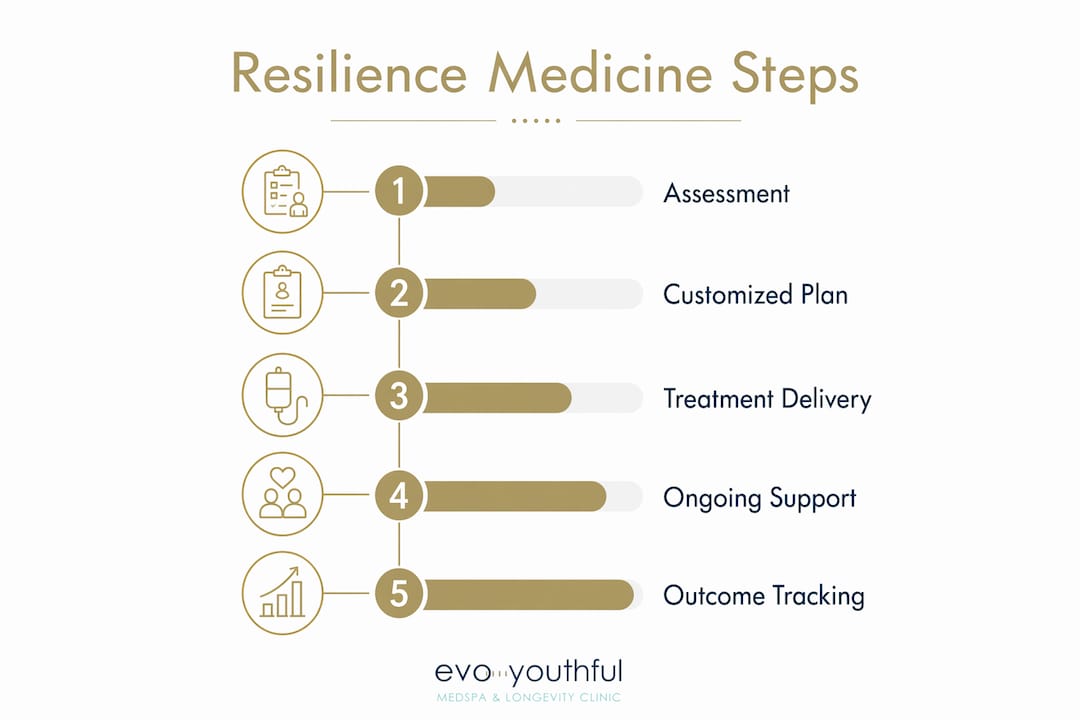
| Phase | Typical focus | Timeframe |
|---|---|---|
| Assessment | Medical history, labs, functional baseline | — |
| Personalized plan | Goal-setting, treatment selection, coordination | — |
| Treatment phase | Active interventions, behavioral supports | — |
| Monitoring and adjustment | Outcome review, plan refinement | Ongoing |
Clinicians typically track functional measures, symptom trajectories, and patient-reported outcomes. Check-ins often occur monthly during the active treatment phase, then quarterly once stability is established.
Cost considerations: Most regenerative and wellness services within a resilience plan are billed out-of-pocket, as insurance coverage for integrative therapies varies widely. Some components — lab work, specialist referrals, certain therapies — may be partially covered. Always request a clear cost breakdown before starting. Practical scheduling guidance is available through evoyouthful’s patient resources.
At-home tracking tips:
- Keep a brief daily log of energy, sleep quality, and functional capacity.
- Note any new symptoms or changes in medication response.
- Contact your care team promptly if you experience unexpected side effects or a significant functional decline.
How do you choose a responsible provider?
Credentials to look for:
- Licensed medical provider (MD, DO, PA-C, NP) leading the clinical plan
- Multidisciplinary team with access to behavioral health, physical rehab, and nutrition support
- Clear documentation practices and specialist communication protocols
Questions to ask in a consultation:
- How do you assess my baseline functional capacity before recommending treatments?
- How will you coordinate with my existing specialists?
- What measurable goals will we set, and how often will we review them?
- What are the realistic risks and benefits of each proposed intervention?
- What is the full cost, and what is covered by insurance?
Red flags to avoid:
- Promises of rapid, dramatic results with no defined timeline or measurable goals
- No coordination with your primary care provider
- Pressure to commit to a full package before completing a thorough assessment
Pro Tip: Ask the clinic for an example of how they track functional outcomes for a patient with a condition similar to yours. A provider who can describe specific measures — not just general wellness language — is demonstrating genuine clinical follow-through.
Key Takeaways
Resilience medicine works by combining medical, behavioral, and system-level supports to help patients absorb, adapt to, and transform in response to health stressors — with functional capacity, not symptom suppression, as the primary measure of success.
| Point | Details |
|---|---|
| Core definition | Resilience medicine builds your capacity to absorb, adapt to, and transform in response to health stressors. |
| Who benefits most | Patients with chronic multi-system conditions, post-treatment recovery needs, or functional decline benefit most from coordinated resilience plans. |
| Evidence and limits | Evidence is growing but primarily qualitative; resilience medicine is not a cure and works best when individual and system-level supports are combined. |
| Choosing a provider | Look for a licensed multidisciplinary team with measurable goals, specialist coordination, and transparent costs. |
| evoyouthful | evoyouthful in Wayzata, MN offers regenerative and integrative services — including BHRT, ExoMind, and peptide therapy — within a coordinated, patient-centered care model. |
A clinician’s perspective on why resilience framing matters
Most patients arrive having already tried the single-problem, single-solution approach — one medication, one specialist, one symptom at a time. What they often describe is a sense of fragmentation: each provider addresses their piece, but no one is looking at the whole picture. Resilience medicine is compelling precisely because it reframes the clinical question. Instead of asking “what is wrong?” it asks “what does this patient need to function well despite what is wrong?” That shift changes everything about how a care plan is built. It means honoring what matters to the patient, not just what is measurable on a lab panel. It means building in system-level supports — coordination, continuity, access — not just prescribing another intervention. And it means being honest that resilience is not a destination. It is a capacity that requires ongoing attention, adjustment, and, sometimes, a willingness to change the plan entirely when circumstances shift.
Ready to explore resilience-focused care at evoyouthful?
evoyouthful is a regenerative and wellness clinic in Wayzata, MN that brings together the medical, behavioral, and system-level supports that resilience medicine requires. Services include bioidentical hormone replacement therapy, ExoMind cognitive support, PRF injections, and peptide therapy — each integrated into a personalized plan built around your functional goals, not a one-size-fits-all protocol.

If you are ready to move beyond fragmented care and build a plan that addresses your whole picture, schedule a consultation with the evoyouthful team. You can also review patient outcome data and resources to understand what evidence-informed resilience care looks like in practice. Call the clinic or book online to take your next step.
Useful sources and further reading
- Resilience in Healthcare — RiH program definition: The foundational source for the absorb/adapt/transform framework used throughout this article.
- PMC — “Not a panacea”: resilience in palliative care: Expert perspectives on the limits of resilience as a concept and the importance of individualized, values-driven implementation.
- PMC — Physician resilience meta-synthesis: Qualitative synthesis of nine studies identifying six themes of clinician resilience; useful for understanding evidence levels.
- PMC — Healthcare resilience scoping review: Broad review of resilience features across healthcare professions, with coping as the central finding.
- University of Washington — Resilience in Medicine monograph: Practical, values-centered framework for resilience in clinical and educational settings.
- UK DFID/NIHR — Health systems resilience brief: Policy-level principles for system flexibility and intersectoral coordination, applicable to understanding system-level supports in patient care.
Recommended
Ready to Start?
Schedule a Consultation
Have questions about what you just read? Our team is here to help.