

What Is Precision Health Care? A Clear Guide
Elizabeth Vogstrom, PA-C
evoyouthful Clinical Team
Discover what precision health care is and how it personalizes treatment for better disease prevention and long-term wellness.
What Is Precision Health Care? A Clear Guide
Precision health care is a personalized medical approach that uses your genetic makeup, lifestyle habits, and environmental exposures to predict, prevent, and treat disease before it takes hold. Unlike traditional medicine, which applies the same treatment to every patient with a similar diagnosis, precision health tailors care to the individual. The National Council on Aging defines it as a contrast to “one-size-fits-all” care, focusing instead on early detection, targeted prevention, and long-term wellness. Tools like genomic testing, wearable health monitors, and big data analytics make this level of personalization possible today.
What is precision health care and how does it work?
Precision health care is defined as a person-centered framework that integrates genetic data, environmental exposure history, and daily lifestyle patterns to guide medical decisions. Stanford Medicine describes it as moving beyond treatment to predictive, personalized care. The goal is to identify your risk for a condition years before symptoms appear, then act on that information with targeted interventions.
The process starts with data collection. Clinicians gather information from multiple sources: your DNA, your medical history stored in electronic health records, your diet and activity patterns, and even the toxins or stressors you are regularly exposed to. Big data analytics then process this information to generate evidence-based predictions specific to you. That is what separates precision health from a standard annual physical.

The result is a care plan built around your biology, not a population average. If your genomic profile shows elevated risk for cardiovascular disease, your provider does not wait for a cardiac event. They adjust your nutrition, prescribe targeted monitoring, and intervene early. This proactive model is the defining feature of the precision healthcare approach.
Key components and tools used in precision health care
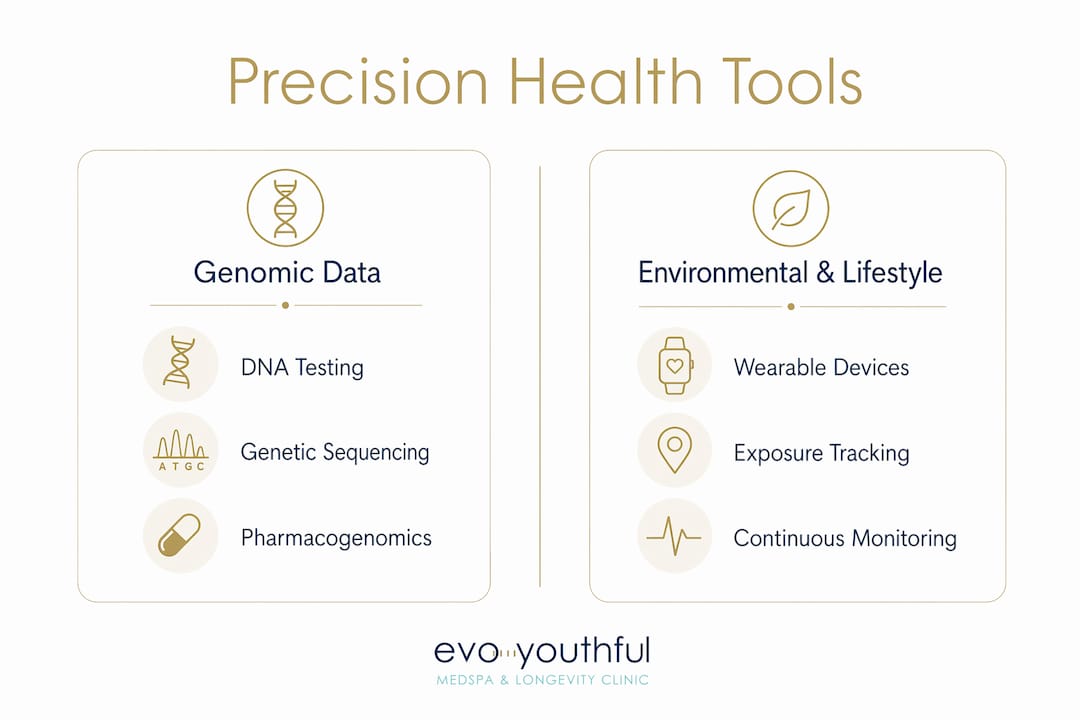
Precision health care draws on several distinct data types and technologies working together. Understanding each one helps clarify why this approach produces more accurate results than conventional screening alone.
- Genomic and omics-level data: Your DNA sequence reveals inherited disease risks. Broader “omics” data, including proteomics and metabolomics, shows how your genes are actually expressing themselves in real time.
- Exposome data: The Precision Health Model integrates omics profiles with exposome data, which captures every environmental exposure you have had across your lifetime, from air quality to occupational chemicals to chronic stress.
- Electronic health records (EHRs): Longitudinal health records provide the clinical context that makes genomic data meaningful. A genetic variant means something different in a patient with a 20-year history of hypertension than in a healthy 30-year-old.
- Wearables and digital health monitors: Devices like continuous glucose monitors, smartwatches with ECG capability, and sleep trackers feed real-time physiological data into your health profile.
- Big data analytics platforms: These tools identify patterns across thousands of data points that no single clinician could process manually.
Pro Tip: A one-time genetic test gives you a snapshot. True precision health programs use continuous risk monitoring that updates your biomarker data over time, adjusting your care plan as your biology and environment change.
The combination of omics-level data and exposome factors explains why lifestyle and environment matter just as much as genetics. Two people with identical DNA can have very different health outcomes based on where they live, what they eat, and how much chronic stress they carry.
How does precision health care differ from precision medicine?
These two terms are often used interchangeably, but they describe different priorities. The distinction matters when you are deciding what kind of care to seek.
| Concept | Primary Focus | Timing | Key Tools |
|---|---|---|---|
| Precision health care | Prediction and prevention | Before disease onset | Genomics, wearables, exposome data |
| Precision medicine | Treatment and diagnosis | After disease is present | Genomic sequencing, targeted therapies |
| Personalized medicine | Broad individualized care | Both prevention and treatment | Patient history, genetics, preferences |
Precision medicine, as defined by the NIH’s National Human Genome Research Institute, uses individual genomic, environmental, and lifestyle data primarily to guide treatment and diagnosis. It is a subset of the broader precision health concept. Precision medicine asks: “Given this patient’s biology, what is the best drug or therapy?” Precision health asks: “Given this person’s biology, how do we keep them from getting sick in the first place?”
Personalized medicine is the oldest of the three terms. It describes any care that accounts for individual patient differences, including preferences, values, and history. It overlaps with both precision health and precision medicine but lacks the specific emphasis on omics data and predictive modeling.
Stanford Medicine emphasizes that precision health is more than personalized medicine. It represents a fundamental shift in how the healthcare system is organized, moving from reactive treatment to proactive prediction across an entire lifespan.
What are the real-world benefits of precision health care?
The practical benefits of precision health care show up most clearly in four areas: early detection, tailored treatment, chronic disease management, and long-term wellness planning.
-
Early disease risk detection. Genomic testing can identify elevated risk for conditions like hereditary breast cancer, type 2 diabetes, or Alzheimer’s disease decades before symptoms appear. That lead time makes prevention possible rather than just treatment.
-
Tailored treatment plans. When a diagnosis does occur, precision health data helps clinicians choose the right intervention for your specific biology. Pharmacogenomic testing, for example, shows which medications your body metabolizes efficiently and which ones are likely to cause side effects.
-
Chronic condition management. Patients living with conditions like heart disease or autoimmune disorders benefit from survivorship plans built around their individual biomarker profiles. Wearable devices can detect early warning signs, like irregular heart rhythms, before a crisis develops.
-
Informed wellness planning. Knowing your genetic blueprint for health lets you make nutrition, exercise, and lifestyle choices that align with your actual biology rather than generic public health guidelines.
-
Insurance and coverage trends. Coverage for genomic testing and related precision health tools is expanding as clinical evidence accumulates. Many major insurers now cover specific genetic panels for cancer risk assessment.
Pro Tip: Ask your provider whether your health plan covers pharmacogenomic testing. This single test can prevent years of trial-and-error medication adjustments and reduce the risk of adverse drug reactions.
Wearable technology is one of the most accessible entry points into precision health care. Devices that track heart rate variability, blood oxygen levels, and sleep architecture give you and your provider a continuous stream of data that a once-a-year checkup simply cannot match. This connects directly to the integrative health care model, which combines conventional and data-driven approaches for whole-person wellness.
What challenges and ethical concerns come with precision health care?
Precision health care carries real promise, but it also raises legitimate concerns that patients and providers need to address directly.
- Genetic data privacy. Your genomic data is the most personal information that exists. The Harvard Law Petrie-Flom Center notes that current frameworks lack comprehensive genomic privacy protections, leaving gaps that existing health privacy laws do not fully cover.
- Lack of diversity in genomic databases. Most large genomic datasets have historically overrepresented people of European ancestry. This means predictive models built on those datasets are less accurate for patients from other backgrounds, creating a real equity gap.
- Consent and data governance. Patients need to understand exactly how their genetic and health data will be stored, who can access it, and how long it will be retained. Implementing precision health requires explicit genomic data governance including consent processes, access controls, and risk mitigation beyond simple de-identification.
- Regulatory evolution. Oversight frameworks for genomic data and AI-driven health tools are still catching up to the technology. Patients should ask providers which regulatory standards their platforms meet.
- Equitable access. Advanced genomic testing and continuous monitoring tools remain expensive. Without deliberate policy and pricing changes, precision health care risks becoming a benefit available only to those who can afford it.
“The promise of precision health depends entirely on whether we build the governance structures to protect the data that makes it possible.” — Harvard Law Petrie-Flom Center, 2026
These challenges do not diminish the value of precision health care. They define the work that clinicians, researchers, and policymakers need to do to make it safe and equitable for everyone.
Key Takeaways
Precision health care delivers its greatest value when genetic, environmental, and lifestyle data are continuously monitored and used to prevent disease before symptoms appear.
| Point | Details |
|---|---|
| Core definition | Precision health tailors prevention and treatment to your genetics, lifestyle, and environment. |
| Prevention over treatment | The approach predicts and prevents disease rather than waiting to treat it after diagnosis. |
| Key tools | Genomic testing, wearables, EHRs, and big data analytics form the foundation of precision health. |
| Distinct from precision medicine | Precision medicine focuses on treating existing disease; precision health focuses on preventing it. |
| Ethical safeguards required | Genomic data governance, diversity in datasets, and equitable access are active challenges to address. |
What I’ve learned from watching patients shift to proactive health
I have worked with patients long enough to see the difference between those who manage their health reactively and those who engage with it proactively. The reactive group shows up when something hurts. The proactive group shows up with questions, data, and a genuine interest in understanding their own biology.
Precision health care gives that second group a real framework. What strikes me most is how often patients are surprised by what their data reveals. A person who feels perfectly fine discovers a metabolic pattern that, left unaddressed, would have led to a serious diagnosis in five years. That early warning is not frightening. It is freeing.
The technology matters, but the human conversation around it matters more. A wearable device that tracks your heart rate variability is only useful if you and your provider know how to interpret the trend and act on it. I have seen patients collect months of data and never discuss it with anyone. That is a missed opportunity.
The shift I encourage every patient to make is from annual checkups to continuous engagement. You do not need to become obsessed with your health data. You need to check in regularly, ask good questions, and work with a provider who treats your numbers as a story about your specific biology, not a comparison to a population average. That is what precision health care actually looks like in practice.
— Elizabeth Vogstrom, PA-C
Precision health care at evoyouthful in Wayzata, MN
evoyouthful applies precision health care principles across its treatments, starting with the data that matters most to your biology.
The Nutrigenomics DNA testing program at evoyouthful reads your genetic blueprint to guide nutrition, supplementation, and lifestyle recommendations specific to your body. For patients managing cognitive health, ExoMind advanced neural support integrates personalized biological profiles to support brain function. Hormone balance is addressed through bioidentical hormone replacement therapy, a treatment that aligns directly with precision health principles by calibrating therapy to your individual hormone profile rather than a standard protocol. Peptide therapy rounds out the longevity-focused offerings for patients who want targeted cellular support. Schedule a consultation at evoyouthful to build a care plan grounded in your unique data.
FAQ
What is the simplest definition of precision health care?
Precision health care is a personalized approach that uses your genetics, lifestyle, and environment to predict and prevent disease before it starts, rather than treating it after diagnosis.
How is precision health different from regular preventive care?
Regular preventive care applies population-level guidelines to everyone. Precision health uses your individual genomic and biomarker data to create a prevention plan specific to your biology.
What data does precision health care use?
Precision health programs draw on genomic sequencing, electronic health records, wearable device data, and environmental exposure history to build an individual health profile.
Is genomic data safe to share with health providers?
Current legal frameworks do not fully cover genomic privacy, so patients should ask providers about specific data governance policies, consent processes, and access controls before sharing genetic information.
Can precision health care help with hormone imbalances?
Yes. Precision health principles apply directly to hormone management. Bioidentical hormone therapy, for example, uses individual lab data to calibrate treatment rather than applying a standard dose to every patient.
Recommended
- What Is Integrative Health Care: A Complete Guide | evoyouthful Blog
- Brain Health & Cognitive Function | Treatments in Wayzata, MN | evoyouthful Wayzata, MN
- Browse Concerns | Face, Body & Wellness Treatments | evoyouthful Wayzata, MN
- Boutique Medical Clinic Evaluation Guide for 2026 | evoyouthful Blog
Ready to Start?
Schedule a Consultation
Have questions about what you just read? Our team is here to help.