
What Is the Role of DHEA in Hormone Balance?
Elizabeth Vogstrom, PA-C
evoyouthful Clinical Team
Discover how DHEA influences hormone balance and explore its potential benefits, including libido and muscle maintenance, with expert guidance.
What Is the Role of DHEA in Hormone Balance?
DHEA is a steroid pro-hormone made mostly in your adrenal glands whose main job is supplying raw material that tissues throughout your body convert into androgens and estrogen. It doesn’t act like a finished hormone itself. Instead, it acts more like a supply chain: production drops significantly between age 20 and age 60, and a 2025 meta-analysis found that supplementing it can measurably raise estradiol and testosterone, especially at higher doses. Whether that translates into something you’ll actually feel is a different question, and one worth working through with a clinician like Elizabeth Vogstrom, PA at evoyouthful before you start.
Here’s the quick version of what the evidence actually shows:
- Possible modest gains in libido, vaginal comfort, and muscle maintenance for some people
- Clinical trial results are mixed and inconsistent across mood, cognition, and bone outcomes
- Real safety flags exist: hormone-sensitive cancers, cholesterol shifts, and blood sugar effects among them
Key Takeaways
DHEA functions as a hormone precursor whose tissue-level effects depend on local conversion, not blood levels alone, which is why supervised testing matters more than the supplement itself.
| Point | Details |
|---|---|
| DHEA is a precursor, not a hormone | Peripheral tissues convert it into androgens or estrogens locally, so blood levels don’t predict individual response. |
| Decline is steep with age | Production drops significantly from age 20 to age 60, a pattern known as adrenopause. |
| Evidence is strongest for one use | Intravaginal DHEA has the clearest data for genitourinary syndrome of menopause. |
| Dose changes the risk profile | Doses of 50 mg per day or higher raise estradiol and testosterone more, and raise side-effect risk alongside it. |
| Supervised testing beats self-prescribing | evoyouthful offers functional hormone testing and individualized BHRT planning with Elizabeth Vogstrom, PA. |
Table of Contents
- How DHEA Works: Production, Decline, and Peripheral Conversion
- What Do Clinical Studies Say About DHEA’s Benefits?
- Who Should Avoid DHEA, and What Are the Risks?
- What Dose of DHEA Is Typical, and How Should It Be Monitored?
- How Do You Decide Whether to Try DHEA?
- A Clinical Perspective on DHEA and Vitality
- Ready to Get Your Hormones Tested Properly?
- Sources
How DHEA Works: Production, Decline, and Peripheral Conversion
Your body makes DHEA primarily in the adrenal cortex’s zona reticularis, with smaller contributions from the ovaries, testes, and even brain tissue. Most of it circulates as DHEA-S, a sulfated, more stable version that acts as a reservoir your tissues draw from as needed, according to research on DHEA/DHEA-S mechanisms.
Levels peak in your twenties, then decline steadily. That decline matters more after menopause, when DHEA becomes a larger share of the raw material your body has left for making estrogen.
What happens next is where DHEA gets interesting. Enzymes like aromatase, 17β-HSD, and 5α-reductase sit inside individual tissues, including skin, fat, and brain, and convert DHEA locally into either androgens or estrogens depending on which enzymes that particular tissue expresses. This is called intracrine conversion, and it’s why:
- Two people with identical blood DHEA levels can have completely different tissue-level hormone activity
- Serum DHEA or DHEA-S testing alone can’t reliably predict how your body will respond to supplementation
- DHEA behaves nothing like standard bioidentical hormone replacement, which delivers a specific hormone directly rather than a precursor
Clinical researchers often describe DHEA as a pro-hormone rather than a direct replacement, precisely because peripheral tissues decide what to make of it. That intracrine autonomy is what makes outcomes so individual.
Pro Tip: Because peripheral conversion happens locally, intravaginal DHEA can deliver benefit right where genitourinary symptoms show up, with far less of the compound reaching your bloodstream than an oral dose would.
Functional testing that looks beyond a single DHEA number, tracking related markers together, gives a clearer read on what’s actually happening in your tissues. Our guide to functional hormone testing walks through how that process works.
What Do Clinical Studies Say About DHEA’s Benefits?
The clearest human evidence sits at one specific use case: intravaginal DHEA for genitourinary syndrome of menopause, where multiple trials confirm meaningful local improvement with limited systemic absorption, according to a review of DHEA as a sexual hormone precursor. Almost everything else about DHEA sits on shakier ground.
The dose-response signal is real, and it’s the strongest data point available, similar to what some natural testosterone supplements like BioSync-XT Natural Testosterone Support & Booster aim to achieve. A 2025 meta-analysis of randomized controlled trials in postmenopausal women found DHEA supplementation raised estradiol by a weighted mean difference of roughly 7.86 pg/mL and testosterone by about 24.31 ng/dL. Effects were larger at doses of 50 mg per day or higher and in participants age 60 and older, though the trials included varied widely in design, making the pooled numbers a rough signal rather than a precise prediction for any one person.
Beyond that hormonal shift, the picture gets murkier:
- Sexual function results vary by trial and population, with some showing benefit and others showing none
- Mood and cognition studies are inconsistent; DHEA is a neurosteroid with promising laboratory data, but human trials haven’t replicated that reliably
- Bone density and muscle mass findings are similarly mixed, often limited by small sample sizes and short trial durations
Animal and mechanistic studies of DHEA tend to look more impressive than the human clinical data. That gap between petri-dish promise and bedside results is exactly why cautious, individualized use beats broad self-supplementation.
Who Should Avoid DHEA, and What Are the Risks?
DHEA is not risk-free, and the concerns cluster around a few specific areas. High doses or extended use may raise the risk of stimulating hormone-sensitive cancers, including breast, ovarian, and prostate tissue, according to Mayo Clinic. Anyone with a personal or strong family history of these cancers should treat DHEA as off the table without a clinician’s explicit sign-off.
Metabolic and mood effects deserve equal attention. Harvard Health notes DHEA can interfere with insulin regulation in people with diabetes and can lower protective HDL cholesterol, particularly at higher doses. Androgenic side effects like acne and hirsutism show up in some users too, since the compound converts partly into male-pattern hormones regardless of your sex.
DHEA should not be combined with external estrogen or testosterone therapy without direct clinical supervision. Stacking hormone sources without monitoring raises the odds of side effects and unintended shifts in secondary sex characteristics.
Mood stability is another underappreciated risk. People with existing mood disorders have reported irritability and impulsivity on DHEA, likely tied to its conversion into active sex steroids in brain tissue.
Before considering DHEA, screen yourself against this checklist:
- Current or past hormone-sensitive cancer (breast, ovarian, prostate, endometrial)
- Pregnancy or breastfeeding
- Uncontrolled diabetes or significant lipid abnormalities
- Active psychiatric illness not currently under professional care
- Ongoing use of exogenous estrogen or testosterone without a supervising clinician
If any of those apply to you, DHEA requires a conversation with a medical professional before it needs anything else.
What Dose of DHEA Is Typical, and How Should It Be Monitored?
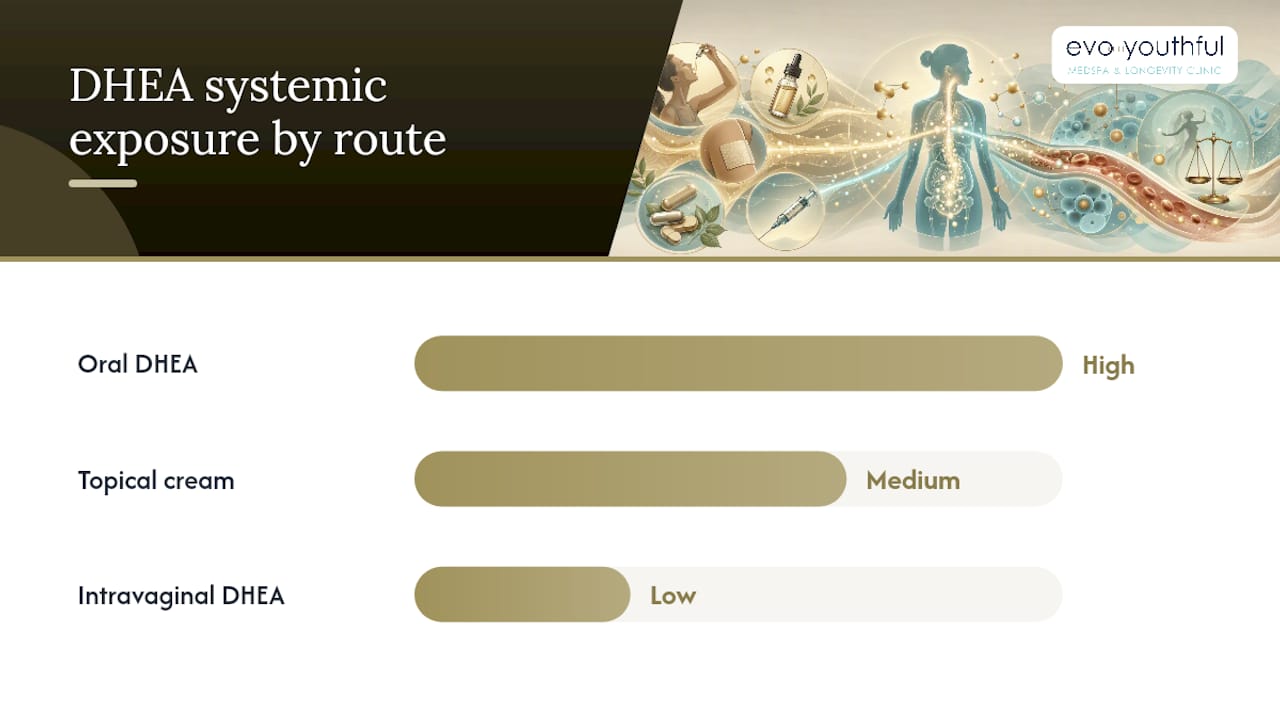
DHEA comes in three main forms, and they don’t behave the same way in your body. Oral DHEA produces the highest systemic exposure and the broadest hormonal effects, which is also why it carries the most side-effect risk. Topical creams offer a middle ground. Intravaginal DHEA delivers targeted relief for genitourinary symptoms while keeping the compound largely local, sparing you much of the systemic exposure oral dosing creates.

Dose matters more than most people assume. The 2025 meta-analysis found that doses of 50 mg per day or higher produced the clearest measurable increases in estradiol and testosterone, but that same dose range is where side-effect risk climbs too. Lower doses tend to be gentler and less predictable in effect.
A practical monitoring plan looks something like this:
- Baseline labs before starting: DHEA/DHEA-S, estradiol, testosterone, a comprehensive metabolic panel, fasting glucose or HbA1c, and a lipid panel
- First follow-up: 6 to 12 weeks after starting, checking hormone levels and symptom changes
- Ongoing follow-up: every 6 to 12 months if you continue, with repeat labs and a fresh look at whether the benefit still outweighs the risk
Pro Tip: If your main concern is vaginal dryness or discomfort rather than systemic vitality, ask specifically about intravaginal DHEA. It often achieves the local goal with a smaller hormonal footprint elsewhere in your body.
Starting low and titrating slowly, with labs guiding each step, beats jumping straight to a higher dose because it sounds more effective. A comprehensive hormone panel gives your clinician the fuller context needed to interpret DHEA-S alongside estradiol and testosterone, rather than in isolation.
How Do You Decide Whether to Try DHEA?
Before bringing DHEA up with a clinician, work through a short mental checklist:
- Do you have a specific, named symptom, such as vaginal dryness, GSM, or new-onset low libido, rather than a vague sense of “not feeling like yourself”?
- Have you had lab-confirmed low DHEA or DHEA-S alongside other relevant hormone findings?
- Have you ruled out major risk factors, including hormone-sensitive cancer history, uncontrolled diabetes, or unsupervised use of other hormone therapies?
If you answered yes to the first two and no to the third, DHEA is worth a real conversation. If not, other evidence-based options, including BHRT, may fit your situation better.
Bring these questions to that appointment:
- What baseline testing do you recommend before I start anything?
- Which formulation fits my specific goal, oral, topical, or intravaginal?
- What’s a realistic timeline for noticing a difference, and how will we measure it?
- What does the monitoring schedule look like, and what would make us stop?
Seek supervised care specifically, not just a general checkup, if you have any hormone-sensitive condition, are already on another hormone therapy, manage diabetes, or live with a psychiatric condition that needs active management.
A Clinical Perspective on DHEA and Vitality
DHEA gets treated online like a universal anti-aging fix, and that framing does a disservice to what the evidence actually supports. It’s a precursor with real, measurable effects on estradiol and testosterone, particularly at higher doses, but “measurable” and “beneficial for you specifically” are not the same claim.
My approach starts with individualized assessment, not a standard protocol handed to everyone who asks about it. That means functional testing that looks at the full hormone picture, a start-low posture on dosing, and monitoring that continues past the first prescription. For genitourinary symptoms in particular, the evidence is solid enough to act on with confidence. For general vitality or anti-aging goals, I’m far more selective, because that’s where the trial data gets thin and the risk-benefit math shifts.
Testing without a clear treatment goal attached to it rarely helps anyone. Pairing the two is where DHEA, used carefully, earns its place.
Ready to Get Your Hormones Tested Properly?
Guessing at a dose based on a supplement label or a forum thread skips the step that actually matters: knowing what your specific hormone panel looks like before you touch anything. evoyouthful runs functional hormone testing that looks at DHEA-S alongside estradiol, testosterone, and metabolic markers together, so a treatment decision is based on your full picture instead of one number in isolation.

Elizabeth Vogstrom, PA sees patients directly for this kind of assessment, and where DHEA isn’t the right fit, individualized bioidentical hormone replacement therapy is available as a more targeted alternative, including BHRT for men dealing with low testosterone specifically. If ongoing symptoms point to a broader imbalance, our hormone imbalance page outlines the paths to care available at the Wayzata clinic. Book a consultation to get tested before you start anything, not after.
Sources
- The Sex Hormone Precursors Dehydroepiandrosterone (DHEA) and Its Sulfate Ester Form (DHEAS): Molecular Mechanisms and Actions on Human Body - PMC
- Meta-analysis (2025) on DHEA supplementation effects on testosterone and estradiol - Springer
- DHEA supplements: Are they safe? Or effective? - Harvard Health
- DHEA - Mayo Clinic
This article is general information, not a substitute for advice from a qualified doctor. Consult a qualified healthcare professional about your own circumstances before acting on anything here.
Recommended
- Hormone Imbalance | Treatments in Wayzata, MN | evoyouthful Wayzata, MN
- Functional Hormone Testing: How It Finds Imbalances and Guides Care | evoyouthful Blog
- Bioidentical Hormone Replacement Therapy | Restore balance from the inside out | evoyouthful Wayzata, MN
- Signs Your Hormones Need Optimization: A Full Checklist | evoyouthful Blog
Ready to Start?
Schedule a Consultation
Have questions about what you just read? Our team is here to help.