
Neck Skin Tightening That Works: Clinician Advice to Match Treatment to Cause
Elizabeth Vogstrom, PA-C
evoyouthful Clinical Team
Clinician led, evidence based guide to neck skin tightening. Learn how to match skin laxity, submental fat, or platysma bands to the right device, thread,...
Neck Skin Tightening That Works: Clinician Advice to Match Treatment to Cause
Energy-based medical procedures and surgery produce measurable neck skin tightening; exercises and topical skincare support skin quality but rarely remove excess skin on their own. Non-surgical devices show gradual improvement over 2 to 6 months, minimally invasive options like threads work faster with moderate durability, and surgery delivers the most dramatic, longest-lasting change. The right choice depends on whether your main issue is loose skin, muscle banding, or fat.
TL;DR:
- Non-surgical devices improve neck laxity gradually over several months but are ineffective for significant excess skin.
- Ultrasound and RF microneedling offer moderate tightening with results lasting up to a year, requiring multiple sessions.
- Surgery provides the most dramatic and long-lasting correction, especially for significant skin, fat, or muscle banding.
- Proper evaluation of whether loose skin, fat, or muscle is the main issue is essential before choosing a treatment approach.
- Combining treatments like RF microneedling with skincare or PRF often produces better outcomes, provided the diagnosis is accurate.
Table of Contents
- What Causes Neck Skin Tightening to Become Necessary?
- Do Neck Exercises and Skincare Actually Tighten Skin?
- What Are Non-Surgical Neck Tightening Options?
- How Does Ultrasound Skin Tightening Work?
- Radiofrequency and RF Microneedling: What’s the Difference?
- When Should You Consider Laser Resurfacing Instead?
- What Minimally Invasive Options Exist Between Devices and Surgery?
- When Is Surgery the Right Choice for Neck Laxity?
- How Do You Choose a Provider for Neck Tightening?
- What Does Neck Tightening Look Like at evoyouthful?
- The Real Problem With How People Approach Neck Tightening
- Ready to Address Your Neck Concerns?
- Sources
What Causes Neck Skin Tightening to Become Necessary?
Neck aging usually isn’t one problem. It’s three, layered on top of each other: skin laxity, platysma banding (those vertical cords that appear when you clench your jaw), and submental fat. A treatment built for one won’t fix the others, which is why so many people try a product or device and feel disappointed.
The neck dermis is thinner than facial skin and has fewer oil glands, so it shows collagen loss earlier and more visibly. Several factors accelerate that decline:
- Age-related collagen and elastin breakdown, which typically outpaces the face
- Cumulative UV exposure, often worse on the neck since sunscreen application there is inconsistent
- Weight fluctuations that stretch skin faster than it can rebound
- Smoking, which degrades collagen production
- “Tech neck,” the repetitive forward head tilt from phones and screens that some clinicians link to premature skin creasing
None of these devices or serums can pull off excess skin. If your neck has more skin than your frame needs, tightening technology can firm what remains, but it can’t remove the surplus. That distinction shapes everything else in this guide.
Do Neck Exercises and Skincare Actually Tighten Skin?
Neck exercises have a passionate following online, but the clinical evidence behind them is thin. Reviews of facial exercise programs consistently find limited, low-quality evidence that toning routines meaningfully change skin laxity, even though they may modestly strengthen the platysma muscle underneath.
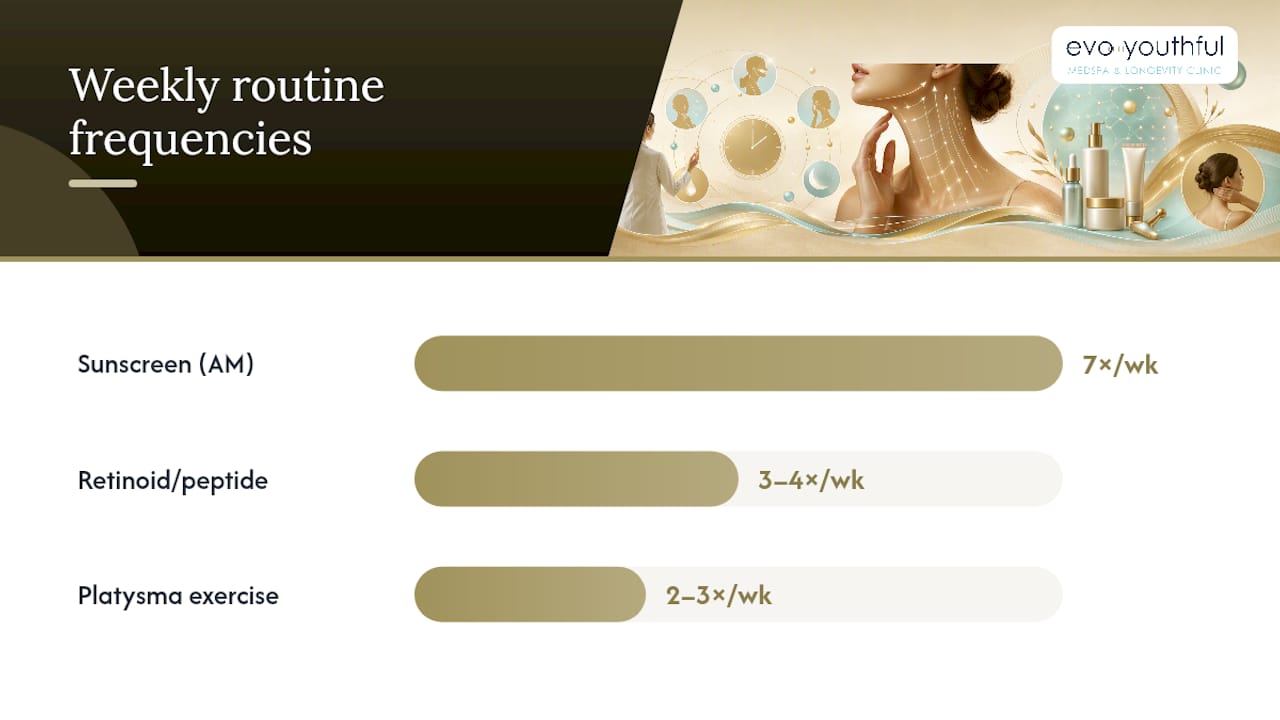
Topical care plays a different role. Retinoids and peptide-based products can improve collagen synthesis and skin texture, but they support the skin rather than replace what an in-office procedure does. Daily sunscreen matters just as much, since UV exposure is one of the few causes of neck laxity you can directly control.
A realistic starting routine:
- Apply a retinoid or peptide serum to the neck three to four nights a week, building tolerance slowly.
- Use a broad-spectrum SPF 30+ every morning, extending it past the jawline.
- Add a chin-tuck or platysma-tensing exercise set two to three times weekly if you want to try it, understanding it’s unlikely to change skin laxity on its own.
- Reassess after 8 to 12 weeks. If skin texture hasn’t shifted noticeably, that’s your cue to talk to a clinician about in-office options.
Pro Tip: Neck skincare fails most often because people stop at the jawline. Extend your retinoid, peptide serum, and sunscreen all the way down to the collarbone. Sun damage doesn’t stop where your face does.
What Are Non-Surgical Neck Tightening Options?
Non-surgical devices work by heating deeper skin layers just enough to trigger collagen remodeling without breaking the surface. Results build gradually, typically becoming visible over several months as new collagen forms.
What to expect from this category:
- Improvement is generally mild to moderate, not dramatic
- Results tend to last several months to about a year, depending on the specific technology used
- Multiple sessions are usually required, not a single visit
- Downtime is minimal, though temporary redness, mild bruising, or brief numbness can occur; however, it’s important to review red light therapy contraindications to ensure the treatment is safe for you
Risk is low when a trained clinician performs the treatment, but results depend heavily on matching the right device to the right degree of laxity. Someone with mild early sagging responds differently than someone with more advanced skin laxity, which is why an in-person evaluation matters more than the specific brand name of the device.
How Does Ultrasound Skin Tightening Work?
Focused ultrasound reaches deeper tissue layers than most surface treatments, stimulating collagen without disrupting the skin’s outer layer. A rater-blinded prospective cohort study found measurable lifting and tightening of facial and neck skin, with visible change developing over a few months. It suits mild to moderate laxity best; those with significant loose skin or heavy platysma banding usually need a stronger approach.
Radiofrequency and RF Microneedling: What’s the Difference?
Surface radiofrequency heats the skin from above, producing gentle, gradual tightening with essentially no downtime. RF microneedling goes further, delivering energy through tiny needles directly into deeper dermal layers. That deeper delivery produces faster tissue contraction and more noticeable remodeling than surface RF alone, typically across a series of three to four sessions with a few days of mild redness. It works well for people with early to moderate laxity plus rough texture, since the microneedling channel also triggers new collagen induction.
When Should You Consider Laser Resurfacing Instead?
Ablative lasers tighten skin faster and more forcefully than most non-ablative devices, but the tradeoff is real: longer downtime, more discomfort, and a higher risk of complications like scarring or pigment changes. The American Academy of Dermatology notes that ablative options deliver quicker visible tightening precisely because they work more aggressively on the skin’s surface. They make sense for people with more pronounced texture and laxity issues who are willing to trade a week or two of recovery for a stronger result, and less sense for anyone wanting a lunchtime procedure.
What Minimally Invasive Options Exist Between Devices and Surgery?
This middle tier fills the gap for people who’ve outgrown non-invasive devices but aren’t ready for surgery.
- Thread lifts provide immediate lift plus gradual collagen stimulation as the threads dissolve, generally suited to mild to moderate laxity, with reported durability of one to three years in appropriately selected patients.
- Subdermal RF-assisted approaches tighten skin while also treating small fat pockets through minimal incisions, sometimes approaching a surgical-like contour for the right candidate.
- Neuromodulator injections into the platysma soften vertical neck bands and sharpen jawline definition, though the effect is temporary and needs repeating roughly every 3 to 4 months.
Pro Tip: If your main complaint is those two vertical cords that pop up when you talk or clench your jaw, that’s platysmal banding, not general skin laxity. Neuromodulator injections address that specific structure. A device meant for skin tightening won’t touch it.
When Is Surgery the Right Choice for Neck Laxity?
Surgery remains the most decisive option because it physically removes excess skin and repositions the underlying muscle rather than just stimulating collagen. For significant skin laxity, substantial submental fat, or pronounced platysmal banding, a neck lift or liposuction is typically what delivers lasting correction. Recovery generally runs over about one to two weeks before returning to normal activity, with residual swelling settling over time. Tradeoffs include anesthesia risk, scarring (usually well hidden behind the ears and under the chin), and a longer commitment than any device-based option. It’s the right call when the anatomy itself, not just the skin quality, needs to change.
How Do You Choose a Provider for Neck Tightening?
Credentials matter more here than almost anywhere else in aesthetic medicine, since the neck has delicate nerves and vessels close to the surface. Columbia Surgery’s patient guidance emphasizes clinician evaluation as the foundation of any treatment plan, whether the outcome is surgical or not.
A solid consultation should include:
- A hands-on assessment distinguishing skin laxity from fat from muscle banding, not a generic sales pitch
- Photos or imaging used to document your starting point and track change over time
- A clear, specific description of expected improvement, not vague promises
- An honest timeline, including how many sessions or how much recovery to expect
- A full breakdown of cost, including any maintenance treatments down the line
Walk away from any provider who guarantees a specific outcome, brushes past potential complications, or can’t show you real before-and-after documentation. If skin laxity is your main concern, ask specifically how they’d evaluate sagging skin before recommending a device or procedure.
What Does Neck Tightening Look Like at evoyouthful?
Elizabeth Vogstrom, PA-C, leads treatment planning at evoyouthful by first identifying which of the three underlying issues, skin laxity, fat, or muscle banding, is actually driving a patient’s concerns. From there, the clinic draws on AgeJET Plasma Skin Therapy, RF microneedling, PRF injections, and physician-curated skincare, often combined for staged results. A typical consult starts with a skin quality assessment before any treatment is recommended.
The Real Problem With How People Approach Neck Tightening
Most people treat neck skin tightening as a single decision: pick a device, book it, hope for the best. That’s backwards. The research doesn’t support one winning modality. It supports matching the tool to the anatomy, and most disappointment I see traces back to skipping that step.
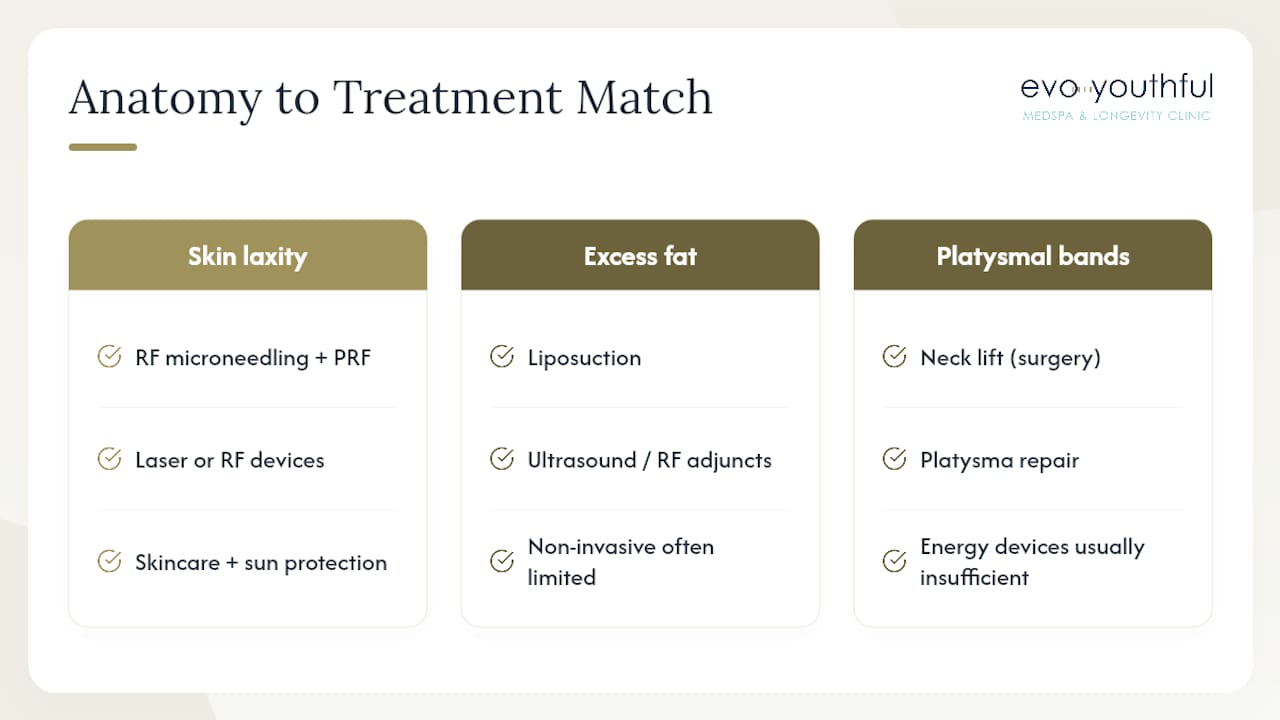
Where conventional advice falls short is in overselling non-invasive devices to people who actually need surgery, and overselling surgery to people who’d do fine with RF microneedling and a good skincare regimen. Both mistakes cost patients money and time. The staged approach, starting conservative and escalating only if goals aren’t met, holds up better than jumping straight to the most aggressive option available.
If you take one thing from this guide, let it be this: figure out whether you’re dealing with skin, fat, or muscle before you spend a dollar on any of it. Combining modalities, like RF microneedling with PRF, tends to outperform any single treatment used alone, but that only works when the underlying diagnosis is right in the first place. Sun protection and a real skincare habit aren’t optional extras either. They’re what makes any in-office result last longer.
— Elizabeth Vogstrom, PA-C
Ready to Address Your Neck Concerns?
Unlike a single device or a home routine that only addresses one layer of the problem, evoyouthful builds a plan around what’s actually happening in your neck, skin laxity, fat, or muscle banding, and treats it with the right combination rather than a one-size-fits-all approach.

The clinic offers AgeJET Plasma Skin Therapy for skin rejuvenation, RF microneedling for deeper collagen remodeling, PRF injections to support healing and tissue quality, and physician-curated skincare to maintain results between visits. An evaluation starts with a hands-on assessment of your skin, muscle tone, and fat distribution, followed by a specific plan with realistic timelines and costs, not a guess. If you’re ready to find out which tier of treatment actually fits your neck, schedule a consultation with evoyouthful in Wayzata.
This article is general information, not a substitute for advice from a qualified doctor. Consult a qualified healthcare professional about your own circumstances before acting on anything here.
Sources
- Ultrasound tightening of facial and neck skin: a rater-blinded prospective cohort study
- Radiofrequency microneedling clinical studies and outcomes
- Many ways to firm sagging skin — American Academy of Dermatology patient resource
- Surgical management of neck laxity and platysmal banding
- Systematic review of facial exercise studies and skin outcomes
Recommended
Ready to Start?
Schedule a Consultation
Have questions about what you just read? Our team is here to help.