

Clinically Guided Hair Treatments for Men That Deliver in 4–6 Months
Elizabeth Vogstrom, PA-C
evoyouthful Clinical Team
Clinic backed, evidence first look at men's thinning hair. Why minoxidil and finasteride matter, and when PRF/PRP, lasers, or transplant help.
Clinically Guided Hair Treatments for Men That Deliver in 4–6 Months
Two medications, topical minoxidil and oral finasteride, remain the only FDA-approved options for male pattern hair loss, and both need four to six months of daily use before you see real change. Regenerative injections like PRP and PRF, low-level laser devices, and hair transplant surgery all have a place, but they work best alongside these medications, not instead of them. Expect ongoing use to hold the gains once you have them.
Low-dose oral minoxidil requires medical supervision: it can cause fluid retention, a faster heart rate, and lowered blood pressure, so clinicians typically monitor blood pressure and ask about heart conditions before prescribing. It is not recommended during pregnancy or breastfeeding. Discuss these risks with a physician before starting.
Finasteride is FDA-indicated for men only. Women who are or may become pregnant must not handle crushed or broken finasteride tablets, due to the risk of harm to a male fetus. It can also cause sexual side effects (reduced libido, erectile dysfunction) in a minority of men, which usually resolve after stopping treatment. Discuss these risks with a physician before starting.
TL;DR:
- Medications like minoxidil and finasteride require four to six months of daily use before visible results and are mainly effective for miniaturized follicles, not fully bald areas.
- Accurate diagnosis, including scalp exam and blood work, is essential, as treating non-androgenetic causes with the wrong method wastes time and resources.
- PRP and PRF injections can improve hair density by stimulating existing follicles but do not create new ones, making them suitable only for early to moderate thinning.
- Low-level laser therapy has modest evidence for improving density, while topical products like ketoconazole shampoo may support scalp health but are not primary treatments.
- A comprehensive plan involves confirming diagnosis first, then starting with FDA-approved medication, followed by adjuncts like LLLT or regenerative injections if needed, and considering surgery as a last resort.
Table of Contents
- What Causes Male Hair Thinning, and How Do Doctors Diagnose It?
- Do Minoxidil and Finasteride Actually Regrow Hair?
- Are PRP and PRF Worth It for Thinning Hair?
- Which Devices and Topical Products Actually Help?
- When Does a Hair Transplant Make Sense?
- How Do You Choose the Right Treatment Plan?
- How evoyouthful Approaches Hair Thinning in Men
- A Clinician’s Honest Take on Managing Expectations
- Ready to Get a Real Diagnosis for Your Hair Thinning?
- Sources
- FAQ
What Causes Male Hair Thinning, and How Do Doctors Diagnose It?
Most thinning in men traces back to androgenetic alopecia, the genetic sensitivity to DHT that shrinks hair follicles over time in a predictable pattern. Clinicians typically map that pattern using the Norwood scale, which grades recession from the temples and crown on a scale that helps predict how the loss will progress. That is different from diffuse shedding, where hair thins evenly across the whole scalp rather than in the classic horseshoe pattern, and it often points to a separate cause like thyroid dysfunction, low iron, or acute stress.
Getting the diagnosis right changes everything about treatment. A man with androgenetic alopecia responds to finasteride because it blocks the hormone driving the miniaturization. A man with an iron deficiency or thyroid problem will not, no matter how long he uses it.
Clinicians typically build the diagnosis from a few core steps, and Mayo Clinic’s clinical guidance outlines the standard workup:
- Pull test: a clinician gently tugs a small section of hair to gauge how many strands release, which flags active shedding.
- Trichoscopy: magnified scalp imaging that shows follicle density, miniaturization, and scalp condition.
- Blood work: checks for thyroid hormones, iron and ferritin, and sometimes testosterone when hormonal imbalance is suspected.
- Scalp biopsy: reserved for unclear or inflammatory cases where the pattern doesn’t fit typical androgenetic loss.
Skipping this step is the most common mistake men make. Starting minoxidil for what turns out to be a thyroid issue wastes months you can’t get back.
Do Minoxidil and Finasteride Actually Regrow Hair?
Topical minoxidil and oral finasteride are the two treatments backed by controlled trials and FDA approval, and they work through different mechanisms. Minoxidil, available over the counter, widens blood vessels around the follicle and appears to extend the growth phase of the hair cycle; most men apply a 5% solution or foam twice daily. Finasteride, a prescription pill, blocks the enzyme that converts testosterone into DHT, the hormone most responsible for follicle shrinkage in pattern hair loss.
By the numbers: Finasteride slows hair loss in 80 to 90 percent of men who use it consistently, and many also see some regrowth. Both medications typically take four to six months to show noticeable change, since hair growth cycles move slowly even when the underlying biology responds fast.
Dermatologists quoted in Men’s Health consistently point to 5% minoxidil as the sensible first-line pick precisely because it’s accessible and well-tolerated, while reserving finasteride for men comfortable with a prescription and its side-effect profile.
Side effects differ sharply between the two:
- Minoxidil: scalp irritation, dryness, or unwanted facial hair in some users; switching from liquid to foam often resolves irritation.
- Finasteride: a small percentage of men report decreased libido or other sexual side effects, which typically resolve after stopping the medication.
- Shedding phase: both drugs can trigger a temporary increase in shedding during the first several weeks as weak hairs cycle out to make room for stronger growth.
Here’s the part men underestimate: these are maintenance treatments, not cures. Stop using either one, and the protective effect fades within months, and the hair loss resumes its original course. If you start, plan to stay on it, or plan for the reversal.
Are PRP and PRF Worth It for Thinning Hair?
Platelet-rich plasma (PRP) and platelet-rich fibrin (PRF) are regenerative injections that use a patient’s own blood, spun down to concentrate growth factors, then injected into the scalp to stimulate existing follicles. The difference is technical but meaningful: PRP typically uses an anticoagulant and delivers a faster release of growth factors, while PRF skips the anticoagulant and forms a fibrin matrix that releases those factors more gradually over days rather than hours.
A 2024 systematic review covering studies on injectable PRF found measurable improvements in hair density among patients treated for alopecia, though the review’s authors were clear that larger, more standardized trials are still needed. A separate comparative analysis found that i-PRF outperformed PRP for target-area hair count at 24 weeks in a multicenter trial, but the same analysis noted that delivery logistics, meaning how the clinic prepares and injects the concentrate, heavily influence whether those results are reproducible.
Neither therapy creates new follicles. Both work by stimulating follicles that are already present but weakened, which is why they perform best on men with early to moderate thinning who still have viable follicles to wake up. A scalp that has gone fully bald in an area typically has nothing left to stimulate.
Practical considerations before booking a series:
- Most protocols run three to four sessions spaced four to six weeks apart, followed by maintenance visits.
- Cost varies widely by region and clinic, and is rarely covered by insurance since it’s considered cosmetic.
- Results are gradual and best judged at three to six months post-treatment, similar to medication timelines.
Pro Tip: Ask any clinic offering PRP or PRF exactly how they process the blood draw and how quickly they inject it. The acronym on the intake form matters less than the protocol behind it, since two providers using the same technique can get very different results based on technique alone.
Which Devices and Topical Products Actually Help?
Low-level laser therapy (LLLT) devices, worn as combs, caps, or helmets, use red light wavelengths thought to stimulate cellular activity in hair follicles. Evidence for LLLT is modest but real: several small trials show improved density with regular use, typically three to four sessions weekly for several months, though results tend to be less dramatic than what minoxidil or finasteride produce alone.
Topical serums and medicated shampoos occupy a supportive role rather than a curative one. Shampoos containing ketoconazole may reduce scalp inflammation linked to androgenetic alopecia, and caffeine-based serums have some laboratory evidence for extending the hair growth phase, but neither replaces a proven medication.
Supplements and botanicals, think saw palmetto, biotin, or marine collagen, carry the thinnest evidence of the group. Biotin deficiency is genuinely rare in men eating a normal diet, so supplementing it rarely moves the needle unless a blood test actually shows a deficiency. Saw palmetto has some laboratory data suggesting mild DHT-blocking activity, but nothing close to finasteride’s track record.
A sensible combination approach looks like this:
- Minoxidil or finasteride as the foundation, since these carry the strongest evidence.
- LLLT three to four times weekly as a low-risk add-on with minimal side effects.
- Ketoconazole shampoo two to three times weekly if scalp inflammation is present.
- Supplements only after blood work confirms an actual deficiency, not as a blanket precaution.
When Does a Hair Transplant Make Sense?
Hair transplant surgery redistributes follicles from a donor area, usually the back of the scalp, into thinning or bald zones, and it remains the only option that restores hair where none currently grows. Follicular unit extraction (FUE) removes individual follicles one at a time, leaving minimal scarring, while follicular unit transplantation (FUT) removes a strip of scalp and dissects it into grafts, generally yielding more grafts per session at the cost of a linear scar.
Good candidates have a stable, dense donor area and realistic expectations about density and coverage, since transplanted hair follows the same genetic rules as the hair it came from. Recovery involves a week or two of visible redness and scabbing, with transplanted hairs shedding around week three before new growth begins months later, following Mayo Clinic’s outline of surgical hair restoration.
Key points before considering surgery:
- Surgery redistributes existing hair; it doesn’t create new follicles or stop ongoing genetic thinning elsewhere on the scalp.
- Most surgeons recommend continuing finasteride after transplant to protect the native hair still at risk.
- Full results take 9 to 12 months to appear as transplanted follicles cycle through growth phases.
Many surgical practices now pair the procedure with regenerative injections in the months following surgery, aiming to support graft survival and improve density in the surrounding native hair.
How Do You Choose the Right Treatment Plan?
The order you approach this in matters more than which specific product you pick first. Follow this sequence with a clinician:
- Confirm the diagnosis before treating anything. A pull test, scalp exam, and basic blood work rule out thyroid or iron issues that mimic pattern loss.
- Start with FDA-approved medication. Topical minoxidil, oral finasteride, or both together address the two main levers: extending growth phase and blocking DHT.
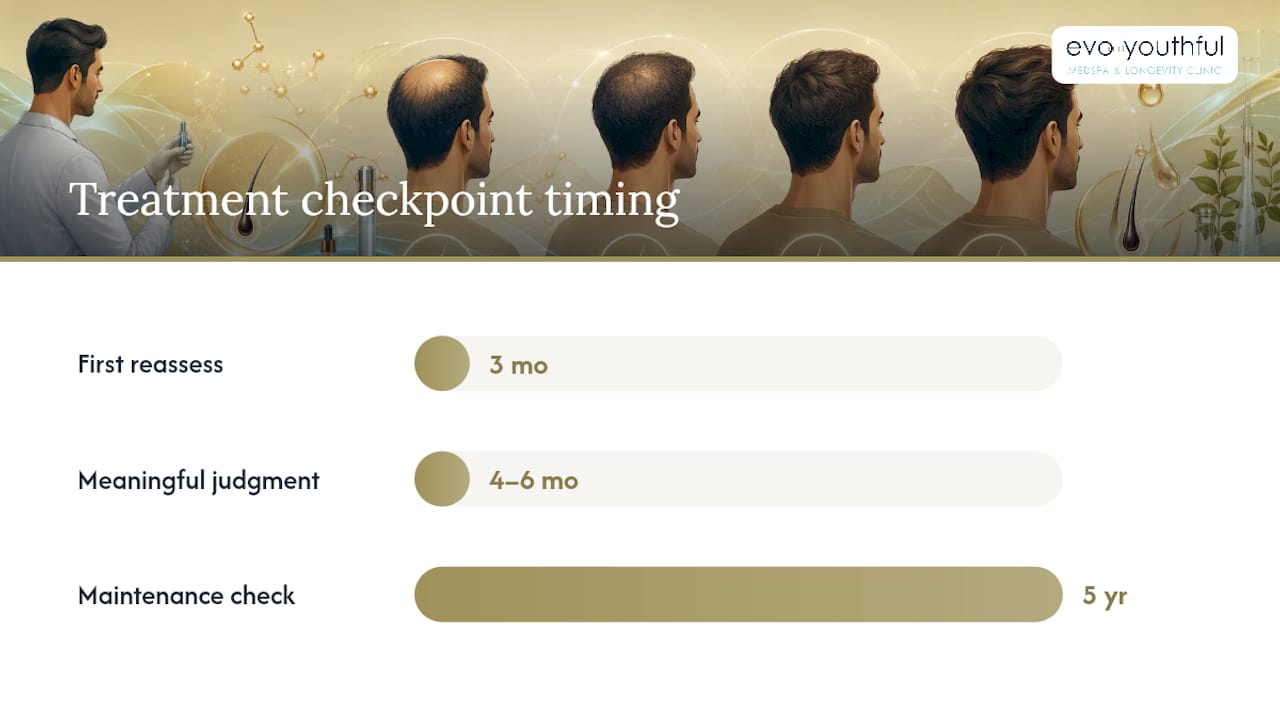
- Reassess at three months, then again at four to six months. Shedding in the early weeks is normal; real judgment happens once a full growth cycle has passed.
- Layer in adjuncts if progress stalls. LLLT, PRP, or PRF can be added once medication is established as the base.
- Consider transplant surgery if medical therapy alone isn’t achieving the coverage you want, and continue medication afterward to protect the gains.
Questions worth asking your clinician: What does my diagnosis actually show? What result can I realistically expect, and by when? How often do your patients report side effects, and what’s the plan if I get them? What does maintaining this treatment look like five years from now?
Watch for red flags that need faster evaluation: sudden patchy shedding, a scalp that’s inflamed, itchy, or scaly, or hair loss paired with fatigue, weight changes, or other systemic symptoms. Those point toward causes beyond standard pattern loss and need workup sooner rather than later.
Cost ranges swing widely by region and provider, from the modest monthly cost of an over-the-counter minoxidil regimen up to several thousand dollars for a full transplant session. Get a written estimate before committing to any regenerative or surgical plan.
Pro Tip: Take a photo of your scalp under the same lighting every month. Memory is unreliable for gradual change, and a consistent photo record is the easiest way to tell if a treatment is actually working before your next checkup.
How evoyouthful Approaches Hair Thinning in Men
Elizabeth Vogstrom, PA-C, brings an advanced BHRT certification and two decades in medical aesthetics to evaluating hair thinning, with particular attention to how hormonal imbalance can compound genetic pattern loss in men. At evoyouthful, candidates for PRF injections are screened first for the extent of existing follicle viability, since the therapy’s success depends on follicles that are weakened, not gone.
For men whose bloodwork suggests low testosterone alongside thinning, a BHRT evaluation becomes part of the conversation, since hormonal shifts can influence hair cycling independent of classic androgenetic alopecia. Every plan gets built around the individual’s diagnosis, timeline goals, and existing medication use rather than a one-size protocol.
A Clinician’s Honest Take on Managing Expectations
The hardest conversation I have with men isn’t about the science. It’s about timing. Hair loss triggers real grief, and the instinct is to want a fix that works in weeks, not months. I’d rather set that expectation honestly upfront than have a patient quit an effective treatment at week eight because it looks like nothing is happening.
My approach stays the same regardless of how motivated someone is walking in the door: confirm the diagnosis, start with what the evidence actually supports, and treat regenerative options as an enhancement once the foundation is working. That order protects patients from spending money on injections before establishing whether medication alone would have solved the problem. Evidence-based doesn’t mean slow for the sake of it. It means not skipping the step that actually determines whether anything else works.
— Elizabeth Vogstrom, PA-C
Ready to Get a Real Diagnosis for Your Hair Thinning?
evoyouthful gives you what an over-the-counter shelf full of shampoos and serums can’t: an actual diagnosis, a clinician who checks whether hormones are part of the picture, and a plan built around your bloodwork instead of guesswork. If PRF injections make sense for your stage of thinning, they’re delivered as part of a personalized protocol rather than a generic package.

A first visit at evoyouthful typically includes a scalp assessment, a conversation about your history and goals, and, when relevant, lab work to rule out thyroid or hormonal contributors. From there, your plan might combine PRF injections with medication guidance, or include a full BHRT evaluation if low testosterone is part of the picture. Book a consultation through evoyouthful’s treatment and booking page to get a plan built around your own diagnosis instead of a generic protocol.
This article is general information, not a substitute for advice from a qualified doctor. Consult a qualified healthcare professional about your own circumstances before acting on anything here.
Sources
- Treating hair loss in men: What works (Harvard Health)
- Hair loss - Diagnosis and treatment (Mayo Clinic)
- Injectable PRF therapy review (Cureus/PMC)
- The 7 Best Hair Loss Treatments for Men in 2026 (Men’s Health)
FAQ
What Is the Best Treatment for Thinning Male Hair?
Topical minoxidil and oral finasteride are the best-supported treatments, since both are FDA-approved and backed by controlled trials showing real regrowth and slowed progression. Many men get the strongest results combining both under a clinician’s guidance, then adding PRP, PRF, or laser therapy if they want additional density gains.
Can Thinning Hair Grow Back in Men?
Yes, when follicles are miniaturized rather than completely gone, medications like minoxidil and finasteride can regrow visible hair over four to six months of consistent use. Regenerative injections such as PRF can add further density in men who still have viable follicles, but neither approach restores hair in areas that are fully bald.
What Did Matthew McConaughey Do to Fix His Thinning Hair?
Matthew McConaughey has not publicly detailed a specific medical hair loss protocol, so any claims about his exact regimen aren’t independently confirmed. What’s clear from the broader evidence is that combining FDA-approved medication with professional evaluation gives the most reliable path to visible improvement for most men.
What Are the “Big 3” for Thinning Hair?
The phrase commonly refers to minoxidil, finasteride, and ketoconazole shampoo, the three most frequently recommended together for androgenetic alopecia. Minoxidil and finasteride carry the strongest clinical evidence, while ketoconazole shampoo plays a supportive role by reducing scalp inflammation linked to hair loss.
Does evoyouthful Offer Hair Thinning Treatments?
evoyouthful offers PRF injections as a regenerative option for men with early to moderate thinning, along with hormonal evaluation through BHRT when low testosterone may be contributing. Current pricing for these services can be found on the clinic’s website.
Recommended
Ready to Start?
Schedule a Consultation
Have questions about what you just read? Our team is here to help.