

Direct Pay Medical Aesthetics Explained for Patients
Elizabeth Vogstrom, PA-C
evoyouthful Clinical Team
Discover how direct pay medical aesthetics explained benefits patients with transparent pricing and immediate access to non-surgical treatments.
Direct Pay Medical Aesthetics Explained for Patients
Direct pay medical aesthetics is a healthcare payment model where patients pay providers directly at the time of service for cosmetic treatments, bypassing traditional insurance entirely. The industry has shifted decisively toward this model: over 80% of cosmetic procedures worldwide are now non-surgical, and the market for non-invasive treatments is projected to reach $171.3 billion by 2030. That growth reflects real demand for treatments like injectables, laser resurfacing, and body contouring. The direct pay model meets that demand with price transparency, faster access, and care that centers on you rather than on insurance paperwork.
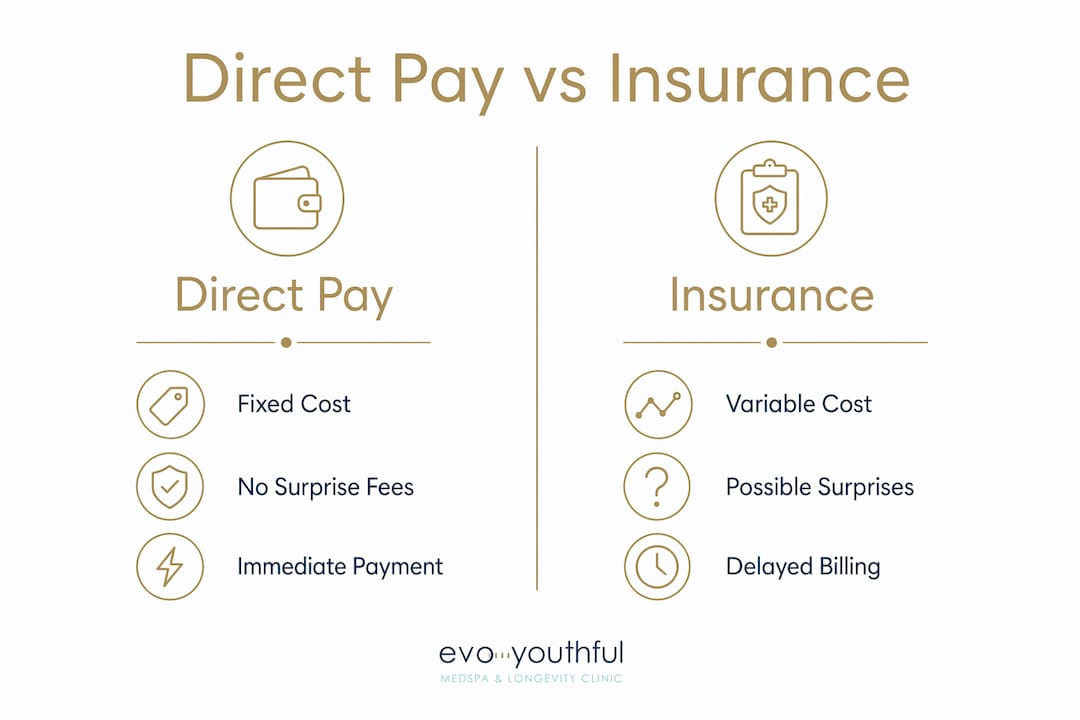
What is direct pay medical aesthetics and how does pricing work?
Direct pay medical aesthetics, also called cash-pay aesthetics, is a model where clinics collect payment at the time of service rather than billing insurance. Payment at time of service eliminates insurance adjudication entirely, shortening accounts receivable periods from 30–90 days to nearly zero. That efficiency passes real benefits to patients: no surprise bills weeks after treatment, no claim denials, and no confusion about what you actually owe.
Membership and concierge pricing structures
Many direct pay clinics offer membership programs as an alternative to paying per visit. Membership fees typically range from $99 to $199 per month or $2,500 to $7,500 annually, with members receiving 10%–15% discounts on aesthetic services. The best membership programs also include priority scheduling and defined complimentary treatments rather than vague “all-inclusive” promises. That distinction matters because open-ended packages are difficult for clinics to sustain and often lead to service cuts over time.

For patients who prefer paying per visit, most clinics post menu pricing for common treatments. Neuromodulators like Botox and Dysport are typically priced per unit, while dermal fillers are priced per syringe. Laser treatments and body contouring sessions are usually priced per area or per session. Knowing these units of measurement before you call a clinic gives you a real basis for comparison.
Pro Tip: Always ask for per-unit pricing on neuromodulators and per-syringe pricing on fillers. Per-unit pricing transparency is the only way to make accurate cost comparisons across providers.
Direct pay vs. out-of-pocket costs: a comparison
| Payment scenario | Typical cost structure | Billing surprise risk |
|---|---|---|
| Direct pay clinic | Fixed menu price, paid at visit | None |
| Insurance-based out-of-pocket | Copay plus deductible, billed later | High |
| Membership direct pay | Monthly fee plus discounted service price | None |
| Financing through clinic | Installment plan, interest may apply | Low |
The table above shows why many patients find direct pay simpler. The total cost is known before treatment begins, not weeks after.
What treatments are available through direct pay aesthetics?
The direct pay model fits non-surgical treatments especially well because these services are predictable, elective, and easy to price in advance. Aesthetic concerns addressed by these treatments include fine lines, acne scars, skin laxity, uneven tone, and body composition changes. Most treatments require minimal downtime and carry strong safety records when performed by licensed providers.
Common treatment categories
- Neuromodulators (Botox, Dysport, Daxxify): Relax facial muscles to reduce dynamic wrinkles like forehead lines and crow’s feet. Results typically last 3–4 months, with longer-lasting options now available.
- Dermal fillers: Restore volume to areas like the cheeks, lips, and under-eye hollows. Results last 6–18 months depending on the product and area treated.
- Laser resurfacing and RF microablation: Address skin texture, tone, and tightening by stimulating collagen production. Treatments like Exion Clear RF Microablation resurface and renew skin with minimal recovery time.
- Chemical peels: Remove the outer layer of skin to improve tone, reduce hyperpigmentation, and smooth texture.
- Body contouring: Treatments like Emsculpt NEO simultaneously build muscle and reduce fat using electromagnetic and radiofrequency energy, with no surgery required.
- PRF injections: Use your body’s own platelet-rich fibrin to stimulate tissue regeneration for skin and hair restoration.
Treatment goals and expected results
| Treatment | Primary goal | Typical results timeline |
|---|---|---|
| Neuromodulators | Reduce dynamic wrinkles | 3–14 days onset, 3–4 months duration |
| Dermal fillers | Restore volume and contour | Immediate, 6–18 months duration |
| Laser resurfacing | Improve texture and tone | 1–4 weeks post-treatment improvement |
| Body contouring | Reduce fat, build muscle | 2–4 weeks post-series improvement |
| Chemical peels | Even skin tone | 1–2 weeks post-peel improvement |
Treatment plans in direct pay settings are customizable because no insurance protocol dictates what you can or cannot receive. Your provider builds a plan around your specific concerns and goals, not around coverage limitations.
What are the benefits and limitations of direct pay aesthetics?
The clearest benefit of direct pay is pricing transparency. Direct pay models provide simplicity, price transparency, and direct patient-provider communication, which increases patient satisfaction and provider focus. When a provider is not managing insurance claims, they spend more time with you. That shift in attention produces better consultations and more personalized care.
Access speed is another real advantage. Direct pay clinics do not require referrals or pre-authorization. You schedule, you pay, you receive treatment. For elective aesthetic services, that speed is a genuine benefit.
Limitations to understand before you commit
Direct pay is best suited for predictable, elective aesthetic services and is not a replacement for complex medical care. If you have a skin condition requiring diagnostic workup or a treatment that crosses into medical necessity, a traditional insurance-based dermatologist may be more appropriate. Direct pay aesthetics is not designed to handle catastrophic or unpredictable care needs.
Direct pay practices also manage retail-style revenue operations including deposit policies, financing options, deferred revenue, and chargeback management. That means you may encounter deposit requirements for high-demand appointment slots or package purchases. Read cancellation and refund policies carefully before committing to prepaid packages.
Pro Tip: Verify that your provider holds active state licensure and that the clinic employs or is supervised by a licensed physician or advanced practice provider. Credential verification takes five minutes and protects you from significant risk.
How do you choose a direct pay medical aesthetics provider?
Choosing a provider in the direct pay space requires more independent research than choosing a specialist through an insurance network. There is no insurer vetting the clinic on your behalf. The responsibility for due diligence sits with you.
What to evaluate before booking
- Licensing and credentials: Confirm the clinic is licensed in your state and that injectors hold credentials such as Registered Nurse, Nurse Practitioner, Physician Assistant, or Medical Doctor. Ask who supervises the practice medically.
- Pricing transparency: A reputable clinic posts treatment prices or provides them freely on request. Reluctance to share pricing before booking is a warning sign.
- Consultation process: Quality providers offer a thorough consultation before recommending treatments. A provider who recommends a full treatment plan without asking about your health history is cutting corners.
- Before-and-after documentation: Ask to see real patient results for the specific treatment you are considering. Generic stock images do not tell you anything about that provider’s skill.
- Membership value: If a clinic offers a membership, ask exactly what is included. Membership programs work best when they offer defined complimentary services rather than vague all-inclusive language.
Research from the Journal of Education, Health and Sport recommends careful patient selection and interdisciplinary coordination with mental health professionals when motivations for aesthetic treatment are unclear. A good provider asks about your goals and expectations, not just your treatment preferences. If a clinic’s consultation feels like a sales pitch rather than a clinical conversation, look elsewhere.
Financing options are worth asking about directly. Many direct pay clinics offer third-party financing plans that spread costs over several months. Understanding your full payment options before committing prevents financial stress later. You can also review the boutique medical clinic evaluation guide for a structured framework on assessing clinic quality.
Integrating aesthetics with general wellness is a growing priority at quality direct pay clinics. Providers who consider your overall health, not just the treatment area, tend to deliver better long-term results. That broader view also helps identify when a treatment may not be appropriate for your current health status.
Key Takeaways
Direct pay medical aesthetics delivers price transparency, faster access, and personalized care by removing insurance from the equation entirely.
| Point | Details |
|---|---|
| Payment at time of service | Eliminates billing delays and surprise charges, so you know your cost before treatment begins. |
| Membership models save money | Monthly fees of $99–$199 typically include 10%–15% discounts and priority scheduling perks. |
| Ask for per-unit pricing | Request per-unit or per-syringe costs to compare providers accurately and avoid bundled price confusion. |
| Best for elective treatments | Direct pay suits predictable, non-surgical aesthetics and is not a substitute for complex medical care. |
| Vet your provider independently | Verify state licensure, medical supervision, and credential transparency before booking any treatment. |
A clinician’s view on where direct pay aesthetics is heading
By Elizabeth Vogstrom, PA-C
What I find most interesting about the direct pay model is not the pricing structure. It is the shift in the patient-provider relationship it creates. When insurance is removed from the equation, the conversation in the room changes. Patients ask better questions. Providers give more complete answers. That dynamic produces better outcomes, and I have seen it consistently.
The trend I watch most closely is the integration of aesthetics with broader wellness goals. Patients increasingly want their skin treatment and their hormone optimization and their cognitive health addressed by providers who understand how those systems connect. That is not a marketing angle. It is a clinical reality. Skin quality, for example, is directly affected by hormonal balance. A provider who treats your fine lines without asking about your overall health is missing half the picture.
My caution for patients entering this space is about expectations. Direct pay aesthetics works best when you approach it with realistic goals and a provider who reinforces those goals rather than inflating them. The patient confidence improvements documented when aesthetics are integrated with wellness are real, but they require honest conversations about what treatment can and cannot do. Providers who promise dramatic results from a single session are not being straight with you.
The membership model is also worth scrutinizing carefully. A well-structured membership at a clinic like evoyouthful gives you defined value: specific discounts, priority access, and named services. An open-ended “all-inclusive” membership at any clinic is a financial model that rarely holds up. Ask exactly what you get, in writing, before you sign.
The future of this space belongs to clinics that treat the whole patient, price honestly, and build long-term relationships rather than chasing single-visit revenue. That is the standard worth holding providers to.
— Elizabeth Vogstrom, PA-C
What evoyouthful offers in direct pay medical aesthetics
evoyouthful in Wayzata, MN operates as a direct pay medical aesthetics and wellness clinic with transparent pricing and a membership program built around defined patient benefits.
The EVO Inner Circle Membership gives members access to discounted treatments, priority scheduling, and exclusive perks across the full treatment menu. Popular aesthetic services include neuromodulator treatments like Botox, Dysport, and Daxxify, skin resurfacing, body contouring with Emsculpt NEO, and PRF injections for natural tissue regeneration. evoyouthful also integrates wellness therapies like bioidentical hormone replacement and peptide therapy for patients who want to address aesthetics and overall health together. Schedule a consultation to review your goals and get clear pricing before committing to any treatment.
FAQ
What is direct pay medical aesthetics?
Direct pay medical aesthetics is a model where patients pay providers directly at the time of service for cosmetic treatments, with no insurance involvement. It offers price transparency, faster access, and personalized care for non-surgical procedures.
How much do direct pay aesthetic treatments cost?
Costs vary by treatment and clinic, but membership programs typically run $99–$199 per month and include 10%–15% discounts on services. Individual treatments like neuromodulators are priced per unit, and fillers are priced per syringe.
Does insurance ever cover medical aesthetic treatments?
Standard health insurance does not cover elective cosmetic treatments like injectables, laser resurfacing, or body contouring. Direct pay clinics are designed specifically for these elective, non-covered services.
How do I know if a direct pay aesthetics clinic is reputable?
Verify state licensure, confirm medical supervision by a licensed physician or advanced practice provider, and ask for transparent per-unit pricing before booking. Clinics that post pricing openly and offer thorough consultations are the most trustworthy.
Is direct pay aesthetics the same as concierge medicine?
Direct pay aesthetics shares the cash-pay structure with concierge medicine but focuses specifically on non-surgical cosmetic treatments. Concierge medicine typically covers primary care, while direct pay aesthetics covers elective cosmetic and wellness services.
Recommended
Ready to Start?
Schedule a Consultation
Have questions about what you just read? Our team is here to help.