

What Is Medical Grade Skincare? Your 2026 Guide
Elizabeth Vogstrom, PA-C
evoyouthful Clinical Team
Discover what is medical grade skincare and how it can effectively target skin conditions. Unlock the power of clinical formulations today!
What Is Medical Grade Skincare? Your 2026 Guide
Medical-grade skincare is defined as products formulated with clinically relevant concentrations of active ingredients designed to target specific skin conditions rather than simply enhance surface appearance. The industry term you will also hear is “clinical skincare,” which more accurately reflects the treatment mindset behind these formulations. Unlike standard cosmetic products, clinical skincare is backed by scientific research and typically used with professional guidance to address concerns like aging, hyperpigmentation, acne, and post-procedure recovery. If you have ever wondered whether what is medical grade skincare really means something different from what you find at a department store counter, the answer is yes. The distinction lies in formulation depth, ingredient potency, and the professional relationship that supports proper use.
What is medical grade skincare, and how does it differ from cosmetic products?
Clinical skincare embodies a treatment mindset focused on visible, long-term skin improvement rather than broad tolerance and surface aesthetics. Cosmetic skincare, by contrast, is formulated for maintenance, sensory elegance, and wide consumer tolerance. Both categories have their place, but they serve fundamentally different goals.

The regulatory picture is where things get complicated. The FDA does not recognize “medical-grade” as a formal skincare category. The term carries no standardized legal definition and no required proof of efficacy. That means any brand can technically use it. This does not make clinical skincare products ineffective. It does mean you need to look past the label and evaluate the actual formulation.
Prescription skincare sits in a separate category entirely. Prescription products are FDA-regulated drugs requiring physician oversight because they contain high-potency actives that cross into drug territory. Medical-grade products, though potent, remain classified as cosmetics. Tretinoin, for example, is a prescription retinoid. A retinol serum sold through a physician’s office is medical-grade but not prescription.
The table below shows the core differences across three product categories.
| Feature | Cosmetic skincare | Medical-grade skincare | Prescription skincare |
|---|---|---|---|
| FDA category | Cosmetic | Cosmetic | Drug |
| Ingredient concentration | Lower | Higher | Highest |
| Physician oversight required | No | Recommended | Yes |
| Distribution channel | Retail, online | Professional offices | Pharmacy, physician |
| Primary goal | Maintenance, aesthetics | Targeted correction | Therapeutic treatment |
Pro Tip: When evaluating a medical-grade product, look for published clinical data on the specific formulation, not just the active ingredient in general. A 10% vitamin C serum in an unstable base delivers far less than a 15% formulation with proper pH and encapsulation.
What active ingredients are in clinical skincare, and when should you use them?
The most common actives in clinical skincare include retinoids, glycolic acid, hyaluronic acid, niacinamide, peptides, ceramides, and vitamin C. Each targets a different aspect of skin physiology. Retinoids accelerate cell turnover and stimulate collagen. Glycolic acid exfoliates and improves texture. Hyaluronic acid replenishes moisture in the skin barrier. Niacinamide reduces inflammation and supports barrier repair. Peptides signal the skin to produce structural proteins. Ceramides restore the lipid barrier. Vitamin C neutralizes oxidative damage and brightens pigmentation.
Timing these ingredients around aesthetic procedures is where clinical knowledge becomes critical. An international expert consensus study evaluated 44 active ingredients across various aesthetic procedures and found that retinoids and glycolic acid should be avoided on the day of treatment to prevent irritation and hyperpigmentation. This is not a minor precaution. Using a strong acid or retinoid before a laser treatment or chemical peel can compromise the skin barrier and worsen outcomes.
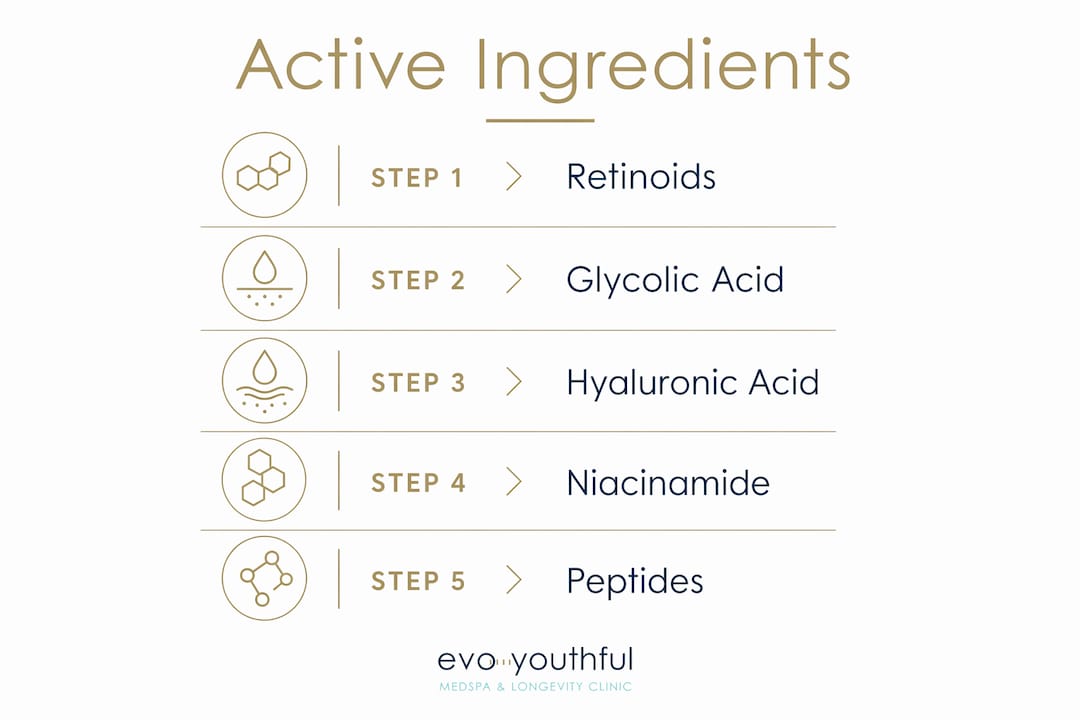
The same consensus identified a group of actives that are generally safe and supportive across most procedure types. These include ceramides, hyaluronic acid, niacinamide, and peptides. They support barrier function and reduce inflammation without increasing procedural risk. For guidance on preparing skin before a procedure, timing and ingredient selection matter as much as the products themselves.
Here is a practical breakdown of ingredient timing:
- Retinoids: Stop 5–7 days before ablative procedures; resume only after full healing
- Glycolic acid and other AHAs: Avoid on treatment day; pause 3–5 days before aggressive treatments
- Vitamin C: Generally safe pre-procedure; may need to pause post-laser depending on skin sensitivity
- Niacinamide: Safe before and after most procedures; supports barrier recovery
- Ceramides and hyaluronic acid: Safe at all stages; prioritize post-procedure for barrier support
- Peptides: Safe pre- and post-procedure; support collagen synthesis during healing
Pro Tip: Post-procedure skin is more permeable, which means actives absorb more deeply. This is an advantage for barrier-supporting ingredients like ceramides and hyaluronic acid, but a risk for potent actives like retinoids. Stick to gentle, restorative products for the first week after any ablative treatment.
How to choose medical grade skincare that actually works for your skin
Choosing the right clinical skincare products starts with moving past marketing language. Transparency in ingredient lists and honest clinical claims are stronger quality indicators than the phrase “medical-grade” alone. A brand that discloses exact concentrations, pH levels, and clinical study references earns more trust than one relying on prestige packaging.
The most effective approach involves professional guidance. Medical-grade products sold through professional channels come with the advantage of customized regimen development. A dermatologist or licensed aesthetician can assess your skin type, identify your primary concerns, and build a protocol that layers actives safely. Self-selecting high-potency products without that guidance often leads to irritation, barrier disruption, or wasted investment.
When evaluating products on your own, ask these questions:
- Does the brand list exact concentrations? Vague language like “enriched with retinol” without a percentage is a red flag.
- Is there clinical evidence for this specific formulation? Ingredient-level research is not the same as product-level validation.
- Does it fit your current routine? Stacking multiple actives without understanding compatibility causes more harm than benefit.
- What is your primary skin concern? Products targeting uneven skin tone require different actives than those targeting laxity or acne.
- Are you using it correctly? Overuse of retinoids or acids is one of the most common mistakes in clinical skincare routines.
Pro Tip: Start with one new active at a time. Introduce it three times per week, observe your skin’s response for two weeks, then increase frequency. This approach protects your barrier and helps you identify exactly what is working.
What are the real benefits of using medical grade skincare consistently?
Consistent use of clinical skincare produces measurable improvements that cosmetic products cannot replicate. The medical skincare benefits most commonly reported include visible reduction in acne breakouts, fading of hyperpigmentation and melasma, improvement in fine lines and photo-aging, and faster recovery after aesthetic procedures. These outcomes require time. Most clinical actives need 8–12 weeks of consistent use before visible change appears.
Skin barrier support is one of the most underappreciated benefits. Ceramides and niacinamide rebuild the lipid barrier, which reduces sensitivity, improves hydration retention, and makes skin more resilient to environmental stress. A stronger barrier also means better tolerance for potent actives over time.
The risks of misuse are real. Using high-concentration actives without professional guidance can cause contact dermatitis, post-inflammatory hyperpigmentation, or chronic barrier disruption. This is why the professional channel matters. The physician-curated skincare model exists precisely to match the right product to the right person at the right stage of their skin health.
Clinical skincare is an investment in long-term skin quality, not a luxury purchase. The difference between a $15 drugstore moisturizer and a $90 clinical ceramide complex is not the price. It is the formulation stability, delivery system, and concentration of actives that actually reach the skin’s target layers.
Key Takeaways
Medical-grade skincare delivers real results only when the right actives are matched to individual skin needs with professional guidance and consistent use.
| Point | Details |
|---|---|
| “Medical-grade” is not FDA-regulated | The term is a marketing label; evaluate products by ingredient concentration and clinical evidence instead. |
| Ingredient timing around procedures matters | Retinoids and acids should be paused before aesthetic treatments to prevent irritation and barrier damage. |
| Professional guidance improves outcomes | Physician or aesthetician oversight ensures actives are matched to your skin type and treatment goals. |
| Barrier-supporting actives are universally safe | Ceramides, hyaluronic acid, niacinamide, and peptides support skin health at every stage of a clinical protocol. |
| Consistency drives visible results | Most clinical actives require 8–12 weeks of regular use before measurable skin improvement appears. |
What I have learned after years of working with clinical skincare patients
I have seen patients arrive with bags full of products they bought online, all labeled “medical-grade,” none of them working together. The frustration is real, and it is completely understandable. The term sounds credible, and the packaging looks clinical. But a label does not treat skin. A protocol does.
What actually moves the needle is personalization. Two patients with hyperpigmentation can need completely different approaches depending on their skin tone, barrier integrity, and whether they are undergoing concurrent aesthetic treatments. One might tolerate a 15% vitamin C serum beautifully. The other might need to start with niacinamide alone for six weeks before introducing any brightening actives. There is no universal answer, and that is exactly why professional guidance exists.
The other thing I see consistently is impatience. Patients expect clinical results in two weeks. Real skin change at the cellular level takes time. Collagen remodeling, pigment clearance, and barrier repair are physiological processes. You cannot rush them. What you can do is build a protocol that supports them steadily and safely.
My honest recommendation is this: stop chasing the best medical grade products based on reviews and start asking what your skin specifically needs. A single well-chosen active used correctly will outperform a shelf of mismatched serums every time.
— Elizabeth Vogstrom, PA-C
Physician-guided skincare at evoyouthful
evoyouthful offers physician-curated skincare lines selected for clinical efficacy and matched to individual skin concerns by our team of medical professionals. Every skincare recommendation at evoyouthful is built around your specific skin type, treatment history, and goals, not a one-size-fits-all retail approach.
For patients undergoing aesthetic treatments like Exion Clear RF Microablation, our team integrates your skincare protocol with your procedure plan to protect your results and support healing. Whether you are starting a clinical skincare routine for the first time or refining an existing one, we are here to help you build something that works. Schedule a consultation at evoyouthful in Wayzata, MN, and get a skincare plan grounded in science and tailored to you.
FAQ
What does “medical grade” actually mean in skincare?
“Medical-grade” is a marketing term, not an FDA-regulated category. It generally refers to products with higher active ingredient concentrations and clinical research backing, sold through professional channels.
Is medical grade skincare the same as prescription skincare?
No. Prescription skincare products are FDA-regulated drugs requiring physician oversight. Medical-grade products are classified as cosmetics, even though they contain higher concentrations of actives than standard retail products.
Which ingredients should I avoid before an aesthetic procedure?
Retinoids and glycolic acid should be paused before aesthetic procedures. An international expert consensus found these actives increase irritation risk and can cause hyperpigmentation when used on treatment day.
How long does it take to see results from clinical skincare?
Most clinical actives require 8–12 weeks of consistent use before visible improvement appears. Collagen remodeling and pigment clearance are physiological processes that cannot be accelerated by using more product.
Do I need a dermatologist to use medical grade skincare?
Professional guidance is strongly recommended. Physician or aesthetician oversight helps match actives to your skin type and prevents the barrier disruption that commonly results from self-selecting high-potency products without a structured protocol.
Recommended
- What Is Advanced Skin Care Access? Your Complete Guide | evoyouthful Blog
- Skincare | Physician-curated skincare lines for clinical results at home | evoyouthful Wayzata, MN
- Boutique Medical Clinic Evaluation Guide for 2026 | evoyouthful Blog
- Your Seasonal Skin Care Minnesota Checklist by Season | evoyouthful Blog
Ready to Start?
Schedule a Consultation
Have questions about what you just read? Our team is here to help.