

48 Published Cases: Under Eye Filler Risks and Wayzata Protocols
Elizabeth Vogstrom, PA-C
evoyouthful Clinical Team
Wayzata patients: learn real under eye filler risks, peer reviewed case counts, delayed complication timelines, and the local clinic safety steps to ask...
48 Published Cases: Under Eye Filler Risks and Wayzata Protocols
Under-eye filler is generally low risk when an experienced medical injector performs it, but it carries one rare and serious exception: vascular occlusion that can lead to skin necrosis or vision loss. Most patients experience only bruising and swelling that resolve within one to two weeks. Before booking, discuss conservative trial dosing with your provider, confirm they keep hyaluronidase on-site, and ask directly how they would handle a vascular emergency, as recommended by experienced practitioners.
TL;DR:
- The risk of vascular occlusion leading to vision loss is extremely rare but serious, requiring immediate hyaluronidase treatment during emergency.
- Technique choice influences safety, with blunt cannulas reducing vascular injury but possibly increasing edema compared to needles, especially with conservative dosing of 0.2 to 0.4 cc per side.
- Most Bruising and swelling resolve within two weeks, but delayed complications can appear up to 52 months later, often requiring multiple treatments to resolve.
- Only experienced, certified providers with proven tear trough expertise, on-site hyaluronidase, and clear emergency protocols should perform the procedure.
- Combining under-eye filler with other treatments like laser or Botox requires careful timing and disclosure of medications to minimize interaction risks.
Table of Contents
- What Are the Under Eye Filler Risks Tied to Anatomy and Technique?
- What’s a Normal Recovery Timeline After Under Eye Filler?
- How Long Can Delayed Complications Take to Show Up?
- How Serious Is the Vision Loss Risk From Under Eye Filler?
- Why Does the Under-Eye Area Cause More Filler Complications Than Other Zones?
- What Should You Ask Before Booking Under Eye Filler?
- What Should You Do If Something Feels Wrong After Filler?
- Are You a Good Candidate for Under Eye Filler?
- Can You Have an Allergic Reaction to Under Eye Filler?
- Can Under Eye Filler Affect Your Mental Health?
- Does Under Eye Filler Interact With Other Treatments or Medications?
- An Honest Look at Why Caution Beats Confidence Here
- A Conservative, Medically Guided Path for Under Eye Filler in Wayzata
- Sources
What Are the Under Eye Filler Risks Tied to Anatomy and Technique?
Hyaluronic acid is the standard material for tear trough correction, and one of its biggest safety advantages is reversibility. If something goes wrong, a provider can dissolve it with hyaluronidase, something not possible with permanent fillers.
The skin under your eyes is some of the thinnest on your body, sitting close to a dense network of small blood vessels that connect to the ocular circulation. That proximity is the reason tear trough work carries more risk than, say, filling nasolabial folds.
Technique matters as much as product choice. A blunt cannula tends to reduce vascular injury compared to a sharp needle, though retrospective data comparing the two show tradeoffs either way:
- Needles are linked to more bruising (ecchymosis) in some patients.
- Cannulas are associated with slightly higher rates of post-procedure edema in certain studies.
- Conservative starting volumes, often cited around 0.2 to 0.4 cc per side, reduce the odds of overcorrection.
What’s a Normal Recovery Timeline After Under Eye Filler?
Bruising and swelling are the two complaints you should expect, and they follow a fairly predictable arc. Most bruising peaks within 48 hours and fades over 7 to 10 days, sometimes longer if you bruise easily. Swelling is usually worse in the morning for the first few days and settles within one to two weeks.
Recovery goes smoother with a few concrete steps:
- Apply cold compresses in short intervals for the first 24 to 48 hours to limit swelling.
- Sleep slightly elevated for a few nights to reduce fluid pooling under the eyes.
- Skip strenuous exercise, alcohol, and blood-thinning medications or supplements (with your doctor’s approval) for 48 hours.
- Avoid rubbing or applying pressure to the area while it settles.
- Call your provider if bruising expands rapidly, if pain increases instead of easing, or if you notice skin turning pale, mottled, or unusually dusky.
That last point is not a formality. Escalating pain or color change after the first day or two is a red flag, not a normal part of healing.
How Long Can Delayed Complications Take to Show Up?
This is where under-eye filler risks get less intuitive. Not every problem shows up in the first week. A systematic review found that delayed complications average 16.8 months after injection, with some cases of discoloration appearing as late as 52 months later.
By the numbers: The average delay before a filler complication surfaces is 16.8 months, and discoloration has been documented up to 52 months post injection, according to a systematic review of delayed filler complications.
What drives this lag? A few overlapping mechanisms:
- A low-grade immune reaction or biofilm can form around the filler months after the initial injection with no obvious trigger.
- Hyaluronic acid can persist in the tear trough for years, and in some documented cases 10 to 15 years, giving it a long window to shift or provoke swelling.
- Product migration away from the original injection site can create lumps or asymmetry well after the area looked settled.
A major review of periorbital filler complications classifies these problems as late complications, distinct from the immediate reactions like redness or bruising. Late complications, including chronic edema, nodules, and persistent discoloration, are harder to resolve. Treatment can require multiple rounds of hyaluronidase, a course of antibiotics if infection is suspected, or in stubborn cases, surgical removal.
How Serious Is the Vision Loss Risk From Under Eye Filler?
This is the risk that should shape every conversation with your injector. Vascular occlusion happens when filler is accidentally injected into a blood vessel, or compresses one enough to cut off circulation. Around the eyes, that vessel network connects to the ophthalmic artery, so a occlusion in the wrong spot can travel toward the eye itself.
The numbers behind the fear: Between January 2015 and September 2018, researchers tracked 48 published cases of filler-related ophthalmic complications worldwide, the majority involving vision loss. That is a small number given how many filler procedures happen globally each year, but it is the reason experienced injectors treat the tear trough with more caution than almost any other facial zone.
Warning signs of a vascular event include sudden, severe pain disproportionate to the injection, immediate vision changes, or skin that turns strikingly pale or mottled during or right after treatment. If any of this happens:
- The injector should stop immediately and administer high-dose hyaluronidase into the affected area without delay.
- An urgent ophthalmology referral is warranted for any vision change, even a brief one.
- Time matters more than almost any other factor in limiting permanent damage, which is why your provider’s readiness to act fast matters more than their bedside manner.
Why Does the Under-Eye Area Cause More Filler Complications Than Other Zones?
Three physical realities explain most of what goes wrong here. First, periorbital skin is thin and sits directly over vessels that other facial zones bury more deeply, which is why both bruising and vascular risk run higher in this spot than in, say, the cheeks or lips.
Second, placement depth changes the entire risk profile. Filler placed too superficially can scatter light and create a bluish tint under the skin, a phenomenon called the Tyndall effect. Deeper, sub muscular placement generally avoids that discoloration but demands more precise anatomical knowledge.
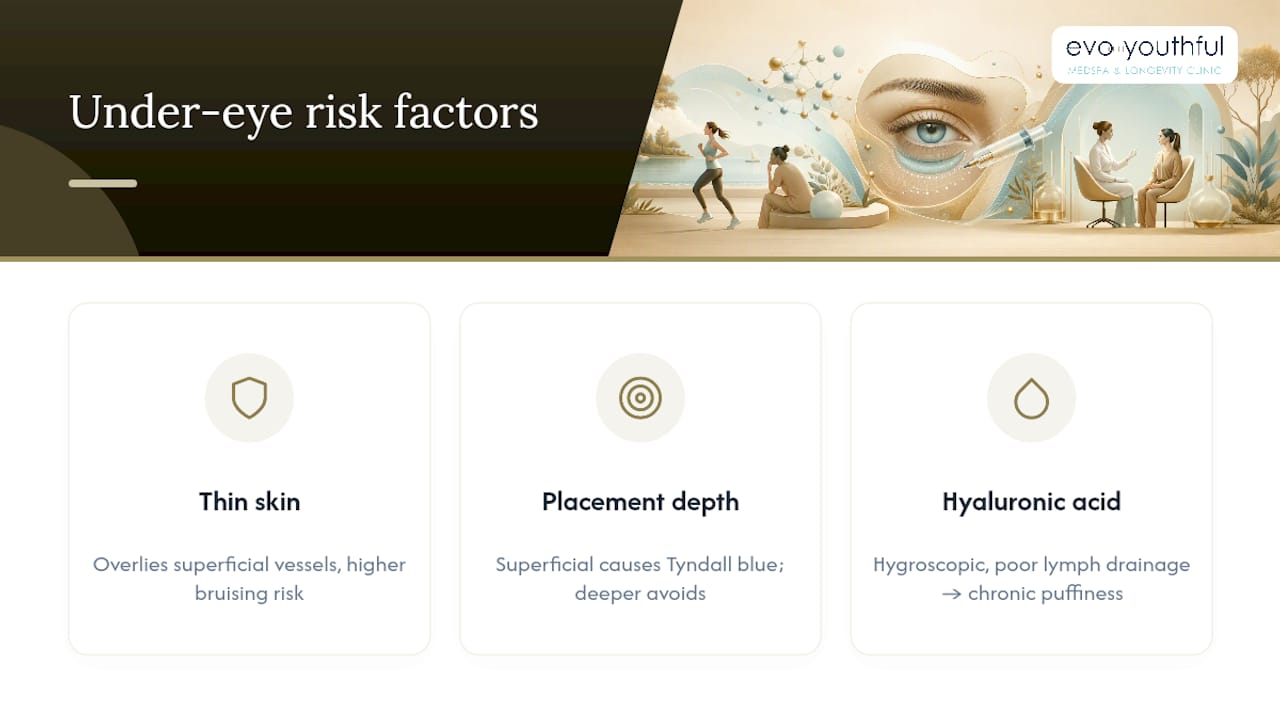
Third, hyaluronic acid is hygroscopic, meaning it draws in water. Combined with the eye area’s limited lymphatic drainage, that water-attracting property can produce chronic puffiness that looks like the under-eye bags the filler was meant to fix.
What Should You Ask Before Booking Under Eye Filler?
Your consult is where most future problems get prevented, not treated. Ask direct questions and expect direct answers.
A short provider checklist worth running through:
- Board certification (or equivalent credential) in a relevant medical specialty.
- Documented, specific experience with tear trough injections, not just filler in general.
- Treatment in a licensed medical setting with hyaluronidase stocked on-site.
- A clear, rehearsed emergency protocol for vascular events.
- A willingness to start conservative and add more filler in a staged follow-up appointment rather than maximizing volume on day one.
Pro Tip: Ask your injector what their smallest and largest tear trough treatments looked like in the past year. A provider who only describes one approach for every patient is less likely to individualize your dosing.
Timing precautions matter too. Avoid elective dental work for two weeks before and after your appointment, since dental procedures can seed bacteria that settle on filler material and trigger delayed infection. Tell your provider about any active infection, cold sore history, or supplements with blood-thinning effects before you sit in the chair.
What Should You Do If Something Feels Wrong After Filler?
Speed and documentation both matter if a complication appears.
- If you notice sudden vision change, severe or worsening pain, or skin that looks pale, mottled, or dusky, call emergency services and your injector at the same time. Do not wait to see if it improves.
- Photograph the area as symptoms develop. Timestamped images help any provider assess how fast something is progressing.
- For vision-related symptoms, get to a provider capable of administering hyaluronidase immediately and request an urgent ophthalmology consult.
- For a firm, warm, tender lump appearing weeks or months later, a sign dermatology sources tie to delayed infection, see a provider who can order imaging or cultures rather than waiting it out.
- For nodules or persistent puffiness that will not resolve, ask about a staged hyaluronidase plan, and if the area is unresponsive, a surgical consult.
Are You a Good Candidate for Under Eye Filler?
Filler tends to work best for mild volume loss with skin that still has decent elasticity. If your main concern is a genuine herniated fat pad pushing forward rather than a hollow, filler can actually make the area look puffier, not better, because it adds volume on top of an existing bulge.
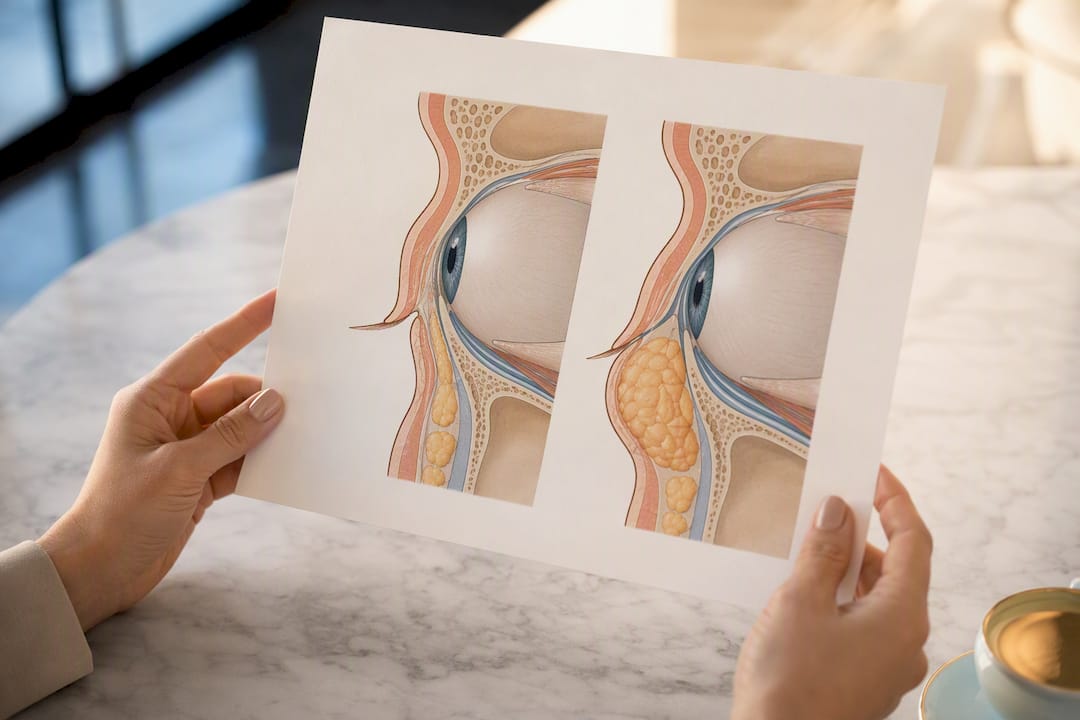
Better alternatives exist depending on the underlying issue. Topical treatments, lasers, or resurfacing address pigment and skin texture. Blepharoplasty or fat repositioning addresses true fat herniation surgically. PRF or fat grafting offer a regenerative option for volume loss without synthetic material. If you have existing filler and are considering surgery later, tell your surgeon. Filler sometimes needs to be dissolved first so it does not interfere with surgical planning.
Can You Have an Allergic Reaction to Under Eye Filler?
True allergic reactions to hyaluronic acid filler are uncommon, since the material is biologically similar to hyaluronic acid your body already produces. That said, hypersensitivity reactions do happen, and they are not the same thing as the normal bruising and swelling you expect the first few days.
Signs of a hypersensitivity reaction include hives, itching that spreads beyond the injection site, unusual warmth, or swelling that seems disproportionate to the procedure itself. In rare cases, a delayed hypersensitivity response shows up weeks later as a firm, sometimes tender nodule, distinct from the biofilm-driven nodules discussed earlier, though the two can look similar without proper evaluation.
Some fillers include trace additives, like lidocaine mixed into the syringe for comfort. If you have a known lidocaine allergy or a history of reacting to injectable materials, mention it before treatment starts, not after. A patch test is not standard for hyaluronic acid filler the way it might be for certain skincare ingredients, but a thorough medical history review at your consult serves a similar screening purpose.
If you develop any signs of hypersensitivity, contact your provider promptly. Mild reactions may resolve with antihistamines or a short course of steroids. More significant reactions may need the filler dissolved with hyaluronidase to remove the triggering material entirely. Anyone with a history of severe allergies or autoimmune conditions should raise that history explicitly during the consult, since it can change how a provider approaches both product choice and monitoring afterward.
Can Under Eye Filler Affect Your Mental Health?
Physical complications get most of the attention, but the psychological side of under-eye filler deserves equal weight. Dissatisfaction with results is one of the more common reasons patients seek dissolving treatments, even when nothing went medically wrong. Overfilled under-eyes can look puffy or unnatural, and that appearance can bother a patient far more than any bruise ever would.
There’s a harder conversation worth having too. For a subset of patients, cosmetic procedures become a repeating pattern rather than a one-time fix. If you find yourself fixated on a specific feature, seeking repeated treatments without satisfaction, or feeling that your appearance is fundamentally flawed despite reassurance from people around you, that pattern can be a sign of body dysmorphic disorder rather than a filler problem. A responsible injector should recognize these signals and, when appropriate, suggest a conversation with a mental health professional before proceeding with additional treatment.
Realistic expectations set at the consult stage prevent a lot of this. Under-eye filler softens hollows and shadows. It does not erase every sign of aging, and it will not resolve concerns rooted in how you see yourself rather than how the mirror actually looks. A provider who takes time to talk through what filler can and cannot achieve, rather than rushing to book the next appointment, is doing you a real favor.
Does Under Eye Filler Interact With Other Treatments or Medications?
Under-eye filler rarely exists in isolation. Most patients combining it with neuromodulators like Botox in the same visit tolerate that pairing well, since the treatments target different tissue layers and mechanisms. Timing still matters. Some providers space filler and neuromodulator injections a week or two apart near the eyes specifically to avoid confusing which treatment caused any swelling that shows up.
Laser resurfacing or RF microneedling around the same area calls for more caution. Heat-based treatments performed too soon after filler placement can theoretically degrade the hyaluronic acid faster or increase swelling risk, so most providers recommend spacing these treatments several weeks apart rather than stacking them in the same session.
Medications and supplements matter just as much as other procedures. Blood thinners, including common over-the-counter options like aspirin, fish oil, and vitamin E, increase bruising risk and should be discussed with your provider ahead of time, never stopped without a doctor’s approval. Anyone on medications that suppress the immune system should flag that history too, since it may affect infection risk and healing time.
The safest approach is full disclosure, not partial disclosure. Tell your injector about every recent cosmetic treatment, current medication, and supplement, even ones that feel unrelated. What looks irrelevant to you might change how they sequence your care.
An Honest Look at Why Caution Beats Confidence Here
Most of the fear-driven content around under-eye filler either overstates the danger or glosses over it entirely, and neither extreme serves patients well. The honest position sits in the middle: this is a low-risk procedure in skilled hands, and the rare exceptions are severe enough that “skilled hands” cannot be a throwaway phrase.
What gets underestimated is how much technique variability exists between providers who all call themselves experienced. A provider who has done a few hundred lip fillers is not automatically equipped for tear troughs, where the anatomy, vessel proximity, and margin for error are all less forgiving. I’d rather see a patient ask uncomfortable questions at a consult, board certification, hyaluronidase availability, actual tear trough case volume, than assume any injector with a needle is qualified for this specific zone.
The other overlooked piece is patience. Staged, conservative treatment consistently outperforms a single large-volume session, both for safety and for how natural the final result looks. If a provider pushes for maximum volume on your first visit, that is worth questioning rather than accepting.
— Elizabeth Vogstrom, PA-C
A Conservative, Medically Guided Path for Under Eye Filler in Wayzata
If you have read this far, you already know that under-eye filler rewards caution over speed, and evoyouthful builds its tear trough filler protocol around exactly that principle rather than a one-size, maximum-volume approach.

Consultations at evoyouthful start with a full assessment of your under-eye anatomy, skin elasticity, and whether filler, PRF, or a combination fits your specific concern better. A few reasons patients choose a medically supervised setting like this one:
- Licensed medical staff perform injections, not aesthetician-only providers.
- Hyaluronidase is kept on-site for reversal if a treatment needs adjusting.
- Follow-up appointments are built into the process, not left to chance.
- Staged, conservative dosing is the default starting point, with room to add more later.
If you are curious whether filler, PRF injections, or a combination approach fits your under-eye concerns best, the next step is simple: book a consultation and ask directly about small test dosing before committing to a full treatment plan.
This article is general information, not a substitute for advice from a qualified doctor. Consult a qualified healthcare professional about your own circumstances before acting on anything here.
Sources
- Delayed complications after dermal filler injections: a systematic review
- Complications of Periorbital Cosmetic Hyaluronic Acid Filler Injections: A Major Review
- Long-term effects of tear-trough hyaluronic acid filler: a retrospective study
- Today
Recommended
Ready to Start?
Schedule a Consultation
Have questions about what you just read? Our team is here to help.