

TMS Side Effects for Patients and Clinicians: Screening, MAUDE, Safety
Elizabeth Vogstrom, PA-C
evoyouthful Clinical Team
Evidence-first TMS safety for patients and clinicians. See which effects are common, how clinics screen and prevent rare risks, and what postmarketing...
TMS Side Effects for Patients and Clinicians: Screening, MAUDE, Safety
Most TMS side effects are mild and temporary. Scalp discomfort and headache affect a meaningful share of patients, especially in the first week, while serious events like seizure are rare when clinics follow standard screening protocols. Experienced clinicians note that the safety profile improves further when providers screen carefully and adjust intensity to each patient’s tolerance.
TL;DR:
- Most common side effects like headache and scalp discomfort are mild, tend to occur in the first week, and usually improve with adjustments or pain relief.
- Seizures are extremely rare, happening roughly once in tens of thousands of sessions, and most are confined to during stimulation, with proper monitoring greatly reducing risk.
- Patients with implanted metal devices, seizure history, or recent head trauma should avoid TMS, and medications lowering seizure threshold require careful evaluation.
- Proper screening, protective measures like earplugs, and gradual intensity ramp-up significantly decrease early discomfort and dropout rates.
- Long-term safety data is limited mainly to short courses, making provider adherence to safety protocols crucial for minimizing rare but serious risks.
Table of Contents
- What Are the Most Common TMS Side Effects?
- How Serious Are TMS Risks, and How Often Do They Happen?
- Who Should Avoid TMS or Needs Extra Screening First?
- How Do Clinics Prevent and Manage TMS Side Effects?
- What Happens During a Typical TMS Session and Course?
- What Does the Research Actually Show About TMS Safety?
- A Clinician’s Take on Evaluating TMS Safety
- Considering TMS? Here’s What a Careful Evaluation Looks Like
- Sources
- FAQ
What Are the Most Common TMS Side Effects?
If you’re weighing transcranial magnetic stimulation, the side effects you’re most likely to notice have nothing to do with seizures or mania. They’re mundane, physical, and short-lived. Headache and scalp discomfort top nearly every list of adverse events, and both tend to fade as your nervous system adjusts to repeated sessions.
Scalp discomfort and localized pain. The TMS coil delivers a focused magnetic pulse to a specific spot on your scalp, and that pulse stimulates not just neurons but also the muscles and nerves just under the skin. Patients often describe it as a tapping or knocking sensation that can feel uncomfortable during the first several sessions. Clinicians manage this by adjusting the coil angle, reducing stimulation intensity temporarily, or recommending an over-the-counter analgesic like acetaminophen or ibuprofen before a session.
Headache. This is the single most frequently reported side effect across TMS studies, according to a systematic review of adverse events in TMS patients, which also flagged insomnia, sinusitis, nausea, and fatigue as less common but still notable events. Headaches after TMS usually resemble tension headaches rather than migraines, tend to show up within an hour of treatment, and typically resolve within the same day. Mayo Clinic’s patient guidance confirms that headache and scalp discomfort are the most commonly reported effects and notes both tend to decrease as the treatment course continues. Your clinician may recommend a mild pain reliever before or after sessions, particularly during the first week, when your body is still adapting to daily stimulation.
Facial muscle twitching and jaw contractions. Because the TMS coil sits near facial nerve pathways, some patients experience involuntary twitching in the face or a tightening sensation in the jaw during stimulation. This happens when the magnetic pulse activates nearby motor nerves rather than the intended brain region. For patients with jaw contractions strong enough to cause teeth chattering, a bite guard can prevent dental strain, particularly for anyone with existing dental wear or a history of teeth grinding. If jaw tension lingers after sessions, treatments that target jaw tension and TMJ discomfort can offer relief separate from the TMS course itself.
Lightheadedness, fatigue, and transient mood shifts. A smaller number of patients report feeling briefly dizzy or unusually tired after a session. These symptoms are typically mild, resolve within hours, and rarely require any change to the treatment plan. Mood changes, when they occur, are usually positive as depressive symptoms improve, but any unexpected shift, whether irritability, anxiety, or unusual euphoria, should be reported to your care team right away.
The pattern across nearly every published case series is consistent:
- Side effects cluster in the first one to two weeks of treatment.
- Intensity decreases as the brain and scalp acclimate to repeated stimulation.
- Adjusting coil placement, angle, or intensity resolves most complaints without stopping treatment.
- Very few patients discontinue TMS solely because of these common effects.
That last point matters. Discomfort during the early sessions is common, but it’s rarely severe enough to end a treatment course. Clinicians who track patient tolerance closely and titrate intensity accordingly see far fewer dropouts than those using a one-size-fits-all protocol.
How Serious Are TMS Risks, and How Often Do They Happen?
The rare risks associated with TMS are the ones that deserve the most careful explanation, precisely because they’re uncommon enough that patients rarely hear detailed numbers. Seizure is the risk most people ask about first, and the honest answer is that it happens, but infrequently, and almost always under specific, identifiable circumstances.
Seizure risk. Guideline data cited in the Danish Psychiatric Society’s TMS guidelines put the seizure rate at a very low level, estimated to be about one in tens of thousands of treatment sessions in some cohort analyses, an estimate consistent with the low-risk profile described in international consensus guidelines on TMS safety. Those same guidelines note that while standard rTMS protocols carry low seizure risk, newer devices and patterned stimulation protocols may shift that risk profile, which is why they call for extra monitoring whenever a clinic introduces new equipment or stimulation patterns. When seizures do occur, they almost always happen during the stimulation session itself, not hours or days later, which is why trained staff stay present throughout every treatment.
Hearing damage and tinnitus. The TMS coil produces an audible click with each pulse, loud enough that hearing protection is considered a standard precaution rather than an optional comfort measure. Guidelines recommending routine earplug use during every session exist specifically because repeated, unprotected exposure to that clicking sound carries a real, if small, risk to hearing over a full course of daily treatments.
Mania or hypomania in patients with bipolar disorder. TMS can, in rare instances, tip a vulnerable patient toward a manic or hypomanic episode. WebMD’s patient-facing safety guidance specifically flags that people with bipolar disorder or severe anxiety need closer monitoring, since TMS can occasionally worsen symptoms like panic, insomnia, or mania rather than improve them. This is one of the clearest reasons a thorough psychiatric history matters before the first session is ever scheduled.
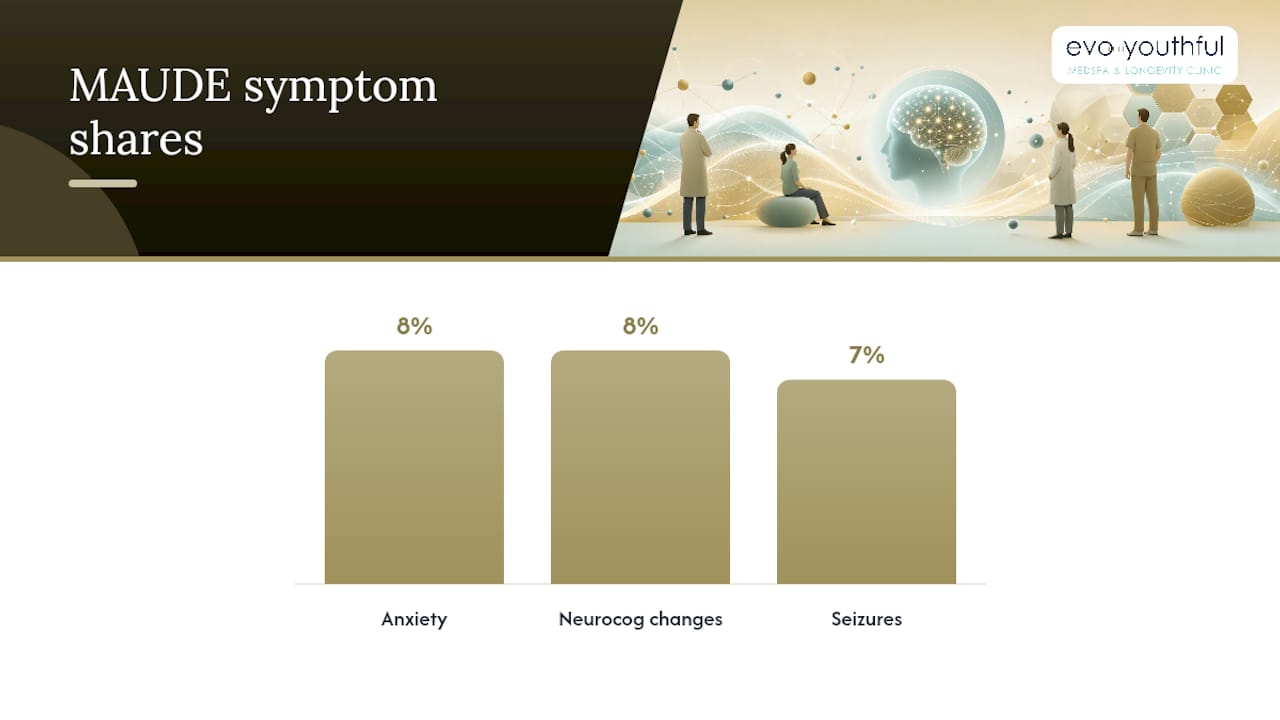
Other rare reports from real-world data. A 10-year analysis of the FDA’s MAUDE database identified 200 unique adverse event reports tied to TMS devices, with anxiety, neurocognitive changes, and seizures among the most frequently logged symptoms, appearing in roughly 8%, 8%, and 7% of reports respectively. That analysis also found most reports concerned patient injury rather than actual device malfunction, an important distinction for anyone worried the equipment itself is unreliable. It’s worth remembering that postmarketing databases like MAUDE capture voluntary reports, not controlled trial data, so they’re useful for spotting patterns but shouldn’t be read as precise incidence rates.
Statistic Callout: Headache and scalp discomfort remain the most frequently reported effects across pooled clinical trial data, while seizure, the most serious acute risk, occurs at an estimated rate of roughly one per tens of thousands of sessions in cohort data reviewed under the Danish Psychiatric Society’s 2025 guidelines. The gap between those two numbers is the clearest evidence that TMS’s risk profile is dominated by mild, manageable effects rather than rare catastrophic ones.
Who Should Avoid TMS or Needs Extra Screening First?
Not everyone is a candidate for TMS, and the exclusions exist for concrete physiological reasons rather than blanket caution. Screening before your first session is designed to catch every one of these issues before treatment begins, not after.
Implanted metallic or electronic devices. Cochlear implants, deep brain stimulators, and certain aneurysm clips near the treatment site are generally considered incompatible with TMS. The magnetic pulses can heat metal components or interfere with electronic device function, which is why a detailed implant history is one of the first things any responsible clinic asks about.
History of seizure disorder or recent head trauma. Anyone with epilepsy, a prior seizure, or a recent traumatic brain injury carries a higher baseline seizure risk, and TMS lowers the seizure threshold enough that this history changes the risk calculation meaningfully. Some patients with well-controlled epilepsy may still be candidates under close medical supervision, but the decision requires individualized clinical judgment, not a blanket rule.
Medications that lower seizure threshold. Certain antidepressants, antipsychotics, and stimulants can lower the seizure threshold on their own, and combining them with TMS compounds that risk. This is why a full medication review, not just a list of psychiatric medications, is part of proper pre-treatment screening.
Current or recent mania and uncontrolled bipolar disorder. As noted earlier, TMS can rarely trigger mood destabilization in susceptible patients. A clinician needs a clear picture of your psychiatric history, including past manic episodes, before recommending TMS as an appropriate treatment path.
Pregnancy. Evidence on TMS during pregnancy remains limited. Rather than a firm yes or no, this is a conversation to have directly with your prescribing physician, who can weigh your specific circumstances against the current evidence.
Full disclosure is the foundation everything else rests on:
- List every current medication, including over-the-counter drugs and supplements.
- Disclose any implanted device, even one you consider unrelated to the head or brain.
- Report any personal or family seizure history, however distant.
- Share your complete psychiatric history, not just your current diagnosis.
Clinics document these disclosures carefully because the informed consent process only works when the information behind it is complete. A patient who leaves out a detail they consider minor, like an old medication or a childhood seizure, removes the clinician’s ability to properly assess risk.
How Do Clinics Prevent and Manage TMS Side Effects?
Safety in TMS isn’t a single checkbox. It’s a sequence of decisions made before, during, and after every session, and the clinics that do it well treat each stage with equal seriousness.
- Pre-treatment screening. Before your first session, expect a detailed questionnaire covering medical history, current medications, implanted devices, and psychiatric background, followed by a conversation about what to expect and formal informed consent.
- Baseline counseling. A trained provider should walk you through common side effects, rare risks, and what a typical course looks like, so nothing you experience in week one comes as a surprise.
- On-session safeguards. Earplugs go on before the coil starts firing. Staff stay in the room to observe your response and adjust stimulation intensity if you’re struggling with discomfort. If jaw contractions are strong, a bite guard gets introduced.
- Ramping and titration. Rather than starting at full intensity, most protocols increase stimulation gradually across the first sessions, giving your tolerance a chance to build and giving staff a chance to catch problems early.
- Emergency preparedness. Every clinic offering TMS should have a documented seizure protocol and staff trained to execute it, plus a brief observation period built into the plan if any unusual event occurs.
- Ongoing adjustment. If headaches or scalp pain persist beyond the first week, expect your provider to adjust coil positioning, reduce intensity temporarily, or recommend simple analgesic strategies rather than pushing through discomfort unchanged.
Clinics that track screening protocols and operator training closely tend to see fewer sessions interrupted by preventable discomfort, since most side effects respond well to small, timely adjustments rather than a change in the overall treatment plan.
Pro Tip: Sleep well the night before each session, skip alcohol on treatment days, and keep an updated list of every medication and supplement you’re taking. Clinics track changes in sleep, new prescriptions, and alcohol use throughout a TMS course because each one can shift your seizure threshold and change how side effects show up.
What Happens During a Typical TMS Session and Course?
A full TMS course typically runs 20 to 30 sessions, scheduled on weekdays over roughly four to six weeks. Each individual session lasts somewhere between 20 and 40 minutes, depending on the specific protocol your clinician selects.
- Coil placement. A technician positions the magnetic coil against a precise spot on your scalp, usually over the region of the brain linked to mood regulation, and secures it in place for the duration of the session.
- Stimulation begins. You’ll hear a repeated clicking sound as pulses fire, and you may feel a tapping sensation along with brief, involuntary muscle twitches in your scalp or face. Earplugs go in before this starts.
- Immediate recovery. Most patients walk out and resume normal activities right away. Cleveland Clinic’s patient guidance confirms TMS is noninvasive enough that most people tolerate it well and can drive themselves home, though anyone experiencing dizziness should arrange alternate transportation as a precaution.
- Symptom pattern over the course. Headache and scalp discomfort, if they occur, tend to show up hardest in the first week and ease noticeably as sessions continue. Clinical benefit for mood symptoms, by contrast, usually builds gradually and often becomes noticeable only after several weeks of consistent treatment, not immediately.
- Communication with your care team. Report any new medication, a significant change in sleep, or any symptom that feels different from your baseline. Cleveland Clinic’s guidance also notes that current evidence hasn’t demonstrated memory loss or serious long-term cognitive effects from standard TMS protocols, which is reassuring for patients weighing a multi-week commitment.
What Does the Research Actually Show About TMS Safety?
The evidence base for TMS safety rests on three overlapping sources: consensus clinical guidelines, systematic reviews of trial data, and postmarketing surveillance of real-world reports. Each fills a gap the others can’t.
Consensus guidance from the International Federation of Clinical Neurophysiology states plainly that seizure risk with standard rTMS protocols is low, while cautioning that novel devices and patterned stimulation approaches need closer monitoring until more data accumulates. That’s a meaningful distinction: the safety data behind a well-established protocol is not automatically transferable to a brand-new device or stimulation pattern, and thoughtful clinics treat newer technology with proportionally more caution.
Systematic reviews of adverse events consistently rank headache as the most frequent complaint, with insomnia, nausea, sinusitis, and fatigue trailing well behind in frequency. Postmarketing data from the FDA’s MAUDE database adds a different lens entirely, capturing real-world reports across a full decade of device use rather than the controlled conditions of a clinical trial.
| Adverse event | Reported frequency context | Source |
|---|---|---|
| Headache | Most frequently reported adverse event in pooled trial data | Systematic review |
| Seizure | Roughly 1 in tens of thousands of sessions in cohort data | Danish Psychiatric Society Guidelines |
| Anxiety (postmarketing) | Present in roughly 8% of MAUDE reports | MAUDE analysis |
| Neurocognitive changes (postmarketing) | Present in roughly 8% of MAUDE reports | MAUDE analysis |
The honest gap in this evidence is long-term monitoring. Most safety data covers a single treatment course of several weeks, not years of follow-up, and newer stimulation paradigms simply haven’t accumulated the same volume of real-world reporting as standard protocols. That’s not a reason for alarm, but it is a reason to favor providers who stay current with published safety data and monitor conservatively rather than assuming yesterday’s evidence automatically applies to tomorrow’s device.
A Clinician’s Take on Evaluating TMS Safety
The gap I see most often isn’t in the research, it’s in how patients evaluate providers. The data on TMS safety is genuinely reassuring: most side effects are mild, predictable, and manageable, and serious events are rare when protocols are followed. What varies dramatically is whether a given clinic actually follows them.
Before starting treatment, ask direct questions. Does the provider use a written screening questionnaire covering seizure history, implants, and medications? Is hearing protection mandatory for every session, not optional? Is there a documented emergency plan if something unexpected happens mid-session? A clinic that can’t answer these clearly, or treats them as an afterthought, is a red flag regardless of how modern its equipment looks. My work overseeing ExoMind TMS treatments at evoyouthful has reinforced something the guidelines already say: the technology is only as safe as the screening and monitoring built around it.
— Elizabeth Vogstrom, PA-C
Considering TMS? Here’s What a Careful Evaluation Looks Like
A careful approach to ExoMind TMS starts with the same screening rigor outlined throughout this guide: a full medication and implant review, a detailed psychiatric history, and honest counseling about what your first week of sessions might feel like before you commit to a full course. That upfront investment in screening is what keeps the common, manageable side effects manageable and catches the rare contraindications before they become a problem.

An initial evaluation walks through your history, answers your questions about the treatment timeline, and sets realistic expectations for when you might notice changes in mood versus when you might notice mild scalp discomfort or headache in the first week. If you’re ready to see whether ExoMind fits your situation, learn more about ExoMind at evoyouthful and request a consultation to get a personalized safety review and treatment plan.
This article is general information, not a substitute for advice from a qualified doctor. Consult a qualified healthcare professional about your own circumstances before acting on anything here.
Sources
- Transcranial magnetic stimulation - Mayo Clinic
- Postmarketing Safety of Transcranial Magnetic Stimulation: A 10-Year MAUDE Database Analysis
- Transcranial magnetic stimulation: TMS Side Effects - WebMD
FAQ
What Is the Success Rate of TMS?
Clinical studies generally show meaningful improvement in depressive symptoms for a substantial portion of patients who complete a full course, though exact response rates vary by study design and patient population. Your own likelihood of benefit depends on factors like diagnosis history and prior treatment response, which is best discussed directly with your provider.
What Are the Negatives of TMS Therapy?
The most common downsides are mild and temporary: headache, scalp discomfort, and occasional facial twitching during sessions, all of which typically ease as treatment continues. The treatment also requires a significant time commitment, often 20 to 30 sessions over four to six weeks, which is a practical hurdle for some patients.
What Is the Controversy With TMS?
Some debate centers on how strongly TMS outperforms alternatives like medication or therapy for certain patients, and on how well safety data for newer stimulation devices and patterns matches the well-studied standard protocols. Consensus guidelines address this directly by calling for extra monitoring whenever a clinic introduces a device or protocol that lacks the same depth of safety data as established approaches.
How Much Does TMS for Depression Cost?
Cost varies by clinic, provider credentials, and the length of the treatment course, so there’s no single fixed number that applies everywhere. evoyouthful does not publish pricing for ExoMind TMS online. Contact the clinic directly to get current pricing and consultation details for your specific situation.
Ready to Start?
Schedule a Consultation
Have questions about what you just read? Our team is here to help.