
Tailbone Pain Therapy: What Works and When to Get Help
Elizabeth Vogstrom, PA-C
evoyouthful Clinical Team
Tailbone pain therapy explained: home care, pelvic floor therapy, medical options and warning signs, so you know what to try first and when to call.
Tailbone pain usually improves with a layered approach: take pressure off the area, calm the muscles around it, and have a clinician look at the cause if it lingers. For many adults, especially those who sit through long workdays, drives and flights, the muscles of the pelvic floor are part of that picture, which is why our pelvic floor therapy is worth knowing about. This guide walks you through the self-care that makes sense in the first weeks, the therapies studied for persistent pain, and the signs that mean you should be examined promptly.
TL;DR
- Most tailbone injuries are bruises, not breaks. MedlinePlus says bruises take about four weeks to heal and fractures about eight to twelve weeks.
- First-line care is simple: limit prolonged sitting and hard seats, use a cushion, apply ice early, and sleep on your stomach if that is comfortable.
- Persistent pain deserves a proper evaluation. Causes range from a hypermobile or injured coccyx to pelvic floor, nerve and sacroiliac problems.
- Physical therapy, including pelvic floor work, has shown short-term benefit in recent reviews, though long-term evidence is still limited.
- Leg numbness, bowel or bladder changes, fever or rectal bleeding mean a same-week call to your doctor.
Table of Contents
- What the tailbone is and why it hurts
- Start here: relief you can begin today
- Bruised or broken: how to tell and what to expect
- What a good evaluation covers
- Physical therapy for tailbone pain: what the research shows
- Medical options when pain persists
- A realistic timeline
- Why the seat matters for busy professionals
- Promo: pelvic floor care in Wayzata
- Our perspective
- FAQ
- Sources
What the tailbone is and why it hurts
The tailbone, or coccyx, is the small bony tip at the bottom of your spine. It is anchored by ligaments and surrounded by muscles of the pelvic floor, the sling of muscle that supports the bladder, bowel and, in women, the uterus. Because so many structures attach there, pain in this spot can come from several places.
According to the MSD Manual Professional Edition, causes include a coccyx that moves too much (hypermobility), bone spurs, dislocation, fracture, other injuries and osteoarthritis. Conditions nearby can also refer pain to the area: anorectal problems, pelvic floor dysfunction, nerve irritation and sacroiliac joint problems (the joints where the spine meets the pelvis).
That range matters. A fall on an icy dock or a golf cart bump produces a very different problem from pain that creeps in after months of long meetings in a firm chair, or after childbirth, and the therapy should match the source.
Start here: relief you can begin today
For a recent injury or a flare, the MedlinePlus aftercare guidance, reviewed October 7, 2024, gives clear steps.
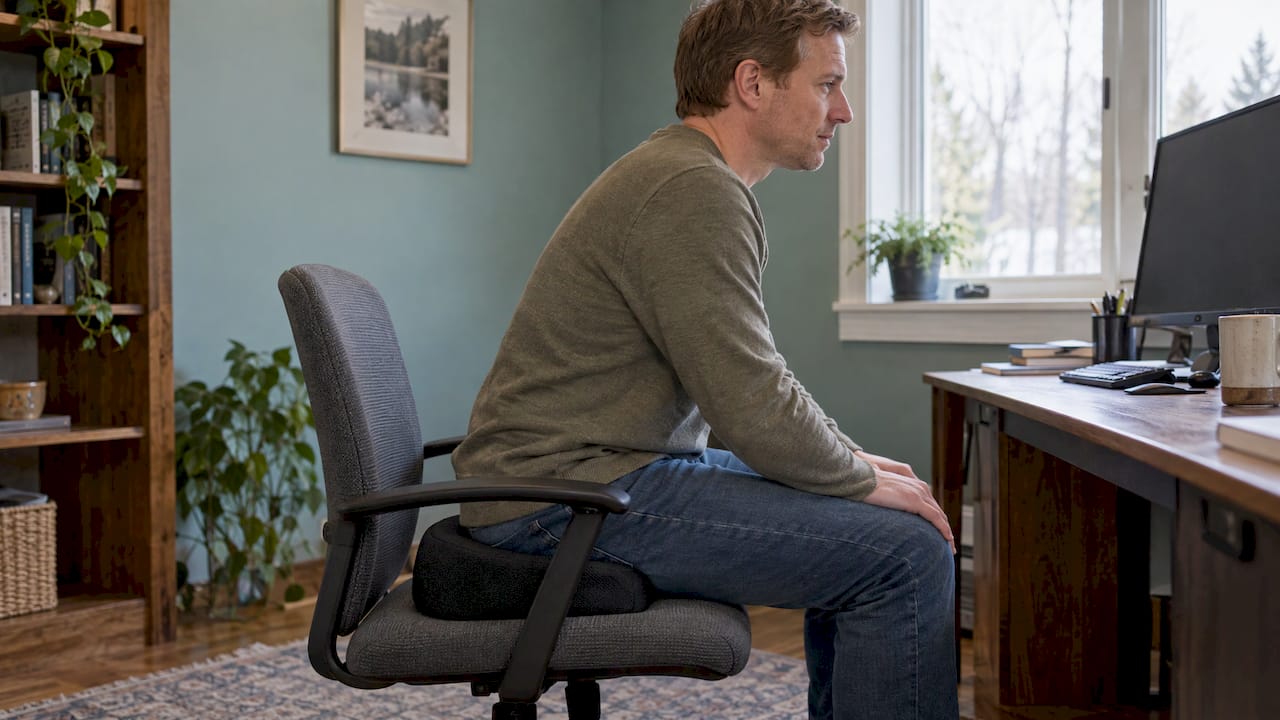
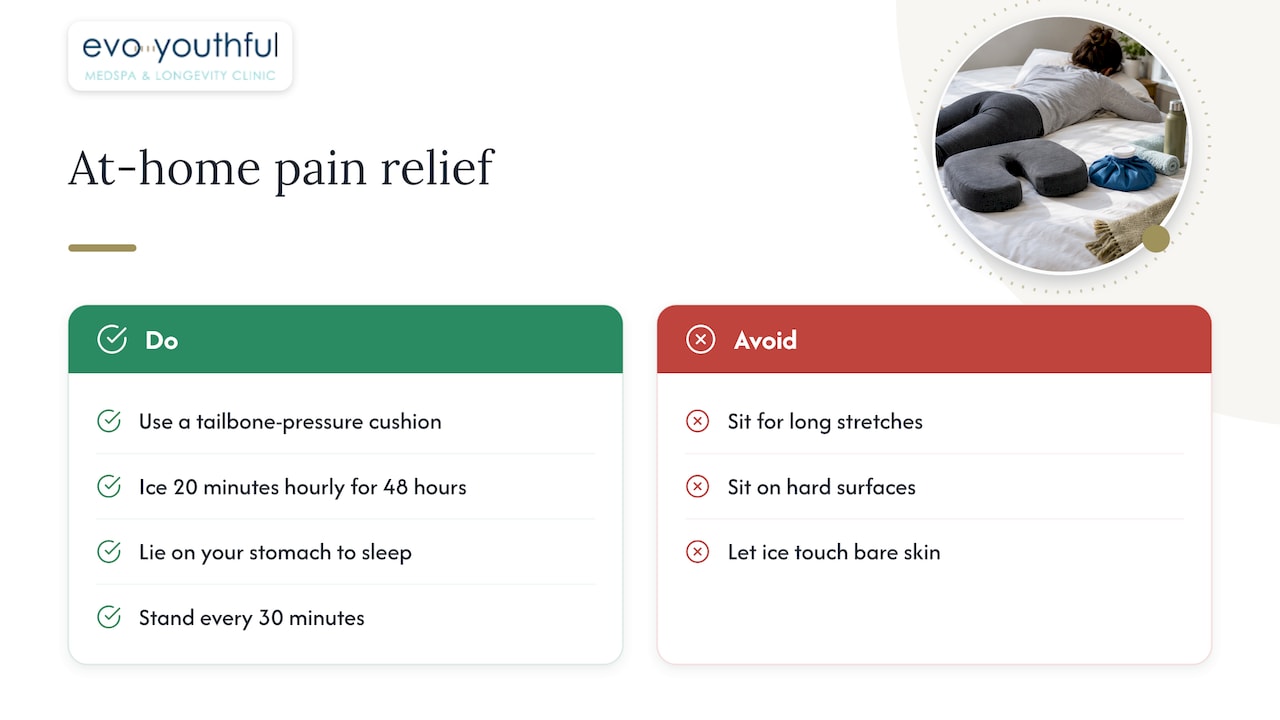
Take pressure off. Avoid sitting for long stretches and avoid hard surfaces. Sit on a cushion designed to relieve tailbone pressure. Many people also find that leaning slightly forward and shifting weight to the thighs helps.
Use ice early. MedlinePlus recommends ice for about 20 minutes every hour while you are awake for the first 48 hours, then two to three times a day, with a cloth or other barrier so the ice never touches bare skin.
Rethink sleep. Lying on your stomach reduces pressure on the tailbone at night. If that is uncomfortable for your shoulders or neck, a pillow under the hips can make it easier.
Build in breaks. If your day is meetings, flights or drives, set a timer to stand every 30 minutes. A standing desk or a cushion on your office chair and car seat removes a lot of repeated pressure.
Your clinician may also advise an over-the-counter pain reliever. The MSD Manual lists oral NSAIDs, acetaminophen and topical diclofenac among the options. Check with your doctor first if you take blood thinners, have kidney or stomach issues, or take other medicines.
Bruised or broken: how to tell and what to expect
You usually cannot tell by feel. MedlinePlus notes that fractures are uncommon and that trauma more often causes bruising or ligament strain. The timeline is the practical clue: a bruise should be steadily improving by about four weeks, while a fracture can take eight to twelve weeks to heal.
If the pain is not following that pattern, a clinician can examine you and, when symptoms persist or the injury was significant, order an X-ray. The MSD Manual adds that pelvic MRI or CT may be considered when symptoms persist without explanation.
Warning signs that need prompt care
Contact a provider if you have any of the following, per MedlinePlus:
- Sudden numbness, tingling or weakness in the legs
- Pain or swelling that is getting worse
- An injury that is not healing as expected
- Prolonged constipation
- Problems controlling your bowels or bladder
The MSD Manual also flags unexplained weight loss or fever, constant pain with no injury behind it, drainage of pus, a rectal mass, and rectal bleeding or painful bowel movements. Severe pain after a serious fall, a suspected spinal injury or being unable to move calls for emergency care, as MedlinePlus states. These are reasons to see your primary care physician or go to urgent care or the emergency room, not to wait and see.
What a good evaluation covers
When pain lasts beyond a few weeks, an evaluation should start with your story. The MSD Manual’s approach begins with when the pain started, how long it has lasted, exactly where it sits, what makes it better or worse, associated symptoms and your medical history. It continues with a focused examination, which may include a rectal or neurologic exam when indicated.
Bring answers to these questions to any visit:
- Did a fall, a hard landing or childbirth come before the pain?
- Does it hurt most when you rise from a seated position, or when you sit down?
- Does it ease when you stand or walk?
- Do you have pain with bowel movements, or with intimacy?
- Do you feel tightness, pressure or a deep ache in the pelvis or buttocks?
That last pair of questions is not incidental. Pain with bowel movements or intimacy can point toward pelvic floor muscles that are tight or not coordinating well, which is a treatable contributor.
Physical therapy for tailbone pain: what the research shows
Two 2025 systematic reviews looked at physical therapy for coccydynia, the medical term for tailbone pain.
The review in Archives of Physiotherapy pooled 10 studies with 515 adults. It found short-term improvements in pain or function with several approaches: shockwave therapy, kinesiotaping combined with exercise, stretching or massage of the levator ani (the main pelvic floor muscle), manipulation, and muscle-energy technique, a gentle method where you contract a muscle against light resistance to release tension.
A second review in BMC Musculoskeletal Disorders included nine randomized trials with 532 participants and reported promising effects, with shockwave therapy standing out. It also found that manual therapy benefits were especially clear in recent-onset pain, and that kinesiotaping improved pain more than it improved day-to-day function.
What does that mean for you? Hands-on and muscle-focused therapy is a reasonable early step, and earlier tends to be better. Both reviews note that the studies were small and varied and that long-term follow-up is limited, so results are best judged by how you feel over weeks, with a plan that is adjusted as you respond.
Why the pelvic floor belongs in the conversation
The tailbone is the attachment point for pelvic floor muscles. When those muscles stay tight, from prolonged sitting, stress, prior injury or childbirth, they pull on the coccyx and can keep it irritated long after an injury should have settled. Releasing and retraining those muscles is one of the techniques studied in the reviews above, and it is gentle compared with many alternatives.
If you want to understand what a pelvic floor program looks like from the first visit through follow-up, our guide to pelvic floor therapy steps and the typical timeline lays it out. Pelvic floor tension also shows up as other symptoms, so you may find our articles on painful intercourse and pelvic floor incontinence relevant.
Gentle movement that supports recovery
Once acute pain settles, many people are guided toward stretches that relax the muscles around the pelvis, such as a supported child’s pose or happy baby, and short walks. Move within comfort. If a stretch sharpens the pain, stop and mention it to your clinician. Exercises for tailbone pain are most useful when matched to the cause, because a hypermobile coccyx and a tight pelvic floor call for different emphasis.
Medical options when pain persists
If several weeks of home care and therapy are not enough, a physician has more tools. The MSD Manual describes injections as one of them. A diagnostic injection of local anesthetic that quickly produces substantial relief can help pinpoint the source of pain. A therapeutic injection may then use a corticosteroid, a local anesthetic, or both, targeted to the suspected site, and it can be repeated if relief is incomplete or the pain returns.
For stubborn cases, the StatPearls review of coccyx pain, updated August 2025, says referral to a clinician experienced in coccydynia is reasonable. If surgery is being considered, it advises a spine surgeon with experience in removing the coccyx, and it notes that pain can persist after surgery. That is a conversation to have with your physician and a surgeon, not something to decide from an article.
A realistic timeline
| Stage | Typical focus | What to watch |
|---|---|---|
| First 48 hours | Ice with a barrier, cushion, less sitting | Numbness, bowel or bladder changes |
| Weeks 1 to 4 | Continue cushion use, short walks, gentle stretching | Bruises should steadily improve by about four weeks |
| Weeks 4 to 12 | Hands-on or pelvic floor therapy, posture and seating changes | Fractures may take eight to twelve weeks to heal |
| Beyond 12 weeks | Full evaluation, imaging if indicated, medical options | Pain that is constant, worsening or unexplained |
The timeframes come from MedlinePlus for healing and from the MSD Manual for evaluation. Your own plan will vary with your age, the cause and your activity level.
Why the seat matters for busy professionals
For executives, business owners and golfers around Wayzata and Lake Minnetonka, tailbone pain often builds from habit rather than a single event: a long commute on 394, hours in a firm boardroom chair, a day on the course with repeated rotation, or a flight to a meeting. A few adjustments make a real difference:
- Keep a cushion in the car and at the office.
- Sit with your weight on your sit bones, not rolled back onto the tailbone.
- Change position often and stand during calls.
- After rounds of golf or yoga, take a few minutes to release the hips and glutes gently.
Promo: pelvic floor care in Wayzata
If your tailbone pain comes with pelvic tightness, bladder or bowel symptoms, or pain with intimacy, a pelvic-floor-focused plan may be the missing piece. Our clinic in Wayzata offers pelvic floor therapy and pain management as part of a personalized, data-driven approach to wellness.

We also offer Emsella, a treatment aimed at the pelvic floor, and you can read how it fits into care in our article on Emsella for incontinence. If your discomfort extends to the lower back or hips, our pages on low back pain and joint pain describe what we address. To talk through your situation, schedule a consultation.
Our perspective
Tailbone pain rarely has one cause, and it rarely responds to one fix. In our experience of working with adults who want to stay active and comfortable, the best results come when the whole picture is considered: the bone, the muscles around it, posture, daily habits and overall wellness.
That is why we build personalized plans. Our clinic is led by an advanced BHRT-certified physician assistant with more than 20 years of medical aesthetics experience, and we combine detailed assessments with regenerative and non-surgical approaches. Pelvic floor therapy and pain management are part of what we offer, and we think the pelvic floor deserves a place in any conversation about persistent pelvic or tailbone discomfort.
If you have warning signs such as leg weakness or bowel and bladder changes, please see your physician right away. For everything else, we would like to help you move toward renewed vitality, one step at a time.
Elizabeth Vogstrom, PA-C
FAQ
How long does tailbone pain last?
A bruised tailbone typically takes about four weeks to heal, and a fracture may take eight to twelve weeks, according to MedlinePlus. Pain that lasts longer or keeps returning is worth a full evaluation to find the cause.
How should I sleep with tailbone pain?
MedlinePlus suggests lying on your stomach so there is no pressure on the tailbone. If that is not comfortable, try lying on your side with a pillow between your knees and avoid sleeping on a firm surface that loads the base of your spine.
Is a donut cushion the best choice?
Any cushion that takes pressure off the tailbone and lets you sit comfortably is reasonable, and MedlinePlus recommends using a cushion. Pick one that keeps your weight off the very tip of the spine, and combine it with regular position changes.
Can pelvic floor therapy help tailbone pain?
Pelvic floor muscles attach to the coccyx, and stretching or massage of the levator ani muscle was among the approaches that showed short-term benefit in a 2025 systematic review. Results vary by cause, so a proper evaluation comes first.
When is tailbone pain an emergency?
Seek emergency care for severe pain after serious trauma, a suspected spinal injury, or if you cannot move, as MedlinePlus notes. Sudden leg numbness or weakness and loss of bowel or bladder control also need prompt medical attention.
Sources
- Tailbone trauma - aftercare, MedlinePlus
- Tailbone trauma, MedlinePlus Medical Encyclopedia
- Coccygeal Area Pain, MSD Manual Professional Edition
- Coccyx Disorders, MSD Manual Professional Edition
- Effectiveness of physical therapy interventions for coccydynia, Archives of Physiotherapy (2025)
- Physiotherapy approaches for coccydynia, BMC Musculoskeletal Disorders (2025)
- Coccyx Pain, StatPearls
Recommended
Ready to Start?
Schedule a Consultation
Have questions about what you just read? Our team is here to help.