
RF Microneedling Downtime: Clinician Plan for Work, 24 to 48 Hour Peak
Elizabeth Vogstrom, PA-C
evoyouthful Clinical Team
Clinician planned timeline to schedule RF microneedling around work. Expect a 24 to 48 hour redness peak and most visible recovery within 3 to 7 days.
RF Microneedling Downtime: Clinician Plan for Work, 24 to 48 Hour Peak
Most people see redness and mild swelling that peaks 24 to 48 hours after RF microneedling and settles within 3 to 7 days. Deeper treatment settings or more sensitive skin can stretch visible recovery closer to the 7 to 10 day mark. Contact your clinician if redness worsens, spreads, or comes with fever or drainage instead of gradually fading.
TL;DR:
- Redness and swelling typically peak within 24 to 48 hours, with visible signs resolving in 3 to 7 days for most patients, depending on treatment depth.
- Deeper or more sensitive treatments can extend recovery up to 10 days, requiring careful observation for worsening symptoms such as spreading redness or persistent pain.
- Proper first 48-hour care, including gentle cleansing, avoiding active skincare ingredients, and resisting picking flaking skin, significantly influences final results and downtime.
- Multiple sessions spaced several weeks apart are usually necessary for optimal results, with collagen remodeling continuing for 3 to 6 months after the last treatment.
- Recovery time varies based on individual skin type, treatment settings, and occupational needs; scheduling treatments to align with personal and professional commitments is recommended.
Table of Contents
- What Is RF Microneedling and Why Does Its Downtime Differ From Regular Microneedling?
- What Happens Hour by Hour After RF Microneedling?
- What Side Effects Are Normal, and When Should You Call Your Clinician?
- How Do You Take Care of Your Skin After RF Microneedling?
- How Many RF Microneedling Sessions Do You Actually Need?
- Who’s Behind This Recovery Guidance?
- The Recovery Timeline Matters More Than the Treatment Itself
- Ready to Plan Your RF Microneedling Timeline?
- Sources
- FAQ
What Is RF Microneedling and Why Does Its Downtime Differ From Regular Microneedling?
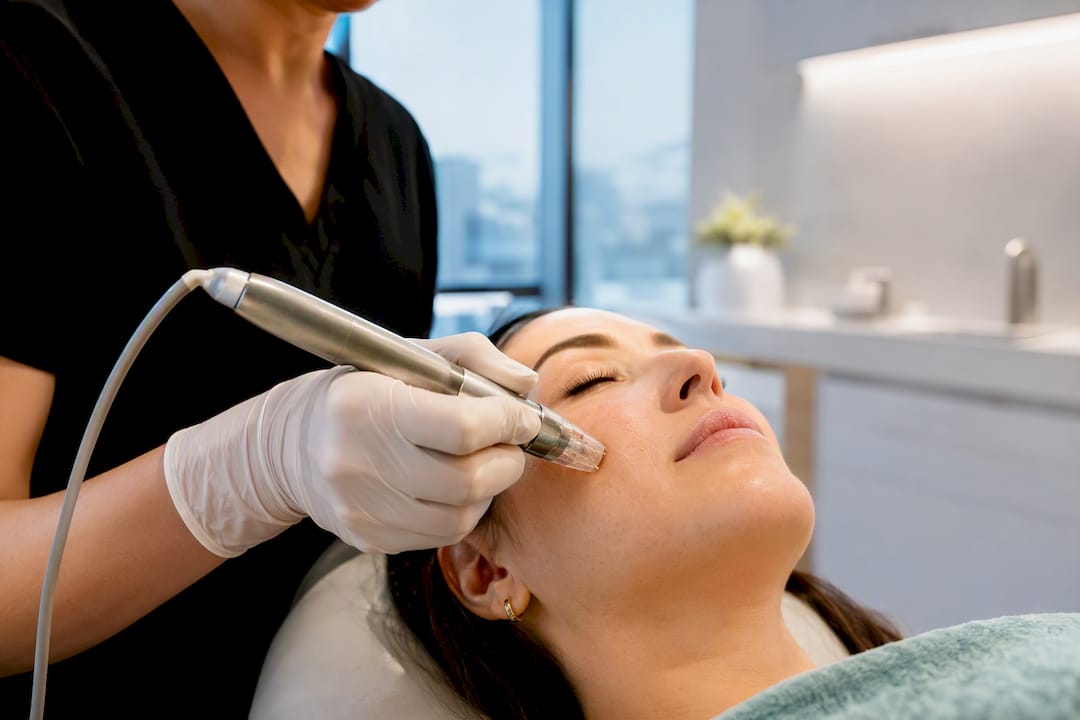
RF microneedling pairs fine needles with radiofrequency energy delivered directly into the dermis. Standard microneedling only creates a physical micro-injury to trigger collagen production. RF microneedling adds a heat component, and that heat is precisely why the recovery timeline looks different from a plain needling session.
The added thermal energy prompts a deeper, more controlled healing response, which is why results tend to be more dramatic but the initial inflammation phase can run slightly longer. Your skin is not just recovering from tiny punctures, it is also processing localized heat that extends into the deeper skin layers.
A typical in-clinic visit follows a predictable sequence:
- Cleansing and numbing with topical anesthetic, usually left on for 20 to 30 minutes
- Device pass across the treatment area, adjusted for depth and energy based on your skin
- Immediate post-treatment cooling and a barrier product applied before you leave
Topical anesthesia matters more than most people expect. One 2026 clinical review tracking 126 patients across 590 treatments reported an average pain score of 5.61 out of 10, which is why proper numbing protocol has a direct effect on how tolerable, and how recoverable, your appointment feels.
What Happens Hour by Hour After RF Microneedling?
Recovery follows a fairly consistent arc, though the exact intensity depends on your device settings, treatment depth, and your skin’s individual response. Here’s how it typically unfolds.
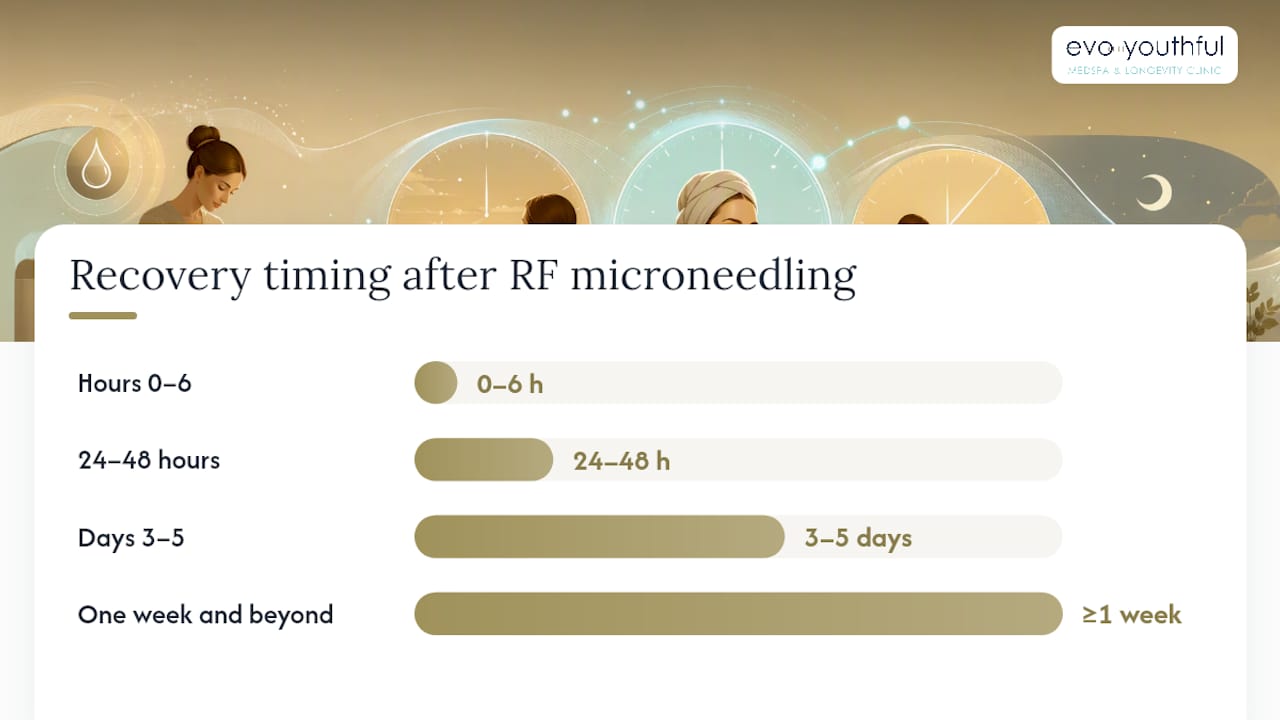
- Hours 0 to 6: Redness and warmth peak almost immediately, often described as feeling like a moderate sunburn. Mild stinging is common, and you may notice pinpoint bleeding or small dots where the needles penetrated. This is the most visually intense phase and the reason most clinicians recommend scheduling treatment when you don’t need to be anywhere right after.
- 24 to 48 hours: Redness usually softens noticeably during this window. Swelling and a tight, “sunburned” sensation may actually peak here before beginning to fade, according to clinic-reported recovery timelines. Some people wake up on day two looking more swollen than day one, which surprises them, but it’s a normal part of the inflammatory response resolving.
- Days 3 to 5: Flaking, dryness, and mild tenderness take over from active redness. Skin can feel rough or slightly tight, similar to peeling after a light sunburn. Makeup usually covers residual pink tones well by this point for most skin tones.
- One week and beyond: Most visible signs, including redness, flaking, and tenderness, have resolved for the majority of patients. The 2026 review found that while all 126 patients in the study experienced temporary redness, it resolved within 3 to 7 days for most of them.
- Weeks to months: This is where the real work happens beneath the surface. Collagen remodeling continues for 3 to 6 months after your last session, gradually improving texture, firmness, and fine lines long after the visible redness is gone.
Pro Tip: Book your appointment on a Thursday or Friday afternoon if your job requires a polished appearance. That gives you the weekend to move through the peak swelling window before Monday.
Skin type and treatment depth change this timeline more than people expect. Someone getting a lighter, more superficial pass for mild texture concerns may barely notice day two. Someone getting a deeper setting for acne scarring or significant laxity should plan for the fuller week.
What Side Effects Are Normal, and When Should You Call Your Clinician?
Redness, tightness, mild swelling, and light flaking are the expected script for RF microneedling recovery. Occasionally, people prone to cold sores notice a flare near the mouth area, since the micro-injury and heat can reactivate the virus, so mention your history to your provider beforehand if this applies to you.
Every single participant in a study of 126 patients receiving 590 total treatments experienced temporary redness after their sessions. That is the expected outcome, not a complication, and it’s exactly why “some redness” shouldn’t alarm you.
What should alarm you is a pattern that gets worse instead of better. Watch for:
- Pain that intensifies rather than fades after day two
- Redness that spreads outward instead of softening
- Pus, unusual drainage, or a foul odor from the treated area
- Fever or chills
- Bleeding that doesn’t stop with light pressure
- Pigment changes that persist well beyond the typical healing window
Professional dermatology guidance consistently flags infection and pigment changes as risks worth active monitoring, particularly for patients with darker skin tones or a history of hyperpigmentation. If you notice any of these signs, apply a clean cold compress, stop every topical product except what your clinic specifically recommends, and call your provider the same day rather than waiting to see if it improves on its own.
How Do You Take Care of Your Skin After RF Microneedling?
The first 48 hours shape your entire recovery, and how you treat your skin during that window has more influence on your final results than almost any other factor. Rushed aftercare is the single most common reason people report longer downtime than expected.
First 24 hours:
- Cleanse only with a gentle, fragrance-free cleanser, using lukewarm water and your hands, not a wash cloth
- Apply the barrier ointment or growth-support product your provider gave you rather than switching to your regular moisturizer
- Skip makeup entirely for a full 24 hours to avoid clogging the microchannels RF microneedling creates
- Use a clean cold compress in short intervals if swelling feels uncomfortable
48 to 72 hours:
- Continue avoiding retinoids, AHAs, and BHAs; most aftercare guidance recommends holding actives for at least 3 to 5 days
- Skip intense exercise, saunas, and hot yoga, since sweat and heat can irritate healing skin and raise infection risk during the first 48 to 72 hours
- Wear mineral sunscreen once you’re cleared to head outdoors, and reapply if you’re out for more than an hour
Pro Tip: Resist the urge to pick at any flaking skin around day three. Picking disrupts the microchannels your provider used to deliver collagen-stimulating energy, and it’s a leading cause of unwanted pigment changes. Practical guides on first 48-hour aftercare consistently point to hands-off healing as the biggest lever for a clean recovery.
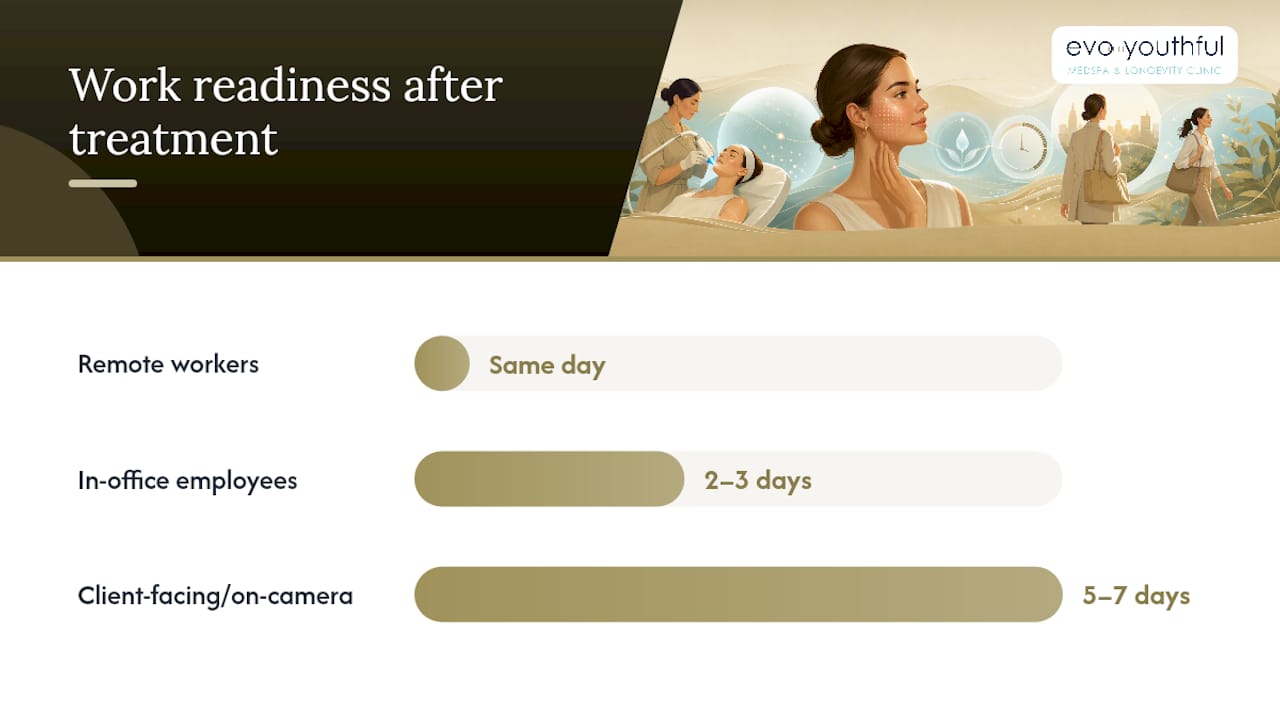
Work readiness depends heavily on your role. Remote workers can often function normally the same day, camera off, with makeup skipped until day two. In-office employees generally feel comfortable returning by day two or three once redness fades to a pink flush that concealer can handle. Client-facing and on-camera professionals should plan for a full 5 to 7 days before a treatment, particularly ahead of a big presentation, photo shoot, or on-air appearance.
How Many RF Microneedling Sessions Do You Actually Need?
One session creates a visible result for some people, but most see their best outcome after a full course. A typical plan runs several sessions spaced a few weeks apart, adjusted to your skin’s response and your specific goals.
The distinction that trips people up is the gap between what you see immediately and what actually develops:
- Immediate: Mild tightening and a temporary plumping effect show up within days, largely from swelling and initial collagen activity
- Progressive: True textural and firmness improvements build gradually over 3 to 6 months as new collagen matures
- Maintenance: Most patients return for a touch-up session annually, or as their clinician advises based on how their skin ages and responds
One session is rarely sufficient if your goal is meaningful scarring, laxity, or texture improvement. It’s a reasonable starting point if you want to test tolerance and downtime before committing to a full series.
Who’s Behind This Recovery Guidance?
This timeline reflects both published clinical findings and hands-on protocol from Elizabeth Vogstrom, PA-C, an advanced BHRT-certified physician assistant with over 20 years of medical aesthetics experience.
At evoyouthful, downtime gets managed proactively rather than left to chance. That means tailored energy settings based on your skin’s depth and sensitivity, thorough topical anesthesia before treatment, and specific post-care products sent home with you rather than a generic printout.
The Recovery Timeline Matters More Than the Treatment Itself
Here’s where most advice on this topic gets it backward. People research the treatment technology extensively, comparing device brands and energy types, and then treat aftercare as an afterthought scribbled on a handout. The research tells a different story: the first 48 hours of care determine your results as much as the treatment settings do.
I’d also push back on the blanket “one week of downtime” advice you see repeated everywhere. It’s not wrong, exactly, but it flattens a range that actually depends on your role, your skin, and your specific settings. A remote worker and an on-camera news anchor should not be planning around the same calendar, and treating them identically sets people up for either unnecessary panic or unpleasant surprises.
My honest recommendation: plan your schedule around your job first, then let your provider adjust treatment intensity to fit that window, not the other way around. Downtime isn’t a fixed number. It’s a variable you and your clinician can actually shape together.
— Elizabeth Vogstrom, PA-C
Ready to Plan Your RF Microneedling Timeline?
Generic downtime advice can’t account for your skin, your schedule, or your job. evoyouthful builds your recovery plan around all three, adjusting energy settings and treatment depth so you get meaningful results without derailing the week you actually have ahead of you.

A consultation starts with an honest assessment of your skin and goals, followed by an individualized plan that accounts for your work calendar and any upcoming events you’re planning around. Evoyouthful offers Exion Fractional RF Microneedling with settings calibrated to balance visible results against realistic recovery time, so you know what to expect before you ever sit in the chair. If skin laxity or textural concerns are part of what’s bringing you in, our team can also walk you through complementary options during your visit. Ready to see what a personalized plan looks like for your skin? Book your consultation and get a recovery timeline built around your actual life.
Sources
For deeper detail, review the 2026 clinical review on RF microneedling recovery and evoyouthful’s collagen induction therapy guide.
- BMC Plastic and Reconstructive Surgery review (2026)
- RF microneedling aftercare — Healthline
- RF microneedling downtime: Recovery timeline & tips — Valencia Med
- RF microneedling aftercare: first 48 hours — Laser Skin Solutions
FAQ
How Long Does RF Microneedling Downtime Really Last?
Most people see redness and swelling peak within 24 to 48 hours, with full resolution for the majority of patients within 3 to 7 days, though deeper treatments can extend that slightly.
What Is the Best Age for RF Skin Tightening?
There’s no single ideal age; RF microneedling is commonly used for adults, with treatment goals and settings adjusted to each person’s skin laxity and concerns rather than tied to a specific age bracket.
Is One Session of RF Microneedling Enough?
One session can produce a visible improvement, but most people need a full course of 3 to 4 sessions spaced several weeks apart to reach their best result for scarring, laxity, or texture concerns.
Does Microneedling Age You Faster?
No. Properly performed RF microneedling stimulates collagen production rather than accelerating aging; the temporary redness and swelling are part of a healing response that ultimately supports firmer, more resilient skin over the following months.
When Can I Wear Makeup After RF Microneedling?
Most guidance recommends waiting at least 24 hours before applying makeup, and choosing a mineral or non-comedogenic formula once you do resume.
Recommended
Ready to Start?
Schedule a Consultation
Have questions about what you just read? Our team is here to help.