

Know the Cause, Pick the Treatment for Non Surgical Jawline Contouring
Elizabeth Vogstrom, PA-C
evoyouthful Clinical Team
Clinic-led breakdown that matches jawline problems—bone, muscle, fat, or sagging—to the right non-surgical contouring, expected timelines, and consult...
Know the Cause, Pick the Treatment for Non Surgical Jawline Contouring
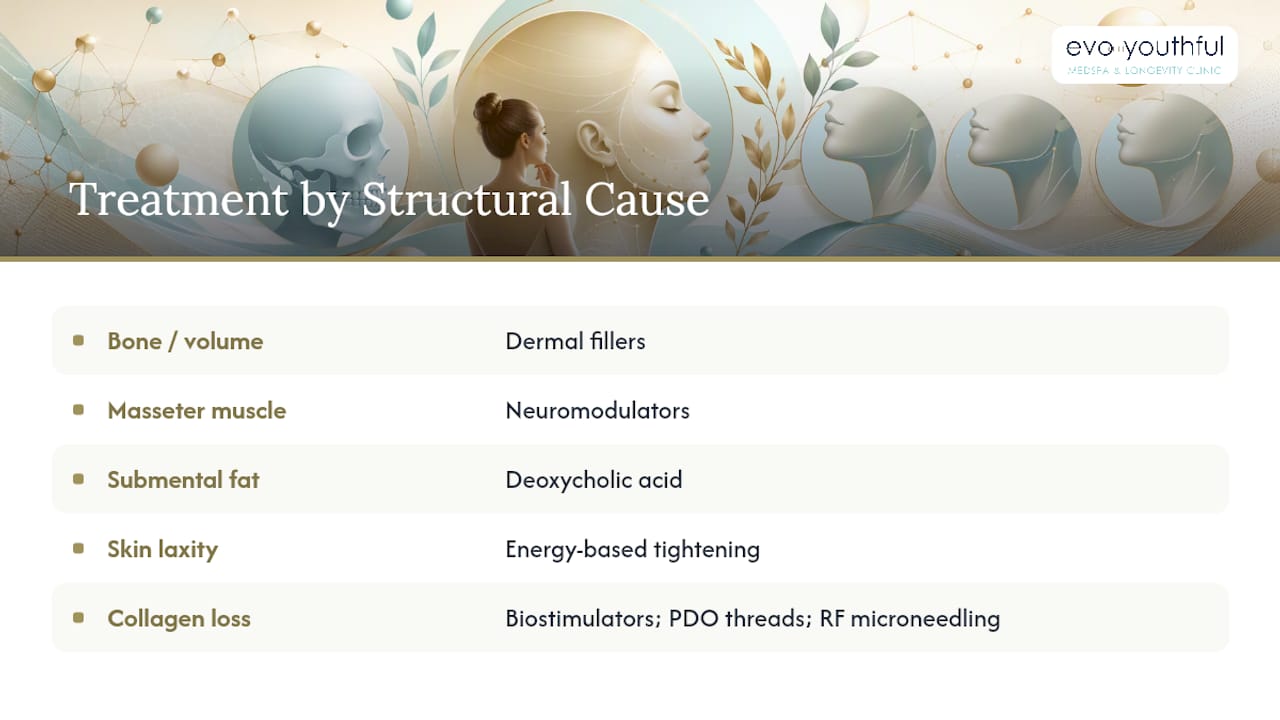
Non surgical jawline contouring works when the treatment matches the actual cause of the concern, not just the general goal of “more definition.” Dermal fillers rebuild lost structure and volume along weak bone or contour, neuromodulators slim a bulky masseter muscle, deoxycholic acid dissolves submental fat, biostimulators rebuild collagen over time, and energy-based skin tightening or PDO threads address sagging skin. Many patients need more than one approach layered together, which is exactly why a proper consultation, not guesswork, decides the plan.
TL;DR:
- Non surgical jawline contouring is most effective when treatment is based on the specific cause, such as bone structure, muscle, fat, or skin laxity.
- Fillers, neuromodulators, deoxycholic acid, biostimulators, and energy-based devices work over different timelines, from immediate to several months, often requiring combination plans.
- Accurate diagnosis is crucial to ensure the chosen treatment matches the concern; for example, muscle relaxants for a square jaw and fillers for bone loss.
- Results vary depending on the treatment, with fillers lasting several months to over a year, while collagen-boosting treatments like biostimulators can provide longer-term improvements.
- A qualified provider should conduct a thorough assessment, explain safety protocols, and develop a staged treatment plan rather than offering quick fixes or guaranteed outcomes.
Table of Contents
- Matching Your Jawline Concern To The Right Non Surgical Treatment
- What Each Non Surgical Jawline Treatment Actually Does
- Choosing A Provider And A Treatment Plan You Can Trust
- What Happens On Treatment Day And During Recovery
- How Long Results Last And Planning For Touch-Ups
- Who’s Behind This Guide
- Why Patients Choose Non Surgical First
- Ready To Map Your Jawline Plan At Evo Youthful
- Sources
- FAQ
Matching Your Jawline Concern To The Right Non Surgical Treatment
Before you commit to any single procedure, it helps to see how each jawline concern lines up with a specific fix. This is where non surgical facial contouring gets practical: the treatment follows the diagnosis, not the trend.
- Weak bone structure or a flat, undefined angle: dermal fillers, usually placed at the periosteal level for structural support.
- Heavy, square jaw from a bulky masseter muscle: neuromodulator injections (Botox or Dysport) to soften muscle bulk over 8 to 12 weeks.
- Double chin or submental fullness: deoxycholic acid injections, typically delivered in a series over several months.
- Sagging skin or early jowls with minimal fat: radiofrequency (RF) skin tightening, ultrasound-based devices like Ultherapy, or PDO threads.
- Diffuse collagen loss with thinning skin: biostimulators such as Sculptra or Radiesse, built up gradually across sessions.
Fillers and threads tend to show results the same day. Neuromodulators, deoxycholic acid, biostimulators, and energy-based devices work over weeks to months. Practitioners frequently combine a fast-acting filler with a slower biostimulator or RF device to balance immediate shape with lasting tissue improvement.
What Each Non Surgical Jawline Treatment Actually Does
Each category solves a different structural problem, and understanding the mechanism helps you evaluate whether a provider’s recommendation actually fits your anatomy.
Dermal fillers for jawline augmentation
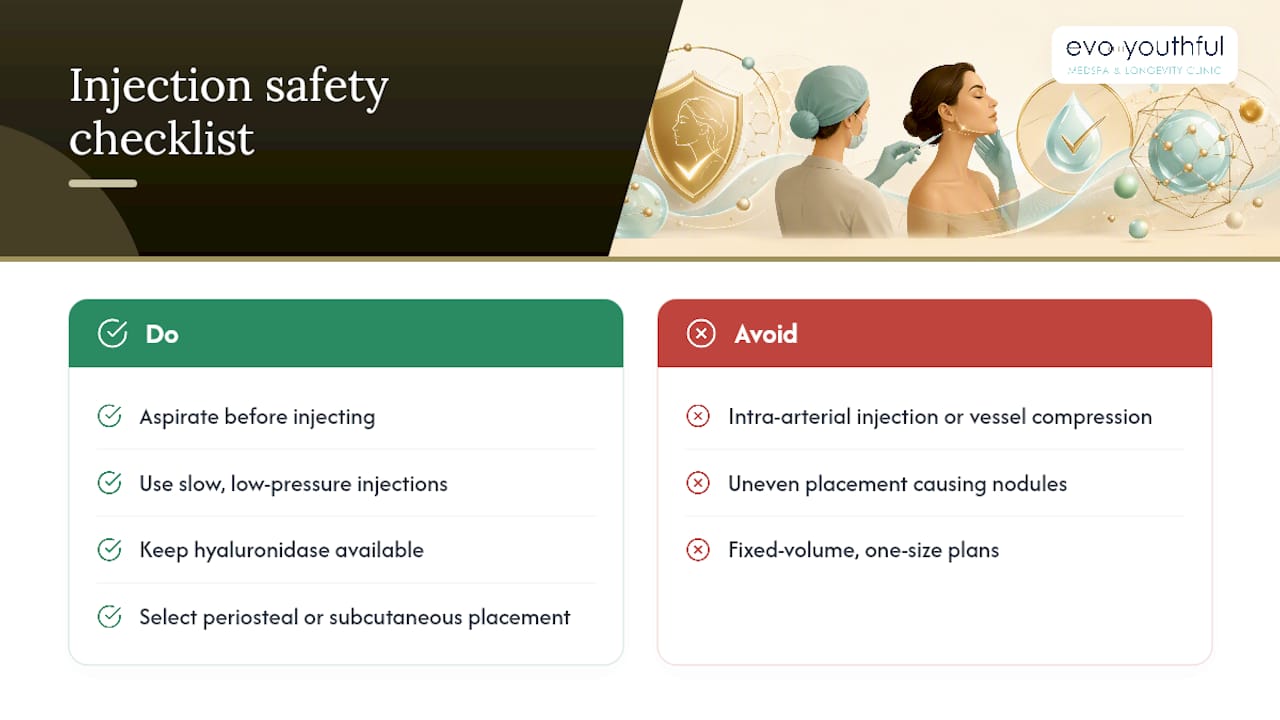
Hyaluronic acid (HA) fillers add immediate mechanical volume and definition, while calcium hydroxylapatite fillers like Radiesse work partly through biostimulation, encouraging your own collagen to build around the material. Placement matters more than product choice. Injecting at the periosteal plane, directly against the bone, gives structural support along the jawline, while more superficial subcutaneous placement softens transitions and blends contour. A PubMed-published review on nonsurgical jawline rejuvenation confirms that injectable fillers safely correct mild to moderate mandibular bone resorption when the injector understands facial anatomy and selects patients appropriately.
Volume is a clinical judgment call based on your bone structure and goals, not a fixed number. Results show up immediately, and HA fillers along the jaw typically last from several months to over a year depending on the product and your metabolism. The main risks are vascular occlusion, when filler is accidentally injected into or compresses a blood vessel, and nodules from uneven placement. Experienced injectors mitigate these risks through aspiration before injecting, slow and low-pressure technique, and keeping hyaluronidase on hand to dissolve HA filler quickly if a problem develops. Evo Youthful’s dermal filler treatments are built around this kind of structural planning rather than a one-size approach.
Neuromodulators for masseter slimming
If your jaw looks wide or square from the front, the cause is often muscle, not bone or fat. Botox or Dysport injected into the masseter muscle relaxes it, and the muscle gradually shrinks with disuse over roughly 8 to 12 weeks. This is a functional change, not an instant one. Typical treatment involves several units per side on a schedule your injector adjusts based on your response, repeated periodically. Chewing weakness is a rare side effect and usually resolves. This approach benefits people with genuine muscle hypertrophy, not those whose jaw width comes from bone structure or fat pads, so an accurate diagnosis before treatment matters enormously.
Deoxycholic acid for submental fullness
Deoxycholic acid, delivered as a series of injections under the chin, breaks down fat cell membranes so the body clears them naturally over subsequent weeks. Several treatment sessions are spaced over time, with visible improvement building gradually rather than all at once. Swelling is common for several days after each session. Deoxycholic acid targets fat specifically. If your submental fullness comes mainly from loose skin rather than fat volume, this treatment alone will underdeliver, and pairing it with an energy-based tightening treatment usually gets better results.
Biostimulators for collagen-based lift
Sculptra and Radiesse do not fill space the way HA does. They trigger your body to build new collagen over time, which means results build gradually across multiple sessions spaced weeks apart, with full effect visible after several months. The tradeoff for that slower timeline is longevity. Biostimulator results can last for a long duration due to collagen rebuilding, making this category a strong fit for patients focused on gradual, natural-looking rebuilding rather than immediate transformation.
Energy-based skin tightening
RF devices and ultrasound-based Ultherapy heat deeper skin layers to stimulate collagen contraction and remodeling without cutting or injecting anything. These work best for mild to moderate skin laxity, not significant sagging. A typical course runs one to three sessions, with improvement continuing for two to three months as collagen remodels, and results are cumulative rather than immediate.
PDO threads and RF microneedling
PDO threads use dissolvable sutures placed under the skin to create an immediate mechanical lift, while the body’s collagen response around the threads adds gradual tightening over the following months. RF microneedling combines controlled micro-injury with radiofrequency energy, producing a slower but often more even collagen remodeling effect. Combining threads for immediate lift with RF microneedling for longer-term skin quality is common in staged plans. Complications with threads are uncommon but include visible dimpling, thread migration, or minor asymmetry, which is why aftercare instructions around facial movement and sleeping position matter in the first two weeks.
Pro Tip: If you have noticeable skin laxity, treat the skin first with an energy-based device or threads before adding filler volume. Filling loose skin without tightening it first often makes sagging more obvious rather than less.
Choosing A Provider And A Treatment Plan You Can Trust
Getting the right non surgical jawline contouring plan starts with an honest assessment, not a product menu. Work through these steps before booking anything.
- Identify the actual cause. Is your concern driven by fat, loose skin, bone loss, or muscle bulk? A provider who skips this step and jumps straight to recommending a filler package is skipping the most important part of the plan.
- Set realistic goals. Non surgical jawline sculpting techniques refine and enhance; they do not recreate a completely different bone structure.
- Vet credentials. Confirm the injector is licensed, has documented experience with facial anatomy specifically, and can show a real photo portfolio of jawline cases, not just lips or cheeks.
- Ask about safety protocols. A qualified provider should explain their adverse-event response plan, including access to hyaluronidase for filler complications, before you consent to treatment.
- Understand cost drivers. Pricing varies by product type, the amount used, injector skill, and geographic market. A single syringe of filler often runs several hundred dollars, while a full contouring plan with combination treatments costs more, so ask for a written estimate rather than a vague range.
Walk away from any provider promising guaranteed results, refusing to discuss risks and complications, or offering deep discounts on injectable treatments with no clinical oversight. Those are the three clearest red flags in this field.
What Happens On Treatment Day And During Recovery
Most non surgical jawline treatments follow a similar rhythm: consultation, numbing, treatment, then a short recovery window.
- Before your appointment: your provider should review medications and supplements that increase bruising risk (fish oil, aspirin, certain herbal supplements), take baseline photos, and walk through informed consent.
- During treatment: injectables typically take 20 to 45 minutes with topical or local anesthetic. Thread lifts run slightly longer. Energy-based sessions like RF or Ultherapy can take varying lengths of time depending on the area treated.
- Right after: expect some swelling and possible bruising with injectables, mild tenderness with energy-based devices, and temporary tightness or pulling sensation with threads.
- Aftercare: ice in short intervals, avoid strenuous exercise for 24 to 48 hours, and hold off on makeup over injection sites for at least several hours. For more detailed post-procedure guidance, step-by-step aftercare instructions can help you track normal healing versus something worth calling about.
- Contact your provider if: you notice progressive numbness, escalating pain rather than gradual improvement, or skin discoloration that spreads instead of fading.
Final results appear immediately with fillers and threads, within 8 to 12 weeks with neuromodulators, and over three to six months with biostimulators and energy-based devices.
How Long Results Last And Planning For Touch-Ups
Durability varies widely by treatment class. HA fillers along the jawline typically last from several months to over a year, while calcium-based biostimulators can hold results for an extended duration because they work by rebuilding your own collagen rather than sitting as filler volume. Neuromodulator results for masseter slimming last several months per treatment cycle before the muscle gradually returns to its prior size. Energy-based tightening and thread lifts generally need periodic refresh sessions.
Metabolism, sun exposure, smoking, and how much you move your face all affect how fast results fade. Most providers recommend scheduling a check-in around the midpoint of your expected results window, so a touch-up happens before definition fully fades rather than after. Staged, combination plans tend to build cumulative improvement over a year or two, meaning each round can use less product than a single, larger correction attempt.
Who’s Behind This Guide
This guide was developed with clinical input from Elizabeth Vogstrom, PA-C, who plans and delivers injectable and energy-based jawline treatments for patients evaluating non surgical options. Evo Youthful’s relevant services for jawline concerns include dermal fillers, PRF injections for skin quality support, RF microneedling, and PDO thread placement.
The strongest results come from staged planning, not a single big appointment. We document baseline photos, treat conservatively, reassess, and layer in the next modality only when it is actually needed. Safety protocol and honest before/after documentation matter as much as the product chosen.
Specific outcome data, before-and-after case documentation, and patient credentials for your consultation can be reviewed directly with the clinic.
Why Patients Choose Non Surgical First
Most patients I see want to see change without disappearing from work for two weeks, and non surgical jawline enhancement options deliver that. Incremental improvement also lets someone test whether more definition actually suits their face before committing to anything permanent.
The harder conversation is trade-offs. Someone with significant skin excess or major bone asymmetry sometimes needs a surgical referral, and I would rather say that plainly than sell three rounds of filler that will not fix the underlying problem. Function comes before appearance, always. Safety and realistic expectations are the whole point, not a footnote.
— Elizabeth Vogstrom, PA-C
Ready To Map Your Jawline Plan At Evo Youthful
This clinic is built for exactly this kind of decision. Instead of guessing between a filler package and a device treatment, you get an assessment that names your actual cause, fat, laxity, bone, or muscle, and a plan built around it.
The clinic’s relevant services include dermal fillers for structural correction, neuromodulators for masseter slimming, PRF injections to support skin quality alongside contouring work, RF microneedling, and PDO thread placement. Your first visit centers on a real diagnostic conversation: bring a list of current medications and supplements, any prior injectable history, and photos of the jawline look you’re aiming for if you have one. Evo Youthful will walk through candidacy, sequencing, and realistic timelines before recommending anything. If you’re also managing hormone-related changes affecting facial volume or skin quality, ask about bioidentical hormone replacement therapy during the same visit. Book a consultation to get a jawline plan built around your actual anatomy, not a generic menu.
FAQ
Can I reshape my jawline without surgery?
Yes. Dermal fillers, neuromodulators, biostimulators, and energy-based devices can each reshape different aspects of jawline appearance depending on whether the cause is bone loss, muscle bulk, fat, or lax skin.
What is the best non surgical treatment for tightening the jawline?
Radiofrequency devices, ultrasound-based Ultherapy, and PDO threads are the primary options for tightening, with threads giving an immediate lift and RF or ultrasound building gradual improvement over two to three months.
Is there a way to reduce jaw size without surgery?
If your jaw looks wide because of a bulky masseter muscle, neuromodulator injections like Botox can functionally slim it over 8 to 12 weeks by reducing muscle bulk with repeated use.
How do you firm up a sagging jawline without surgery?
Mild to moderate sagging responds well to energy-based tightening or PDO threads, while more significant collagen loss benefits from biostimulators like Sculptra layered in over several staged sessions.
Recommended
Ready to Start?
Schedule a Consultation
Have questions about what you just read? Our team is here to help.