

6–8 Week Clinician Plan to Cut Menopause Belly Fat and Tackle Hormones
Elizabeth Vogstrom, PA-C
evoyouthful Clinical Team
Clinician evidence to counter menopause belly fat: a 6–8 week plan to preserve muscle, improve sleep, and explain BHRT's realistic role.
Menopause typically shifts fat toward the abdomen, but hormones alone rarely explain total weight gain. Declining estrogen, rising FSH, muscle loss, and disrupted sleep all interact to slow metabolism and change where fat settles. Menopausal hormone therapy usually doesn’t cause overall weight gain and may help redistribute abdominal fat and improve sleep. Right now, the highest-impact moves are starting resistance training, nudging up protein intake, and talking to a clinician if hot flashes or night sweats are wrecking your sleep.
TL;DR:
- Resistance training two to three times weekly and increasing protein intake can effectively counteract muscle loss and maintain metabolic rate during menopause.
- Waist measurements and body composition are better indicators of metabolic health than scale weight, as fat shifts to the abdomen even without overall weight gain.
- Menopausal hormone therapy does not cause weight gain and may improve sleep and insulin sensitivity, but it should not be seen as a weight-loss treatment.
- Managing stress, improving sleep, and addressing psychological factors can help reduce emotional eating and support consistent health behaviors during menopause.
- A personalized clinical assessment of hormones and metabolic markers is essential to develop a targeted plan that addresses individual needs and risks.
Table of Contents
- What Causes Weight Gain During Perimenopause and Menopause
- Why Fat Shifts to the Belly and Why It Matters
- Does Menopausal Hormone Therapy Affect Weight or Body Composition?
- Evidence-Based Strategies That Actually Move the Needle
- A 6-to-8 Week Plan to Preserve Muscle and Cut Visceral Fat
- When to See a Clinician About Menopause Weight Changes
- Gut Health and the Menopause Weight Connection
- Psychological Factors Behind Menopause Eating Habits
- A Clinician’s Honest Take on Menopause Weight Gain
- Getting Personalized Support for Menopause-Related Hormone Changes
- Sources
What Causes Weight Gain During Perimenopause and Menopause
Weight gain at midlife rarely traces back to one cause. It’s a convergence of hormonal shifts and lifestyle pressure points hitting at once, and understanding each piece helps you know where to actually intervene.
Estrogen decline gets most of the attention, but researchers now point to follicle-stimulating hormone (FSH) as an independent player in how your body stores fat and regulates energy. As estrogen drops, FSH rises sharply, and emerging research suggests FSH has direct metabolic effects on fat storage and energy balance that go beyond estrogen’s role alone. That means treatments focused only on estrogen may not fully address the metabolic picture for every woman.
Muscle loss compounds the problem. Starting in your 40s, sarcopenia, the gradual loss of lean muscle mass, lowers your basal metabolic rate, so you burn fewer calories even at rest. Combine that with insulin resistance, hot-flash-driven sleep loss, elevated cortisol from chronic stress, and a natural dip in daily activity, and the math tips toward weight gain even without eating more.
- Estrogen decline plus rising FSH alters fat storage patterns and energy regulation
- Muscle loss reduces resting metabolic rate year over year
- Sleep disruption from vasomotor symptoms raises hunger hormones like ghrelin
- Chronic stress elevates cortisol, which favors central fat storage
- Reduced activity often follows fatigue and joint discomfort
Pro Tip: Weigh yourself less and measure your waist more. Scale weight often stays flat while body composition shifts substantially toward fat and away from muscle.
Mayo Clinic’s clinical guidance describes this as fundamentally multifactorial: hormones drive where fat lands, while muscle loss, sleep, and activity levels drive how much total weight you gain.
Why Fat Shifts to the Belly and Why It Matters
Visceral fat, the fat that wraps around your abdominal organs rather than sitting just under the skin, becomes more common after menopause even in women who don’t gain a single pound. Lower estrogen appears to shift fat storage away from the hips and thighs and toward the trunk, a pattern distinct from the pear shape many women carried earlier in life.
This matters because visceral fat isn’t just cosmetic. It behaves like an active endocrine organ, releasing inflammatory compounds that raise your risk for insulin resistance, type 2 diabetes, and cardiovascular disease. A review of weight regulation in menopause links this abdominal shift directly to worsening metabolic markers independent of total body weight.
- Waist circumference above 35 inches signals elevated cardiometabolic risk for most women
- Visceral fat correlates with insulin resistance even when BMI stays in a normal range
- A tape measure tracks composition changes the scale misses entirely
That’s why a body composition check, or simply a consistent waist measurement taken the same way each month, tells you more about your metabolic health than the number on your bathroom scale.
Does Menopausal Hormone Therapy Affect Weight or Body Composition?
Hormone therapy doesn’t make you gain weight, and it isn’t a weight-loss drug either. That’s the clearest signal from the strongest evidence available, and it’s worth sitting with before you decide whether MHT belongs in your plan.
Cochrane-level systematic reviews of menopausal hormone therapy find no significant difference in total weight or BMI between women using MHT and those who don’t. Some trials even show favorable redistribution away from the abdomen. The REPLENISH randomized controlled trial, which followed women using combined 17β-estradiol and progesterone for 12 months, found no clinically meaningful weight or blood pressure change compared with placebo.
Where MHT tends to help is indirect. Treating hot flashes and night sweats improves sleep, and better sleep supports the energy and motivation needed to exercise and eat consistently. Some estrogen regimens also show modest improvement in insulin sensitivity and a reduction in central fat accumulation.
- MHT is primarily indicated for vasomotor symptoms and osteoporosis prevention, not weight loss
- Weight-related benefits, when they occur, usually come from better sleep and symptom control, not a direct metabolic effect
- Contraindications, including certain cancers, clotting disorders, and cardiovascular history, make individualized risk assessment essential
- FSH’s independent role means some women may not fully normalize body composition on estrogen-only regimens
Pro Tip: If you’re considering hormone therapy specifically to lose weight, reset that expectation with your clinician first. The realistic goal is symptom relief that makes lifestyle changes sustainable, not a number on the scale.
Evidence-Based Strategies That Actually Move the Needle
Lifestyle changes carry more weight loss potential than any single hormone intervention, and the research is specific about which ones matter most.
- Lift weights two to three times a week. Resistance training with progressive overload, meaning you gradually increase resistance or reps over time, directly counters sarcopenia and preserves the resting metabolic rate that naturally declines at midlife. Compound movements like squats, rows, and hip hinges, scaled to your mobility, deliver the most functional benefit.
- Raise your protein intake modestly. Bumping protein concentration by roughly 1% to 3% of your total daily energy, up toward 19% of digestible energy, can offset the protein-leverage effect that drives overeating when your body senses it isn’t getting enough protein relative to carbs and fat.
- Add interval or steady-state cardio as a complement, not a replacement. Cardio supports heart health and insulin sensitivity, but it won’t rebuild the muscle mass that strength training does.
- Fix your sleep before you fix your diet. Poor sleep raises ghrelin and cortisol, both of which increase hunger and cravings the next day.
- Track waist circumference, not just weight. Set small, measurable goals, like an extra strength session per week or a half-inch reduction over a month, and consider enlisting a workout partner or your clinician for accountability.
If joint pain limits load-bearing exercise, partner resources on bone-health-friendly strength training offer modified movement patterns that still build muscle without aggravating joints.
Pro Tip: Protein timing matters almost as much as total intake. Spreading 25 to 30 grams across each meal supports muscle protein synthesis better than loading it all at dinner.

A 6-to-8 Week Plan to Preserve Muscle and Cut Visceral Fat
You don’t need a complete life overhaul to see measurable change. A structured eight-week block gives your body enough time to adapt without asking for more than is sustainable.
- Weeks 1 to 2: Take baseline measurements (waist, weight, a simple strength benchmark like push-up count). Start two resistance sessions weekly. Set a consistent sleep window and a protein target near 25 to 30 grams per meal.
- Weeks 3 to 5: Increase to three resistance sessions or add volume to existing ones. Layer in one to two cardio sessions, either intervals or steady-state walking. Fine-tune protein intake based on hunger and energy levels.
- Weeks 6 to 8: Remeasure waist circumference and strength benchmarks. If vasomotor symptoms are still disrupting sleep, loop in a clinician. Set your next 90-day goal based on what worked.
- Track: waist circumference, resting heart rate, sleep hours, strength progression
- Modify for joint pain: swap standing squats for chair-assisted versions, use resistance bands instead of free weights
When to See a Clinician About Menopause Weight Changes
See a clinician if weight gain is rapid or unexplained, vasomotor symptoms are severe, you notice signs of sleep apnea like loud snoring or daytime exhaustion, or routine labs show shifting glucose or lipid values.
Clinicians commonly order a comprehensive hormone panel, fasting glucose or A1c, a lipid panel, and thyroid function tests, since thyroid changes often overlap with menopausal symptoms and can independently affect weight. A body composition assessment adds useful context beyond BMI.
- Comprehensive hormone panel (estrogen, FSH, thyroid)
- Fasting glucose/A1c and lipid panel
- Body composition scan when available
Pro Tip: Bring a symptom and sleep log to your appointment. Patterns over several weeks give your clinician far more to work with than a single office visit snapshot.
BHRT evaluation involves informed consent and realistic expectation-setting: symptom relief through BHRT can enable better sleep and activity, but it isn’t a weight-loss treatment on its own.
Gut Health and the Menopause Weight Connection
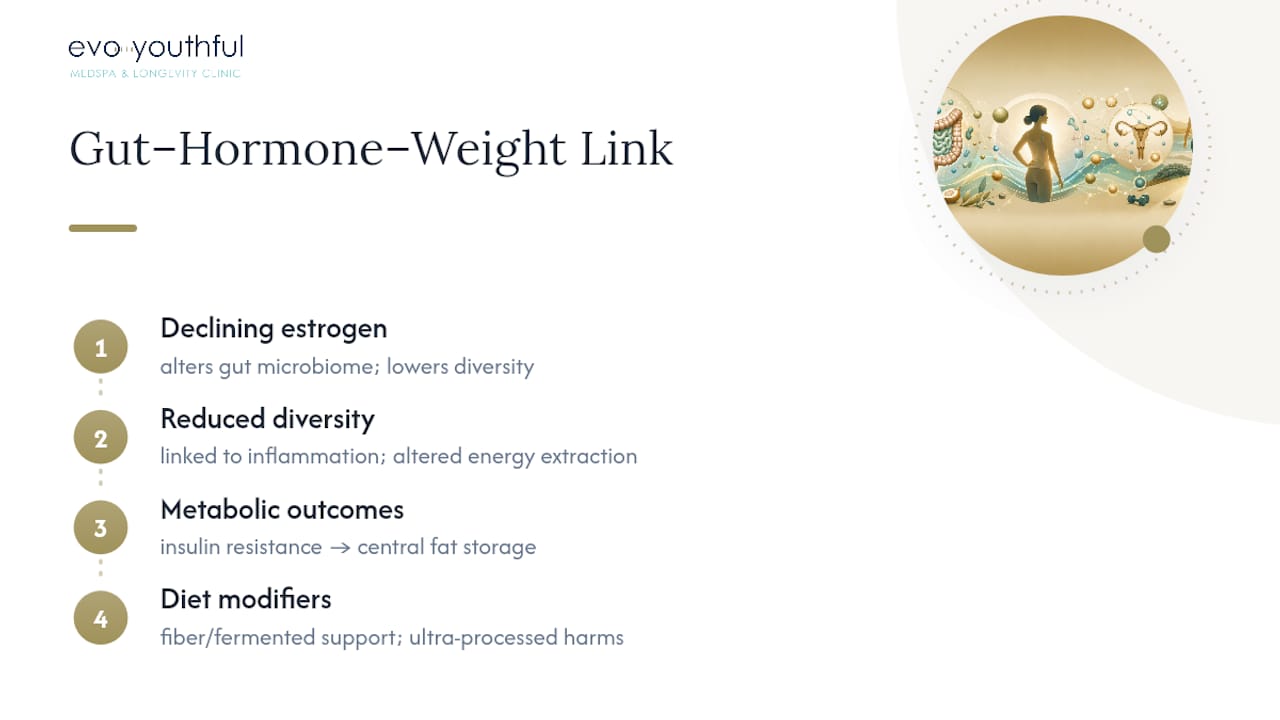
Your gut microbiome shifts measurably during the menopause transition, and that shift has real metabolic consequences. Estrogen influences the diversity and composition of gut bacteria, and as estrogen declines, many women see reduced microbial diversity, a change associated with increased inflammation and altered how efficiently the body extracts and stores energy from food.
This isn’t just a digestive footnote. A less diverse microbiome has been linked to greater insulin resistance and a stronger tendency toward central fat storage, the same visceral fat pattern driven by hormonal change. Some researchers suspect the gut-hormone relationship runs both directions: declining estrogen changes the microbiome, and an altered microbiome may in turn affect how estrogen and its metabolites get processed and recycled in the body.
Practical steps here overlap heavily with general metabolic health advice, which is reassuring rather than frustrating. Fiber intake feeding beneficial bacteria, fermented foods supporting microbial diversity, and minimizing ultra-processed food all support a healthier gut environment. None of this replaces strength training or protein intake as your top priorities, but it’s a legitimate secondary lever, especially if you notice new digestive symptoms alongside weight changes. Bloating, altered bowel habits, or new food sensitivities appearing alongside menopausal symptoms are worth mentioning to your clinician rather than dismissing as unrelated.
Psychological Factors Behind Menopause Eating Habits
Weight management during menopause isn’t purely physiological, and pretending otherwise sets women up to blame willpower for what’s often a hormonal and psychological mix. Mood changes, tied to fluctuating estrogen and progesterone, affect motivation, stress eating, and the mental energy required to plan meals and stick to exercise routines.
Many women describe a specific frustration: doing everything that worked in their 30s and seeing different results now. That mismatch between effort and outcome is demoralizing, and demoralization tends to erode consistency faster than any single bad day of eating. Anxiety and low mood, both more common during the menopause transition, also change eating patterns directly, sometimes toward comfort foods high in refined carbohydrates that offer short-term relief and long-term frustration.
Sleep loss compounds all of this. Poor sleep doesn’t just raise hunger hormones; it reduces the cognitive bandwidth needed to resist impulsive food choices and stick to a plan you made when you were better rested. Building in realistic flexibility, rather than rigid all-or-nothing rules, tends to hold up better over months than a strict plan that collapses the first time life gets stressful. If mood changes feel disproportionate to typical hormonal fluctuation, that’s worth raising with a clinician directly, since treating the underlying mood component often does more for consistency than any dietary tweak.
A Clinician’s Honest Take on Menopause Weight Gain
The best results come from combining targeted lifestyle changes with individualized clinical care, not chasing a single fix. Skip the one-size-fits-all approach. Get your hormones and metabolic markers checked, then build a plan around what your body actually needs.
— Elizabeth Vogstrom, PA-C
Getting Personalized Support for Menopause-Related Hormone Changes
evoyouthful takes a different approach than the generic weight-loss advice you’ve probably already tried: we start with your actual hormone panel, not a standard checklist. A comprehensive hormone evaluation shows where your estrogen, FSH, and thyroid markers actually stand, so any plan we build addresses your physiology instead of guessing.

If your labs and symptoms point toward hormone therapy, our team walks through bioidentical hormone replacement therapy with you directly, covering realistic expectations, contraindications, and how it fits alongside strength training and nutrition changes you’re already making. BHRT is one option among several, and whether it makes sense depends on your individual risk profile and symptom severity, something we assess together rather than assume. A first visit at our Wayzata, MN clinic typically starts with lab work and a detailed symptom history. From there, we build a plan that treats sleep disruption, hormone imbalance, and body composition as connected problems rather than separate appointments. If disrupted sleep from hot flashes is your biggest daily obstacle, that’s often the most useful place to start the conversation.
This article is general information, not a substitute for advice from a qualified doctor. Consult a qualified healthcare professional about your own circumstances before acting on anything here.
Sources
- The reality of menopause and weight gain — Mayo Clinic
- Protein leverage and dietary protein recommendations in menopause (PMC10952331)
- FSH and metabolic effects in menopause (PMC8569454)
Recommended
Ready to Start?
Schedule a Consultation
Have questions about what you just read? Our team is here to help.