

BHRT for Menopause: What the Evidence Says
Elizabeth Vogstrom, PA-C
evoyouthful Clinical Team
Discover how FDA-approved BHRT for menopause can effectively manage symptoms. Learn key steps for a productive conversation with your clinician.
BHRT for Menopause: What the Evidence Says
FDA-approved bioidentical hormone therapy is an appropriate, evidence-based option for managing menopausal symptoms in many women — and the single most important next step is a clinician conversation about which FDA-approved formulation fits your symptom profile and personal risk factors. Custom-compounded “bioidentical” products, despite their marketing, have no high-quality evidence showing they are safer or more effective than regulated preparations.
Before that appointment, three practical steps will help you get the most from it:
- Track your symptoms for two to four weeks: note frequency and severity of hot flashes, sleep disruption, vaginal discomfort, and mood changes.
- Gather your medical history: personal or family history of breast cancer, blood clots, cardiovascular disease, or liver disease are all relevant to your clinician’s recommendations.
- Ask specifically about FDA-approved options rather than accepting a compounded product as the default — regulated therapies have documented safety profiles that compounded preparations simply do not.
Key Takeaways
FDA-approved bioidentical hormone therapy is the evidence-based standard for menopausal symptom relief, with the most favorable risk-benefit profile for women who begin within approximately 10 years of menopause onset or before age 60.
| Point | Details |
|---|---|
| FDA-approved vs. compounded | No high-quality evidence shows compounded BHRT is safer or more effective than FDA-approved preparations. |
| Timing matters | Starting hormone therapy within ~10 years of menopause or before age 60 offers the most favorable benefit-risk profile. |
| Route affects risk | Transdermal estrogen is associated with fewer coagulation effects and may carry lower VTE risk than oral estrogen. |
| Nonhormonal options exist | Fezolinetant (Veozah), low-dose paroxetine, CBT, and ospemifene are evidence-based alternatives for those who cannot use systemic hormones. |
| evoyouthful’s approach | evoyouthful in Wayzata, MN offers individualized BHRT starting with FDA-approved formulations, serum-based testing, and scheduled follow-up. |
Table of Contents
- What does the evidence say about BHRT for menopause?
- How FDA-approved bioidentical hormones differ from compounded BHRT
- What symptoms can BHRT treat, and when will you feel better?
- What are the main risks, and who should avoid hormone therapy?
- What are the evidence-based alternatives to hormone therapy?
- How do you decide, and what should you ask your clinician?
- How evoyouthful approaches BHRT safely for menopausal women
- A clinician’s perspective on shared decision-making in hormone therapy
- Ready to talk through your options at evoyouthful?
- Sources
What does the evidence say about BHRT for menopause?
The professional consensus is clear and consistent. The North American Menopause Society (NAMS), the American College of Obstetricians and Gynecologists (ACOG), and the Endocrine Society all recommend hormone therapy as first-line treatment for vasomotor symptoms in eligible women, and all three organizations draw a firm line between FDA-approved preparations and custom-compounded products.
A PMC clinical review summarizes the core finding plainly: menopausal hormone therapy (MHT) is the most effective treatment available for vasomotor symptoms, and the most favorable risk-benefit profile applies to women who begin therapy within approximately 10 years of menopause onset or before age 60. This is often called the “timing hypothesis,” and it has become a cornerstone of individualized prescribing decisions.
The Endocrine Society adds a specific warning: compounded bioidentical hormone therapy lacks FDA oversight, may be inconsistent in dose and purity, and has no outcome trials demonstrating superiority to regulated products. That is not a minor caveat. It means the safety claims made by some compounding pharmacies and clinics rest on marketing language, not clinical trial data.
The Office on Women’s Health reinforces the dose principle: use the lowest effective dose for the shortest duration needed, with individualized risk assessment accounting for age, time since menopause, and cardiovascular or thromboembolic history.
Pro Tip: When evaluating any study on hormone therapy, look for these markers of quality: randomized and placebo-controlled design, a duration of at least 12 weeks, and endpoints that measure clinically meaningful outcomes like hot flash frequency or validated quality-of-life scores — not just hormone blood levels.
How FDA-approved bioidentical hormones differ from compounded BHRT
The word “bioidentical” simply means the hormone’s chemical structure matches the hormones your body produces naturally. What it does not mean is “unregulated” or “compounded.” Many FDA-approved hormone products — including estradiol patches, gels, and micronized progesterone capsules — are chemically identical to human hormones and have undergone rigorous randomized clinical trials. The marketing term “bioidentical” is often used to imply “natural” or “safer,” but ACOG’s 2023 clinical consensus makes clear that FDA-approved products already are bioidentical in the chemical sense — and they come with documented safety data.
Custom-compounded BHRT, by contrast, is mixed by a compounding pharmacy without FDA approval for that specific formulation. Dose and purity are not subject to the same manufacturing standards, and adverse events including supratherapeutic hormone levels have been documented with compounded pellet therapy in particular.
Systemic vs. local therapy: why the route matters
Systemic therapy (oral tablets, transdermal patches, gels, sprays, or vaginal rings that deliver hormones into the bloodstream) addresses whole-body symptoms: hot flashes, night sweats, sleep disruption, and mood changes. Local vaginal therapy (low-dose estrogen creams, tablets, or rings that stay in vaginal tissue) targets genitourinary symptoms — dryness, discomfort, and recurrent urinary tract infections — with minimal systemic absorption.

Route also affects risk. Clinical guidance consistently notes that transdermal estrogen is associated with fewer adverse effects on coagulation markers and may carry a lower risk of venous thromboembolism than oral estrogen. For women with elevated thrombotic risk, transdermal delivery is generally preferred.
| Dimension | FDA-approved systemic therapy | FDA-approved local vaginal therapy | Custom-compounded BHRT |
|---|---|---|---|
| Regulation | Full FDA approval; standardized dose and purity | Full FDA approval; standardized dose and purity | No FDA approval; variable dose and purity |
| Proven effectiveness | Randomized trials for vasomotor symptoms, bone loss prevention | Randomized trials for genitourinary symptoms | No outcome trials showing superiority |
| Safety profile | Documented; labeling includes risk information | Minimal systemic absorption; favorable local safety | Inconsistent; adverse events reported with pellets |
| Typical monitoring | Serum hormone levels if needed; clinical symptom assessment | Clinical symptom assessment; minimal lab monitoring | Variable; saliva/urine testing not validated |
| Cost and insurance | Often covered by insurance with prior authorization | Often covered; lower cost than systemic | Usually out-of-pocket; costs vary widely |
Pro Tip: If you have a history of deep vein thrombosis or are at elevated clotting risk, ask your clinician specifically about transdermal estrogen rather than oral tablets. The route change can meaningfully shift your risk profile without sacrificing effectiveness.
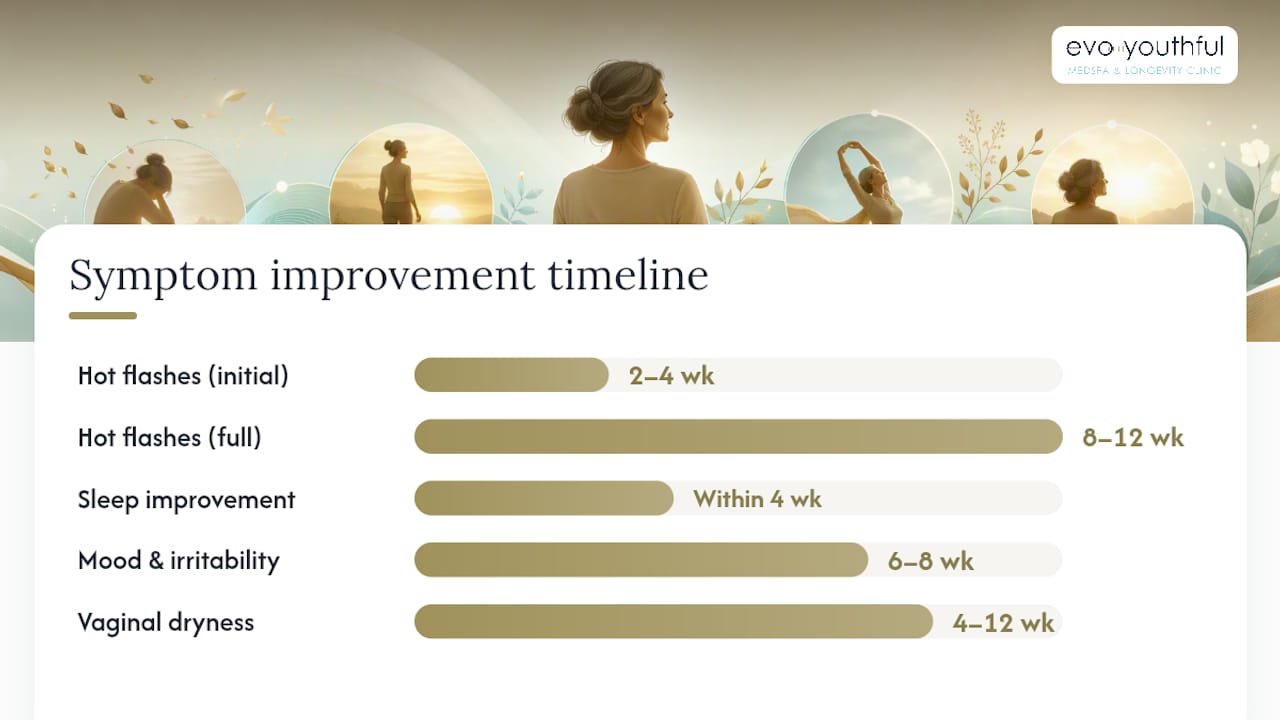
What symptoms can BHRT treat, and when will you feel better?
Hormone therapy for menopause addresses a specific cluster of symptoms, and the timeline for improvement varies by symptom type.
- Hot flashes and night sweats: Most women notice meaningful reduction in frequency and severity within two to four weeks of starting systemic therapy. Full benefit typically develops over eight to twelve weeks.
- Sleep disruption: Improvement often follows vasomotor symptom relief, since night sweats are a primary driver of broken sleep. Some women report better sleep quality within the first month.
- Mood changes and irritability: These tend to improve alongside vasomotor symptoms, though mood response can take six to eight weeks to stabilize.
- Vaginal dryness and discomfort: Local low-dose vaginal estrogen produces noticeable improvement in most women within four to twelve weeks. Systemic therapy also helps, but local therapy is more targeted for genitourinary symptoms.
- Cognitive symptoms like menopause-related brain fog are reported by many women; some find improvement with hormone therapy, though evidence here is less definitive than for vasomotor symptoms.
Hormone therapy is FDA-approved for vasomotor symptoms and for prevention of bone loss in certain contexts, but systemic therapy is not recommended solely to prevent chronic diseases like cardiovascular disease or dementia. Symptom relief is the primary indication. If your main concern is bone density, your clinician will weigh hormone therapy against other approved options based on your full picture.
Setting realistic goals matters. A reasonable target is a substantial reduction in hot flash frequency and severity, not complete elimination. Reassess with your clinician at three months; if relief is insufficient or side effects emerge, dose or route adjustments are appropriate.
What are the main risks, and who should avoid hormone therapy?
Hormone therapy carries real risks, and they depend heavily on your age, how long it has been since menopause, your formulation, and your individual health history. Understanding these risks in absolute terms — not just relative terms — is what makes a clinician conversation so valuable.
Key risks to discuss:
- Venous thromboembolism (VTE): Oral estrogen is associated with an increased risk of blood clots. Transdermal estrogen appears to carry a lower risk in observational data, making route selection clinically meaningful for women with thrombotic risk factors.
- Stroke: Risk appears modestly elevated with oral estrogen, particularly at higher doses. Transdermal formulations show a more favorable profile in most analyses.
- Breast cancer: Combined estrogen-progestogen therapy is associated with a possible increase in breast cancer risk with longer duration of use. Estrogen-only therapy (appropriate only for women without a uterus) has a different risk profile. The absolute risk increase for most women using therapy for fewer than five years is small, but it is not zero.
- Endometrial protection: Women with an intact uterus must take progestogen alongside estrogen. If progesterone is underdosed, the risk of endometrial hyperplasia and cancer rises. This is one reason ACOG specifically cautions against compounded progesterone, where batch-to-batch consistency cannot be guaranteed.
Absolute contraindications — avoid systemic hormone therapy if you have:
- Personal history of breast cancer or estrogen-sensitive cancer
- Active or recent thromboembolic disease (DVT, pulmonary embolism)
- Uncontrolled cardiovascular disease or recent stroke
- Active liver disease
- Unexplained vaginal bleeding
The Office on Women’s Health emphasizes that risk is not static: initiating therapy within 10 years of menopause onset or before age 60 in otherwise healthy women is associated with a more favorable benefit-risk balance than starting later. Ongoing monitoring — blood pressure checks, lipid and glucose assessment as clinically indicated, and routine breast and cervical screening — remains part of responsible long-term management.
What are the evidence-based alternatives to hormone therapy?
For women who cannot use systemic hormones or prefer not to, several options have meaningful clinical support.
FDA-approved nonhormonal prescription options:
- Fezolinetant (Veozah): A neurokinin B receptor antagonist specifically approved for menopausal hot flashes. Mayo Clinic guidance notes it may require liver enzyme monitoring for some patients.
- Paroxetine (low-dose): The only FDA-approved SSRI for vasomotor symptoms; effective for hot flash frequency and severity.
Commonly used off-label options with clinical evidence:
- SSRIs and SNRIs (venlafaxine, escitalopram): Reduce hot flash frequency; useful when mood symptoms co-occur.
- Gabapentin: Modestly effective for vasomotor symptoms, particularly night sweats; sedating side effects can be a limitation.
- Oxybutynin: Some evidence for hot flash reduction; primarily used for overactive bladder.
For genitourinary symptoms specifically:
- Local vaginal estrogen: Minimal systemic absorption; appropriate even for many women with contraindications to systemic therapy.
- Ospemifene (Osphena): An oral selective estrogen receptor modulator approved for moderate-to-severe dyspareunia related to menopause; a useful option when topical application is not preferred.
Non-pharmacologic approaches:
- Cognitive behavioral therapy (CBT): The NAMS 2023 nonhormone therapy position statement identifies CBT and clinical hypnosis as having good evidence for improving vasomotor symptoms and sleep disturbance.
- Clinical hypnosis: Supported by NAMS as an adjunct or alternative for women who cannot take systemics.
- Lifestyle strategies: Weight management, cooler sleep environments, and limiting alcohol and spicy foods have modest but real effects on hot flash frequency.
Pro Tip: If you have contraindications to systemic hormones, local vaginal estrogen is often still an option — it is not systemic therapy and carries a very different risk profile. Ask your clinician whether it applies to your situation before ruling out all hormone-based options.
How do you decide, and what should you ask your clinician?
A good BHRT decision is individualized, not algorithmic. These are the factors that belong in the conversation.
Decision checklist:
- Age and timing: Are you within 10 years of menopause onset and under age 60? If yes, the risk-benefit profile for systemic therapy is generally more favorable.
- Symptom burden: Are hot flashes, sleep disruption, or genitourinary symptoms significantly affecting your quality of life? Mild symptoms may not warrant systemic therapy.
- Comorbidities: Do you have a history of breast cancer, VTE, cardiovascular disease, or liver disease? These shift the calculus toward nonhormonal options.
- Medication interactions: Some hormone formulations interact with anticoagulants, certain antidepressants, and other medications.
- Personal priorities: How do you weigh symptom relief against a small increase in absolute risk? This is a values conversation, not just a clinical one.
Testing and monitoring: Baseline serum hormone levels, blood pressure, and a review of lipid and glucose status are reasonable starting points. Routine follow-up at three months after initiation, then annually, is standard. Saliva and urine hormone panels are not validated for guiding menopausal hormone therapy decisions — major societies advise against using them for dose titration, and a clinic that relies on them as the primary dosing tool is a red flag. A structured hormone panel testing approach using serum measures is the standard.
Questions to bring to your appointment:
- “Is there an FDA-approved bioidentical option that fits my symptoms?”
- “What are the absolute risks for someone with my health history — not just relative risks?”
- “Which route of delivery makes the most sense for me, and why?”
- “How will we monitor safety over time, and when would we reassess the dose?”
- “If I can’t use systemic hormones, what nonhormonal options have the best evidence for my specific symptoms?”
Red flags to watch for: providers who rely solely on saliva testing, prescribe without documented informed consent about risks, or default to pellet therapy without discussing alternatives and monitoring. Compounded pellet therapy has documented variability in absorption and occasional supratherapeutic hormone levels.
On cost and insurance: FDA-approved hormone therapies are frequently covered by insurance with prior authorization, though coverage varies by plan and formulation. Compounded products are almost always out-of-pocket, and costs vary widely by pharmacy and formulation. For most women, an FDA-approved option will be both better supported by evidence and more affordable than a compounded alternative.
How evoyouthful approaches BHRT safely for menopausal women
At evoyouthful in Wayzata, MN, the BHRT process starts with a thorough clinical evaluation — not a saliva test kit and a one-size-fits-all protocol. Here is what a new patient can expect:
- Comprehensive medical history review: symptom burden, personal and family health history, current medications, and prior hormone therapy experience.
- Baseline serum testing: appropriate laboratory assessment to inform individualized dosing decisions.
- Evidence-based formulation preference: FDA-approved preparations are the starting point. When a compounded product is considered, the rationale and risks are discussed transparently.
- Individualized dosing plan: lowest effective dose, with a clear follow-up schedule to assess response and adjust as needed.
- Scheduled monitoring: follow-up at three months, then on an ongoing basis, with attention to symptom response, blood pressure, and relevant labs.

evoyouthful’s approach reflects what the evidence actually supports: personalized care grounded in FDA-approved options, honest conversations about compounded alternatives when they come up, and a monitoring plan that does not end at the prescription pad. If you are ready to have that conversation, schedule a BHRT consultation at evoyouthful in Wayzata, MN.
A clinician’s perspective on shared decision-making in hormone therapy
The question I hear most often from women considering hormone therapy is some version of: “Is this safe for me?” And the honest answer is that it depends — on your age, your timing since menopause, your symptom burden, and your personal values around risk. What I find most important is that women come to this decision with accurate information, not marketing language.
The “bioidentical” framing has created real confusion. Many women arrive believing that compounded products are inherently safer because they are “natural,” when in fact the FDA-approved options are chemically identical to human hormones and have the clinical trial data to back their safety profiles. Compounded products do not. That asymmetry matters enormously when you are making a decision that affects your long-term health.
Shared decision-making means your clinician brings the evidence, and you bring your priorities. Neither one alone is enough. The goal is a plan that reflects both — one that you understand, that you have consented to with full knowledge of the risks, and that includes a clear path for monitoring and adjustment. That is what good hormone therapy care looks like, and it is what every woman deserves.
Ready to talk through your options at evoyouthful?
Women coming from this article typically know what they want: a clinician who will take their symptoms seriously, explain the evidence honestly, and build a plan that fits their health history — not a generic protocol. That is exactly what evoyouthful offers in Wayzata, MN.
The clinic’s BHRT program begins with a full clinical evaluation, serum-based hormone assessment, and a frank conversation about which FDA-approved formulations make sense for your symptoms and risk profile. If a compounded option ever comes up, you will hear why, what the evidence says, and what the monitoring plan looks like. No guesswork, no pressure, no one-size-fits-all pellet protocol.
Visit evoyouthful’s BHRT service page to learn more about the clinic’s approach, or reach out directly to schedule your first consultation in Wayzata, MN. If you are also navigating hormone imbalance symptoms beyond menopause, the clinic’s broader wellness program addresses those too.
This article is for general informational purposes only and is not a substitute for professional medical advice. Please consult a qualified clinician to discuss your individual symptoms, health history, and treatment options.
Sources
These are the most credible resources for deeper reading on hormone therapy and menopause management:
- Compounded bioidentical menopausal hormone therapy — ACOG clinical consensus (2023)
- A review of hormone and non-hormone therapy options for treatment of menopause — PMC review
- Womenshealth
Recommended
- Hormone Panel Testing Checklist: Benefits for BHRT | evoyouthful Blog
- Menopause Brain Fog: Symptoms, Causes, and What Helps | evoyouthful Blog
- Bioidentical Hormone Replacement Therapy | Restore balance from the inside out | evoyouthful Wayzata, MN
- BHRT for Men | Low Testosterone Treatment in Wayzata, MN | evoyouthful
Ready to Start?
Schedule a Consultation
Have questions about what you just read? Our team is here to help.