

3–4 Months Is Typical: Clinician Tips to Predict How Long Botox Lasts
Elizabeth Vogstrom, PA-C
evoyouthful Clinical Team
Botox typically lasts 3–4 months and can range 2–6 months. Clinician led guidance ties FDA ranges to dosing and follow up advice.
3–4 Months Is Typical: Clinician Tips to Predict How Long Botox Lasts
Cosmetic Botox typically lasts about 3 to 4 months on average, though duration can vary depending on the treated area, dose, and individual biology. Medical uses like hyperhidrosis often last longer. The FDA prescribing information and clinical experience at evoyouthful both point to the same range, with individual variation the rule rather than the exception.
TL;DR:
- Botox effects typically last 3 to 4 months for cosmetic treatments, but duration varies significantly by treatment area, dose, and individual factors.
- Smaller muscle groups like crow’s feet usually wear off in 7 to 12 weeks, while underarm hyperhidrosis can last six months or longer.
- Higher doses, stronger muscle activity, faster metabolism, and product choice influence how long Botox remains effective.
- The timeline from injection to peak effect is generally 10 to 14 days, with gradual wearing off occurring over the next 8 to 16 weeks.
- Regular re-treatment every 3 to 4 months is recommended, with adjustments based on individual response, activity level, and treatment goals.
Table of Contents
- How Long Does Botox Last by Treatment Area?
- What Factors Change How Long Botox Lasts?
- When Does Botox Kick In, and When Does It Wear Off?
- How Often Should You Get Botox? Maintenance and Spacing
- Cosmetic Botox vs. Medical Botox: Why Duration Differs
- Botox Side Effects: What’s Normal and When to Call Your Provider
- What evoyouthful Sees in Practice
- The Gap Between the Label and the Mirror
- Ready to Personalize Your Botox Timeline?
- Primary Sources and Further Reading
- Sources
How Long Does Botox Last by Treatment Area?
The 3 to 4 month figure is a starting point, not a fixed rule. Duration shifts noticeably depending on where you’re treated and why.
- Forehead and glabellar lines (the “11s” between your brows): about 3 to 4 months, per manufacturer prescribing highlights
- Crow’s feet: often shorter, in the 7 to 12 week range, since this muscle group is smaller and more active
- Chronic migraine: dosed and scheduled differently, with injections repeated every 12 weeks as a fixed protocol
- Axillary hyperhidrosis (underarm sweating): effects frequently last 6 months or longer, since sweat glands respond differently than facial muscles
Statistic Callout: Clinical overviews put the realistic range for cosmetic Botox at 2 to 6 months once you account for area, dose, and patient biology, according to Medical News Today’s clinical summary.
A first-time patient with light dosing in the crow’s feet might see results fade by week 8. A heavier dose in the forehead on someone with a slower metabolism might still look sharp at month 5.
What Factors Change How Long Botox Lasts?
Two people can get injected on the same day, by the same provider, and see very different timelines. The variables usually come down to a handful of factors.
- Dose and concentration: more units in the treated muscle generally means a longer effect, though heavier dosing can also change how “natural” the result looks
- Muscle mass and expression habits: strong, expressive muscles (think habitual frowners) tend to reassert themselves faster
- Metabolism and activity level: patients with high metabolic rates or intense exercise routines often notice movement returning sooner, an observation providers see repeatedly in practice
- Product choice: Botox and Dysport offer similar overall duration, though potency units and onset speed differ, with Dysport sometimes kicking in a day or two faster
- Treatment history: first-time patients sometimes metabolize the toxin faster than those on a consistent maintenance schedule
Pro Tip: If you’re highly active or have a fast metabolism, ask your provider about slightly higher initial dosing or an earlier three-month check-in rather than waiting the full four months to reassess.
Understanding your units per treatment area helps explain why your results might differ from a friend’s, even with the same product.
When Does Botox Kick In, and When Does It Wear Off?
The timeline from injection to fade follows a fairly predictable arc, even though the exact days shift a little person to person.
- Days 1 to 3: Little visible change yet. Some patients using Dysport report early softening around day 2 or 3.
- Days 3 to 5: Botox typically begins showing visible effect in this window.
- Days 10 to 14: Peak effect. This is when your results look their most complete and when providers recommend evaluating whether touch-ups are needed.
- Weeks 8 to 16: Gradual wearing off begins as nerve signals slowly reconnect with the muscle, a process called re-innervation.
Fine lines usually reappear before full muscle movement returns. That’s normal. It means the muscle is waking up in stages, not all at once.
How Often Should You Get Botox? Maintenance and Spacing
Most patients settle into a rhythm of returning every 3 to 4 months, though your own schedule depends on how your body responds and how quickly your goals shift back into view.
- Rebook when you notice visible lines returning at rest, not just during a big expression
- Some patients stretch maintenance to every 4 to 6 months once results have accumulated over several treatment cycles
- Avoid going more frequently than every 3 months for most cosmetic uses unless your provider has a specific clinical reason, since tighter intervals raise the risk of antibody formation reducing future effectiveness
Waiting until movement fully returns before rebooking, rather than chasing perfection at the two-month mark, tends to make each treatment cycle more predictable.
Cosmetic Botox vs. Medical Botox: Why Duration Differs
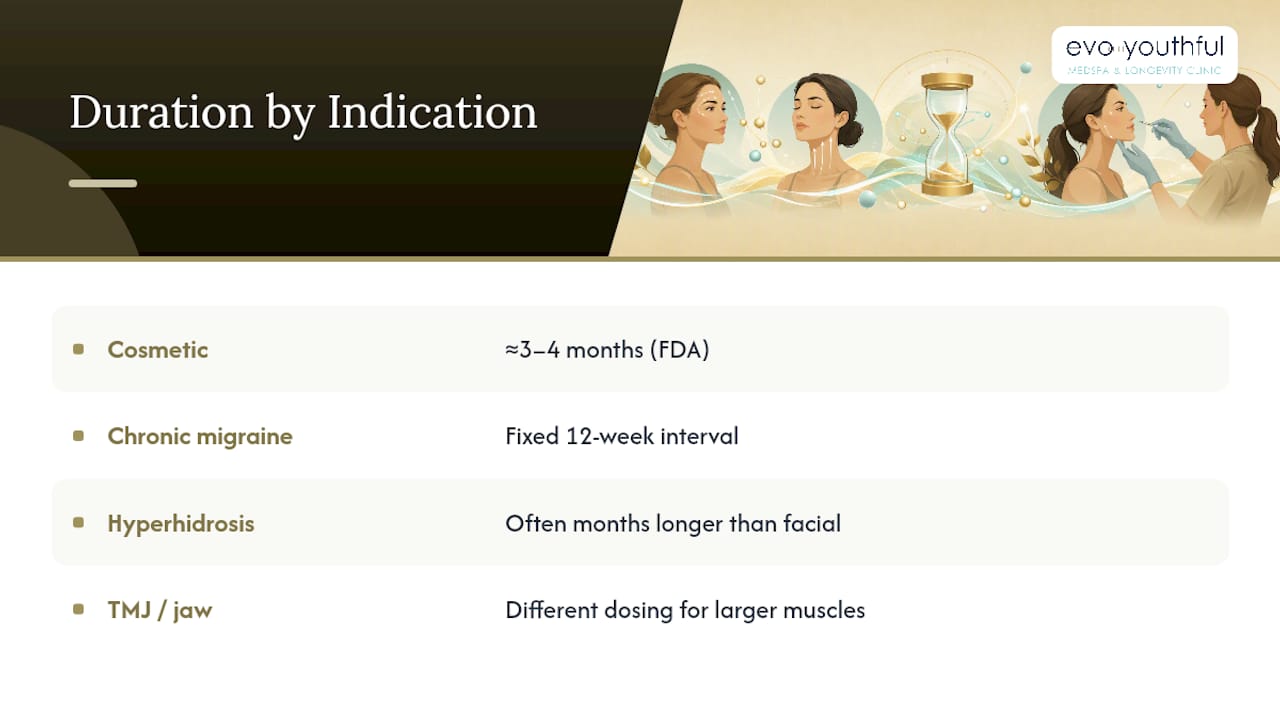
The same toxin behaves differently depending on why it’s being used. Cosmetic treatment targets small, precise muscle groups with lower total doses, which is part of why the 3 to 4 month window holds fairly consistently across the FDA’s own labeling.
Medical indications work differently. Chronic migraine protocols use a fixed 12 week interval regardless of how a patient feels at week 10. Hyperhidrosis targets sweat glands rather than muscle fibers, which is why its effects often outlast facial treatments by months. Even Botox for TMJ and jaw tension follows its own dosing logic, since larger jaw muscles need different unit counts than delicate crow’s feet.
Botox Side Effects: What’s Normal and When to Call Your Provider
Most side effects are minor and resolve within days. Knowing the difference between expected and concerning symptoms saves you an unnecessary worry, or worse, a delayed call to your provider.
- Expected and short-lived: mild bruising at injection sites, slight soreness, a brief tension headache, temporary heaviness in the treated area
- Less common, worth monitoring: a “frozen” or overly tight feeling, which typically eases within 1 to 2 weeks as you adjust
- Contact your provider promptly if you notice: eyelid drooping (ptosis), visible asymmetry, or any trouble swallowing, speaking, or breathing, which can signal the toxin has spread beyond the treated area
Most clinics schedule a two-week follow-up specifically to catch asymmetry early, while there’s still time to adjust with a small touch-up.
What evoyouthful Sees in Practice
At evoyouthful, dosing decisions start with your muscle strength, your goals, and how your face moves at rest, not a one-size formula. Patients with strong expression patterns often get a slightly higher starting dose paired with an earlier follow-up, since that combination tends to produce more predictable timing for the next appointment. Every patient’s response gets documented at follow-up visits, building a personal history that makes each future treatment more precise than the last. Elizabeth Vogstrom, PA-C, oversees treatment planning with an emphasis on matching dose to anatomy rather than defaulting to a standard unit count.
The Gap Between the Label and the Mirror
The FDA’s numbers are accurate, but they describe averages across large trial populations, not your face specifically. That gap is where most of the frustration around Botox duration comes from. Patients read “3 to 4 months” as a promise, then feel shortchanged when their own results fade at week 10. It’s not a failure of the product. It’s a failure of expectation-setting.
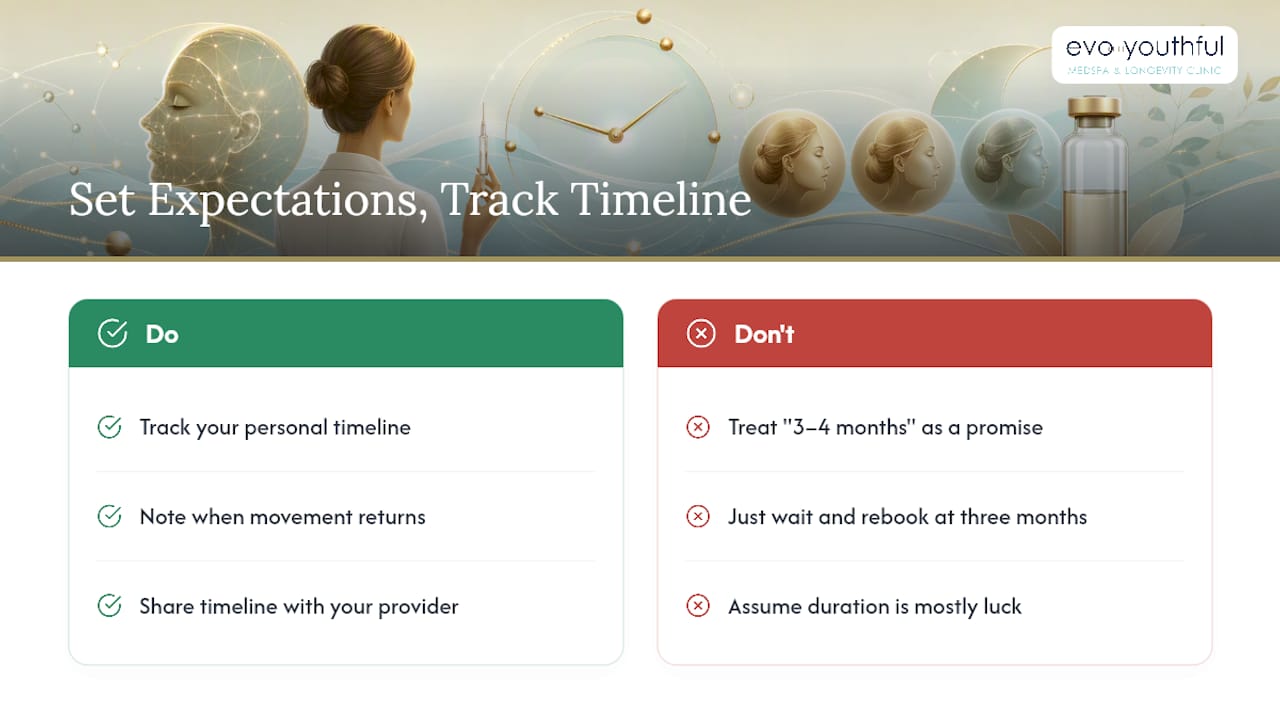
The conventional advice, “just wait it out and rebook at three months,” ignores how much dose and technique actually shape the timeline. A light, natural dose in an expressive muscle will fade faster than a fuller dose in a quieter one, and that’s not a flaw, it’s physics. What I’d push back on is the idea that duration is mostly luck. It’s mostly decisions, made at the injection appointment, about units, placement, and follow-up timing.
If you take one thing from this, take this: track your own timeline. Note when movement starts returning, not just when lines show up. That single habit gives your provider the real data needed to fine-tune your next appointment instead of guessing.
— Elizabeth Vogstrom, PA-C
Ready to Personalize Your Botox Timeline?
evoyouthful is the option for readers who want their dosing based on their own muscle pattern and metabolism rather than a generic three-month default. The clinic offers Botox, Dysport, and Daxxify, giving you a choice between products if faster onset or longer duration matters more for your schedule. For patients dealing with jaw tension, Botox for TMJ addresses a functional concern most cosmetic-only providers never screen for.

A consultation starts with an assessment of your muscle strength, expression habits, and prior treatment history, so your first dose is calibrated rather than standardized. If you’re also curious about longevity treatments beyond injectables, evoyouthful’s peptide therapy options are worth asking about during the same visit. Book a consultation to get a dosing plan built around your face, not an average.
Primary Sources and Further Reading
Duration and dosing claims here draw from DailyMed’s FDA prescribing information, peer-reviewed comparisons in PMC’s toxin review, and clinical overviews from Healthline and Cleveland Clinic.
This article is general information, not a substitute for advice from a qualified doctor. Consult a qualified healthcare professional about your own circumstances before acting on anything here.
Sources
- DailyMed - BOTOX® (onabotulinumtoxinA) prescribing information
- Comparative review of botulinum toxins (PMC article)
- How long does Botox take to work? — Healthline
- How does Botox wear off and where does it go — Medical News Today
- BOTOX Cosmetic highlights of prescribing information (Rx AbbVie PDF)
Recommended
Ready to Start?
Schedule a Consultation
Have questions about what you just read? Our team is here to help.