
How Many Botox Units Do You Actually Need?
Elizabeth Vogstrom, PA-C
evoyouthful Clinical Team
Discover how many Botox units you actually need for effective results. Learn the ideal amounts for each treatment area during your consultation.
How Many Botox Units Do You Actually Need?
Most patients need roughly 10 to 30 units for the forehead, 15 to 25 for the glabella, and 10 to 24 for crow’s feet, making a three-area treatment commonly total 40 to 64 units. Your exact number depends on muscle strength, sex, and how much softening you want. A qualified provider like Elizabeth Vogstrom, PA-C, confirms the specifics during your consultation.
TL;DR:
- Most patients require between 10 and 30 units for the forehead and 15 to 25 units for the glabella, with crow’s feet treatments averaging 10 to 24 units.
- Higher doses are needed for men, strong muscles, or individuals with habits like teeth grinding, while prior treatments can reduce the required units.
- FDA-approved doses for treating multiple upper face areas total 64 units, but actual needs vary based on muscle strength and personal goals.
- First-time patients should start conservatively with around 30 to 50 units across targeted areas and plan follow-up visits for adjustments.
- Side effects are usually minor and temporary, but practitioners should carefully balance doses to prevent issues like brow or eyelid drooping.
Table of Contents
- Average Botox Units By Treatment Area
- What Factors Push Your Dose Higher Or Lower?
- What Do FDA Label Dosing And Vial Sizes Mean?
- How Should You Plan Your First Botox Session?
- Are There Side Effects You Should Watch For?
- When Will You See Results, And How Long Do They Last?
- A Practitioner’s View On Assessing Your Dose
- What Most Advice On Botox Dosing Gets Wrong
- Ready To Build Your Personalized Dosing Plan?
- Sources
Average Botox Units By Treatment Area
Every face responds differently, but decades of clinical practice have settled into predictable ranges for each muscle group. Here’s what typically shows up on a treatment plan, organized by area.
- Glabella (frown lines between the brows): 15 to 25 units, reflecting the on-label 20-unit standard.
- Forehead: 10 to 30 units, adjusted for how much the frontalis muscle moves when you raise your eyebrows.
- Crow’s feet (lateral canthal lines): 10 to 24 units total, or roughly 5 to 12 per side. The FDA label specifies 24 units total, split into 12 per eye across several injection points, though many injectors customize this to 8 to 16 units per side depending on the look you want.
- Masseter (jaw slimming or teeth grinding relief): 20 to 50 units per side, with heavier doses reserved for larger, stronger jaw muscles.
- Lip flip: 4 to 6 units, just enough to relax the upper lip border without affecting your ability to purse your lips.
- Bunny lines (nose wrinkles): 5 to 10 units.
- Chin (dimpling or “pebble chin”): 5 to 10 units.
- Neck and platysma bands: require a variable number of units depending on technique and how many bands need softening.
- Underarm hyperhidrosis (excessive sweating): 50 or more units per underarm, a therapeutic rather than cosmetic use.
A peer-reviewed review of aesthetic dosing confirms these ranges reflect standard clinical practice, while final numbers still hinge on injector judgment. Men frequently need higher doses across the board because facial muscles tend to be denser and stronger than in women, and grinding or clenching habits push masseter and forehead doses toward the top of the range.
What Factors Push Your Dose Higher Or Lower?
Two people with the same wrinkle pattern can walk out of a consultation with very different unit counts, and the reasons usually come down to a short list of physical and lifestyle traits.
- Muscle size and strength: Men and people who grind their teeth typically need more units to achieve the same softening effect.
- Age and skin quality: Deeper, static lines etched into the skin at rest often respond better to slightly higher doses than fine, dynamic lines that only appear with movement.
- Treatment history: Frequent prior treatments can train muscles to require less product over time, while first-timers with strong, untreated muscles sometimes need more.
- Metabolism and activity level: Highly active people occasionally metabolize the effects faster, which can shorten how long results last.
- Your goal: A “soft” natural look calls for fewer units than a fully frozen, maximal result.
Pro Tip: Bring a mirror to your consultation and show your provider exactly which expressions bother you most; a targeted description of your movement pattern helps the injector map units more precisely than a generic “I want my forehead treated” request.
What Do FDA Label Dosing And Vial Sizes Mean?
The FDA-approved prescribing information for BOTOX Cosmetic lists a specific 64-unit regimen for treating three upper-face areas together: 20 units for the forehead, 20 units for the glabella, and 24 units for crow’s feet. This combination appears repeatedly in clinical literature because treating all three zones at once tends to produce a more balanced result than isolating one area.
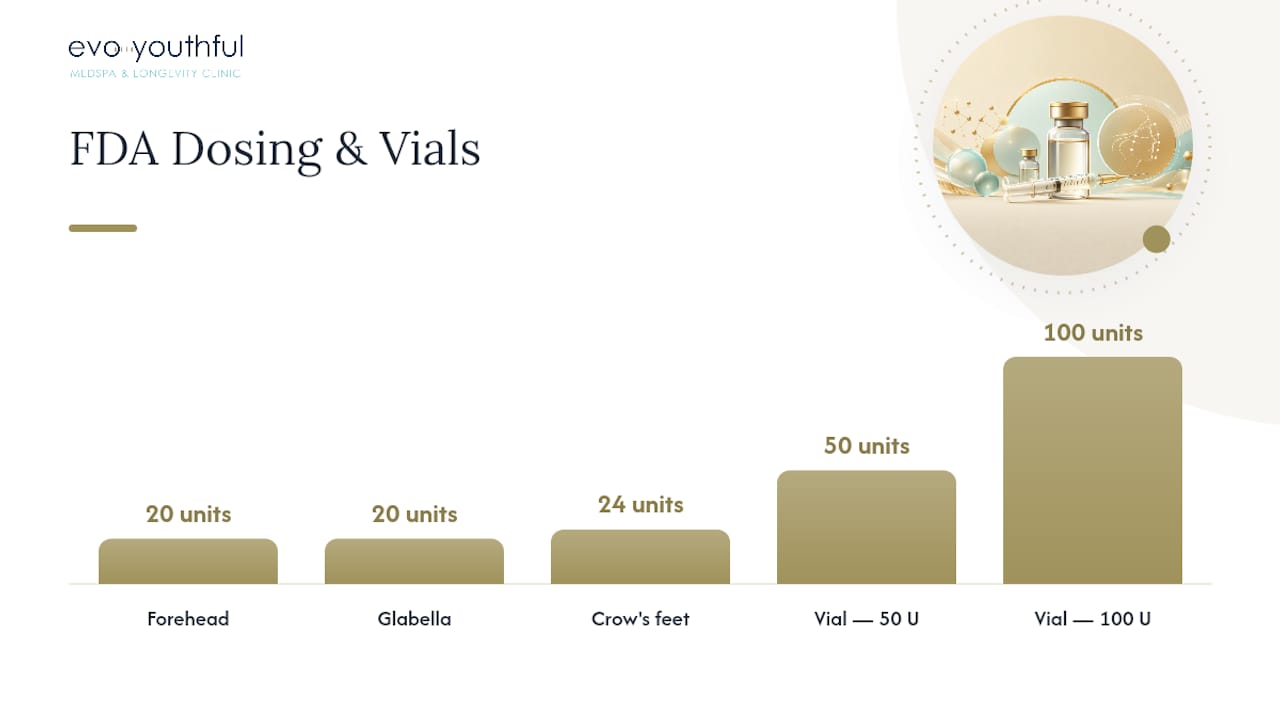
Vials come in two sizes, 50 units and 100 units, and clinics reconstitute them with saline before injecting. A common dilution yields about 4 units per 0.1 mL, according to DailyMed’s drug information. Diluting the vial more or less changes the injection volume per site, not the biological strength of each unit, so a “watered down” vial isn’t a weaker treatment.
How Should You Plan Your First Botox Session?
First-time patients almost always benefit from starting conservative and building up over a follow-up visit rather than committing to a maximal dose right away.
- Start with lower-range doses: Roughly 10 to 15 units for the forehead, 15 to 20 for the glabella, and 6 to 12 for crow’s feet, putting a conservative three-area total around 30 to 50 units.
- Add functional areas separately: Masseter or neck treatment adds substantially to the total, and each side of the jaw is typically dosed and counted independently.
- Ask about pricing structure: Some clinics charge per unit, others price by area or package, so ask directly how your quote breaks down before booking.
- Plan a two-week check-in: Many injectors build in a follow-up to assess symmetry and offer a small top-up if needed, a strategy InjectCo’s dosing guide also recommends for new patients.
Underdosing tends to mean more frequent touch-ups and higher costs over a year, while a well-calibrated first session often lasts longer and needs less correcting.
Are There Side Effects You Should Watch For?
Most side effects are minor and temporary, but a few warrant real caution.
- Common and temporary: Bruising, mild swelling, and slight asymmetry that typically resolves within days.
- Rare but significant: Brow ptosis (a heavy, drooping brow) and eyelid ptosis, along with unintended weakness in nearby muscles.
Treating the forehead without also balancing the glabella raises the risk of brow ptosis, since the frontalis muscle lifts the brow and the corrugators pull it down. Cleveland Clinic’s patient guide notes that individualized dosing based on muscle strength and history helps prevent this kind of imbalance. Avoid rubbing the treated area for 24 hours, and contact your provider promptly if you notice drooping that doesn’t improve within a week or two.
When Will You See Results, And How Long Do They Last?
Botox typically starts working within 2 to 7 days, with full effect visible around the two-week mark. Results commonly last 3 to 6 months, depending on the area treated and the dose used. Most clinicians recommend waiting roughly 3 to 4 months between early treatments, giving the muscle time to fully respond before deciding whether an adjustment is needed.

A Practitioner’s View On Assessing Your Dose
When Elizabeth Vogstrom, PA-C evaluates a new patient, the process starts with watching the muscles move at rest and during full animation, since a strong frontalis or a tight masseter tells a very different dosing story than a subtle one. A conservative starting dose gives room to adjust rather than overcorrect. Follow-up visits often involve small top-ups in areas that under-responded, refining the plan visit by visit rather than guessing at a “final” number upfront.
What Most Advice On Botox Dosing Gets Wrong
Most articles hand readers a chart and call it a day. The chart isn’t wrong, but it creates a false sense of precision. Two patients can both fall into the “15 to 25 units for glabella” range and need completely different treatments because one clenches their jaw at night and the other doesn’t move their forehead much at all.
The bigger gap in conventional advice is treating dosing like a fixed recipe instead of a starting hypothesis that gets tested and adjusted. The FDA’s 64-unit three-area regimen is a genuinely useful anchor, not because it’s the “right” number for everyone, but because it reflects a balanced ratio between muscle groups that prevents problems like brow ptosis. Patients who fixate on hitting a specific unit count often miss the more important question: is my provider adjusting based on how my muscles actually move, or just filling in a template?
If you’re planning your first session, prioritize finding an injector who explains their reasoning, not just their price per unit. A provider willing to start conservative and follow up in two weeks is telling you something important about how they think.
— Elizabeth Vogstrom, PA-C
Ready To Build Your Personalized Dosing Plan?
Unit charts give you a starting point, but your actual dose depends on your muscle strength, treatment history, and goals, which is exactly what a hands-on consultation is for. evoyouthful offers Botox and related injectables alongside a broader menu of aesthetic and wellness treatments, so your provider can look at your face as a whole system rather than one isolated area.

If jaw tension, teeth grinding, or a square jawline is part of what you’re trying to solve, evoyouthful’s Botox treatment for TMJ and jaw tension addresses both the functional and cosmetic side of masseter dosing in one visit. For classic forehead, glabella, and crow’s feet work, the clinic’s Botox and Dysport services walk you through unit planning tailored to your muscle strength and desired result. Book a consultation to get an actual number instead of a range, and leave with a plan built around your face, not a generic chart.
This article is general information, not a substitute for advice from a qualified doctor. Consult a qualified healthcare professional about your own circumstances before acting on anything here.
Sources
- DailyMed — BOTOX Cosmetic drug information
- Peer-reviewed review article on aesthetic uses and dosing (NCBI PMC)
- Cleveland Clinic — Botulinum toxin injections patient guide
Recommended
Ready to Start?
Schedule a Consultation
Have questions about what you just read? Our team is here to help.