

Hormone Imbalance Signs That Quietly Hurt Business Performance
Elizabeth Vogstrom, PA-C
evoyouthful Clinical Team
Discover how hormone imbalance signs can harm your business performance. Learn to identify symptoms and enhance productivity today.
Hormone Imbalance Signs That Quietly Hurt Business Performance
Yes, hormone imbalances commonly cause fatigue, brain fog, and mood changes that directly reduce productivity, decision quality, and presence in high-stakes work situations. These aren’t vague complaints. The Cleveland Clinic lists persistent fatigue, unexplained weight changes, irritability, and difficulty concentrating among the most common signs, and the NIEHS has spent decades studying how endocrine disruptors interfere with the hormonal signaling that keeps your energy, mood, and focus steady.
If any of this sounds familiar, take two steps today, before you read another paragraph:
- Start a simple symptom log. Note energy dips, memory slips, and mood shifts by date and time, along with what meeting or task you were doing.
- Pause nonessential high-stakes decisions until you’ve tracked a pattern for at least a week or two. Hormonal fatigue and brain fog tend to cluster; a log makes that visible fast.
Key Takeaways
Hormone imbalances commonly cause fatigue, brain fog, and mood changes that reduce workplace productivity, decision quality, and presence, and targeted testing can identify the cause.
| Point | Details |
|---|---|
| Core signs to track | Fatigue, brain fog, mood changes, sleep disruption, and weight shifts often signal hormonal rather than situational causes. |
| Distinguish from burnout | Multi-system symptoms that persist despite rest and standard stress management point toward hormonal evaluation. |
| Testing takes time | Reliable diagnosis often requires cycle-timed panels or diurnal cortisol sampling, not a single blood draw. |
| Managers can help discreetly | Flexible scheduling and confidential check-ins support employees without requiring a diagnosis disclosure. |
| Economic stakes are real | Hormone-related issues may cost the U.S. economy nearly $196 billion annually in lost productivity. |
| Evaluation options exist | evoyouthful offers comprehensive hormone panels and BHRT as one clinical path toward addressing symptoms affecting work. |
Table of Contents
- Hormone Imbalance Signs Business Performance Depends On
- Why Hormones Affect Performance: The Mechanisms Worth Understanding
- Is It Hormones, Stress, or Burnout? Red Flags to Watch
- What Clinicians Test and Why: A Diagnostic Checklist
- Reducing Symptoms That Hurt Work: What Actually Helps
- Supporting Employees Without Overstepping: A Manager’s Guide
- Your 7-Day Plan If You Suspect Hormones Are Affecting Your Job
- A Clinician’s View on Hormones and Workplace Performance
- A Confidential Next Step for Busy Professionals
- Sources
Hormone Imbalance Signs Business Performance Depends On
Not every symptom carries the same weight at work. Some quietly erode output for months before anyone, including you, connects the dots.
- Persistent fatigue. Waking up tired despite adequate sleep often shows up as presenteeism: you’re at your desk, but your output has quietly dropped by half.
- Brain fog. Trouble concentrating, forgetting names mid-meeting, or losing your train of thought during a presentation signals more than a busy week. The Cleveland Clinic notes this kind of cognitive fog is a hallmark hormonal symptom, not just stress.
- Anxiety and irritability. Short fuses in negotiations or snapping at direct reports can stem from hormonal mood disruption rather than a genuine personality shift.
- Sleep disruption. Waking at 3 a.m. and staring at the ceiling wrecks next-day reaction time and patience, both of which matter in client calls.
- Unexplained weight or appetite changes. Sudden shifts often accompany thyroid or metabolic hormone issues and frequently travel alongside fatigue and low motivation, according to UCLA Health.
Age and gender shape which symptoms dominate. Women in perimenopause often report brain fog and confidence loss specifically in high-demand roles like finance and venture capital, where split-second judgment calls are the job. Men with declining testosterone more often report fatigue, low motivation, and reduced assertiveness in leadership settings. Neither pattern is universal, but both are common enough that clinicians watch for them by age and life stage.
Why Hormones Affect Performance: The Mechanisms Worth Understanding
Absolute hormone levels matter less than most people assume. Timing, rhythm, and how well your cells respond to hormonal signals often matter just as much, a concept researchers call endocrine noise. When that signaling gets degraded, cognitive and emotional symptoms follow even when a single blood test looks “normal.”
- Cortisol rhythm. A healthy cortisol curve peaks shortly after waking and tapers through the day. Chronic stress or endocrine disruption can flatten that curve, and a flattened rhythm is linked to poorer attention, weaker memory consolidation, and skewed risk tolerance, according to a review on endocrine noise and HPA-axis disruption.
- Thyroid function. Low thyroid hormone slows metabolism and mental processing speed, which shows up as sluggish responses in meetings and slower task completion.
- Sex hormones. Estrogen and testosterone both influence verbal fluency, working memory, and confidence. Declines or fluctuations in either can blunt performance in roles that depend on quick, articulate thinking.
Picture two curves on a chart: a healthy diurnal cortisol curve rising sharply at dawn and sloping down by evening, versus a flattened line that barely rises or falls. The flattened pattern correlates with the 2 p.m. crash many professionals blame on lunch, when the real driver is a stalled cortisol rhythm.
Is It Hormones, Stress, or Burnout? Red Flags to Watch
Distinguishing a hormonal cause from garden-variety burnout matters, because the fixes are different. A few signals point toward the endocrine system rather than pure overwork.
- Multi-system symptoms. Sleep problems plus unexplained weight change plus skin or menstrual changes together suggest something systemic, not just a rough quarter.
- Symptoms that don’t respond to rest. If a vacation or a lighter workload doesn’t touch your fatigue or fog, that’s a red flag stress-management alone won’t fix it.
- Cyclical or persistent timing. Symptoms that track a monthly cycle, or that have persisted for months regardless of workload, point toward hormonal rather than situational causes.
- No improvement after standard stress steps. If you’ve tried sleep hygiene, exercise, and reduced hours without relief, it’s worth asking a clinician about hormone testing.
One more wrinkle: certain medications and supplements can mimic or mask hormonal symptoms. Beta blockers, some antidepressants, and even high-dose biotin supplements can skew thyroid readings or blunt symptoms. Never stop a prescribed medication on your own. Bring your full list to your appointment so your clinician can factor it in.
What Clinicians Test and Why: A Diagnostic Checklist
A useful evaluation isn’t just “a blood draw.” Clinicians typically build a picture from multiple markers, sometimes over more than one visit, because single-point measurements can miss rhythm-related problems entirely.
| Test category | What it checks | Timing note |
|---|---|---|
| TSH, free T4, free T3 | Thyroid function and metabolic rate | Fasting morning draw is standard |
| Sex hormone panel | Estrogen, testosterone, progesterone | Timed to menstrual cycle when relevant |
| Cortisol (morning or diurnal saliva) | HPA-axis rhythm and stress response | Single-point tests can mislead; diurnal sampling is more reliable |
| Metabolic panel, fasting glucose/HbA1c | Blood sugar regulation and metabolic health | Fasting required |
| Inflammatory markers | Systemic inflammation contributing to fatigue | As clinically indicated |
The NIEHS points out that appropriate timing and clinical context matter as much as the raw numbers, which is why a single morning cortisol reading sometimes prompts a referral to endocrinology for time-resolved sampling instead of a quick verdict.
Before your appointment, bring:
- A symptom log with dates and workplace impact examples
- Your full medication and supplement list
- A rough sleep and work-stress timeline from the past two to three months
- Any recent lab results you already have
A comprehensive hormone panel typically covers most of these categories in one coordinated workup rather than piecemeal testing.
Reducing Symptoms That Hurt Work: What Actually Helps
Interventions fall into three practical categories, and most people need a combination, not just one.
Lifestyle changes address the foundation: consistent sleep and wake times, morning light exposure to anchor circadian rhythm, reduced late-day caffeine, and regular exercise, which several clinical resources link to improved cortisol regulation and cognitive function. Sleep and clinical fatigue solutions that combine both approaches tend to outperform lifestyle changes alone.

Clinical treatments matter when lifestyle changes plateau. Thyroid hormone replacement for confirmed hypothyroidism often relieves fatigue and cognitive slowing once properly dosed. Bioidentical Hormone Replacement Therapy (BHRT) is one option clinicians use to address sex-hormone decline tied to fatigue, mood, and libido changes, always under medical supervision, since dosing and monitoring need individualized oversight.
Environmental steps reduce ongoing hormonal interference. The EPA notes that endocrine-disrupting chemicals can mimic, block, or alter hormone signaling, so cutting exposure to certain plastics and personal care chemicals where practical is a reasonable, low-cost step. For people looking to start with everyday, nonprescription routines, resources like this guide to natural support for hormonal balance outline lifestyle-level changes worth trying alongside clinical care.
Never make abrupt changes to prescribed hormone medication without medical guidance, and treat over-the-counter supplements with the same caution you’d apply to any drug affecting your endocrine system.
Supporting Employees Without Overstepping: A Manager’s Guide
Managers rarely need to diagnose anything. They need to notice, ask thoughtfully, and adjust workload without turning a private health issue into office gossip.
- Build regular, informal health check-ins into one-on-ones rather than reserving them for performance problems.
- Offer flexible scheduling around high-stakes meetings when an employee seems to be struggling.
- Provide temporary workload adjustments during documented rough patches, without demanding a diagnosis.
- Route employees to your Employee Assistance Program (EAP) or medical benefits proactively, before performance issues escalate.
- Train leadership on basic hormonal health awareness so patterns like perimenopause-related brain fog aren’t mistaken for disengagement.
Keep any related notes limited and confidential, shared only with HR when necessary and never discussed casually with other team members.
Pro Tip: Frame support offers around flexibility, not diagnosis. Instead of “Are you going through menopause?” try “I’ve noticed some tough weeks, would adjusting your meeting schedule help?” It respects privacy while still extending real support.
Your 7-Day Plan If You Suspect Hormones Are Affecting Your Job
- Days 1 to 3: Start a daily log tracking energy, focus, mood, and sleep, noting specific work moments affected (a missed deadline, a foggy presentation).
- Day 3: Gather your full medication and supplement list, including dosages and start dates.
- Day 4: Schedule a visit with your primary care provider or a hormone imbalance specialist.
- Days 5 to 7: Continue logging, and where possible, avoid scheduling major decisions during your lowest-performance windows.
Bring these questions to your appointment:
- What’s the right timing for my labs, and should any be repeated at a different time of day or cycle phase?
- If BHRT or thyroid treatment is appropriate, what’s the expected timeline before I notice a difference?
- What side effects should I watch for in the first few weeks?
- Can you document anything I might need for workplace accommodations?
Document workplace impact specifically: missed deadlines, meetings where you lost your train of thought, or projects that took noticeably longer than usual. Concrete examples give your clinician far more to work with than “I’ve just been tired.”
A Clinician’s View on Hormones and Workplace Performance
Most professionals wait far too long before asking whether hormones are behind their slipping performance. They chalk it up to a demanding quarter, poor sleep, or simply “getting older,” and by the time they come in, they’ve often spent months compensating with extra coffee, extra hours, and sheer willpower.
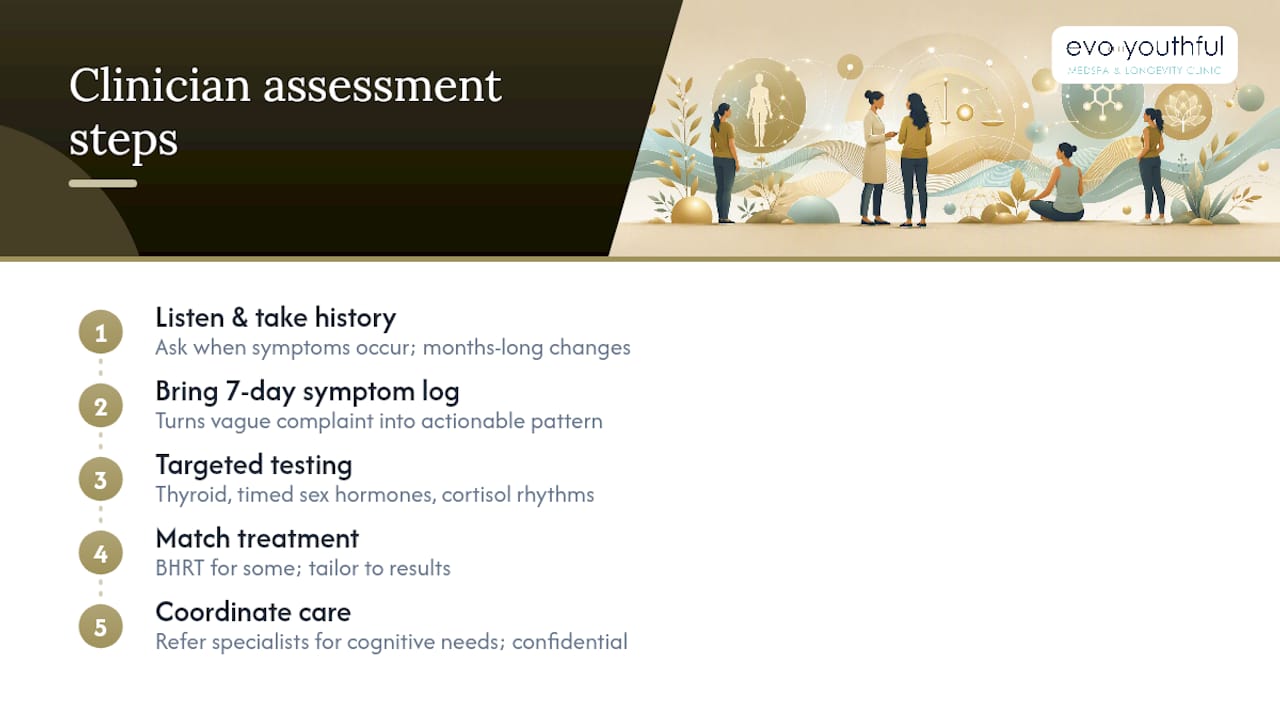
A thorough evaluation starts with listening, not just ordering labs. I want to know when the fatigue hits hardest, whether brain fog shows up in specific situations like public speaking or financial modeling, and how sleep and mood have shifted over months, not days. From there, testing gets targeted: thyroid panels, sex hormones timed appropriately, and cortisol patterns when the history suggests rhythm disruption rather than a flat deficiency. BHRT is one tool among several, useful for some patients and unnecessary for others, and the goal is always matching treatment to what the evaluation actually shows.
Bring your 7-day symptom log to your first visit. It turns a vague complaint into a pattern we can act on. Everything discussed stays confidential, and when cognitive symptoms need more than hormonal correction alone, we coordinate with other specialists rather than guessing.
A Confidential Next Step for Busy Professionals
If your energy, focus, or mood have been quietly working against you at your desk, evoyouthful offers a discreet path to find out why, rather than guessing for another six months. A comprehensive hormone panel gives you real data instead of assumptions, and it’s the same starting point Elizabeth Vogstrom, PA-C, described above.

Depending on what your evaluation shows, evoyouthful offers several targeted paths forward. Bioidentical Hormone Replacement Therapy addresses fatigue, mood, and libido changes tied to declining sex hormones. Men dealing with low energy and reduced drive can explore testosterone-focused BHRT built specifically around male hormone patterns. For cognitive symptoms like brain fog that need support beyond hormone correction alone, ExoMind offers a non-hormonal option worth discussing with your provider.
Every consultation is private, and nothing about your evaluation or treatment plan gets shared beyond your care team. Schedule a confidential consultation online or call the Wayzata clinic to ask what a comprehensive panel involves before you commit to anything.
Sources
- Hormonal imbalance — Cleveland Clinic
- 7 signs of hormonal imbalance and what to do about it — UCLA Health
- Overview of endocrine disruption — U.S. EPA
- Hormonal issues could cost U.S. economy almost $200 billion annually — Forbes
Lab results and symptom patterns vary from person to person. Talk with your clinician about what your specific results mean before making treatment decisions.
FAQ
Can hormone imbalances really affect job performance, not just general health? Yes. Fatigue, brain fog, and mood changes tied to hormone imbalance directly reduce concentration, decision speed, and presence in meetings, which shows up as measurable workplace impact.
How do I know if it’s hormones and not just work stress? Look for multi-system symptoms, timing that doesn’t improve with rest, and patterns that persist despite standard stress management. A clinician can order targeted testing to clarify the cause.
What tests should I expect at a first appointment? Typically a thyroid panel, sex hormone levels timed appropriately, a metabolic panel, and sometimes diurnal cortisol sampling if your history suggests rhythm disruption rather than a flat deficiency.
Is BHRT the only treatment option? No. BHRT is one option among several, including thyroid replacement, lifestyle changes, and cognitive supports like ExoMind, chosen based on what your evaluation actually shows.
This article is general information, not a substitute for advice from a qualified doctor. Consult a qualified healthcare professional about your own circumstances before acting on anything here.
Recommended
Ready to Start?
Schedule a Consultation
Have questions about what you just read? Our team is here to help.