

Concierge Medicine vs Traditional Care: 2026 Guide
Elizabeth Vogstrom, PA-C
evoyouthful Clinical Team
Discover the key differences between concierge medicine vs traditional care in our 2026 guide. Learn how your choice can impact your healthcare.
Concierge Medicine vs Traditional Care: 2026 Guide
Concierge medicine is a retainer-based healthcare model where physicians serve panels of 100–600 patients, offer 30–60 minute visits, and provide same or next-day access. Traditional primary care, by contrast, operates on panels of 2,500 or more patients with 15-minute appointments and wait times stretching weeks. Understanding concierge medicine vs traditional care means understanding a fundamental structural difference, not just a lifestyle upgrade. The model you choose shapes how quickly you get answers, how well your doctor knows your history, and how proactively your health is managed.
How do concierge medicine and traditional care compare in access?
The most immediate difference between these two models is how quickly and directly you can reach your physician. Traditional primary care averages 20–26 day wait times for new patients, with visits capped at roughly 15 minutes. That time constraint is not a physician preference. It is a structural outcome of managing a panel of 2,500 or more patients under a fee-for-service billing system.
Concierge medicine flips that equation. Physicians in concierge practices typically serve 100–600 patients, which creates the capacity for longer visits and faster scheduling. Same or next-day access is standard, not exceptional. That difference matters most when a symptom is ambiguous and you need a real conversation, not a rushed appointment.

Communication access is another key distinction. Concierge practices often provide direct physician contact 24/7 via personal cell phone or secure messaging. Traditional care routes most communication through front desk staff or patient portals, which adds time and filters the message before it reaches your doctor.
The quality of that access, however, varies. Some concierge practices offer a true direct line to your physician. Others use triage systems that resemble traditional care more than patients expect. Verifying exactly what “direct access” means before signing up is not optional.
- Panel size: Concierge practices serve 100–600 patients vs. 2,500+ in traditional care
- Visit length: 30–60 minutes in concierge vs. approximately 15 minutes in traditional care
- Wait time: Same or next-day in concierge vs. 20–26 days for new patients in traditional care
- Communication: Direct physician contact in concierge vs. front desk or portal in traditional care
Pro Tip: Ask any prospective concierge practice to describe their after-hours communication process in writing. Practices that cannot answer clearly may not deliver the access they advertise.
What are the cost differences between concierge and traditional care?
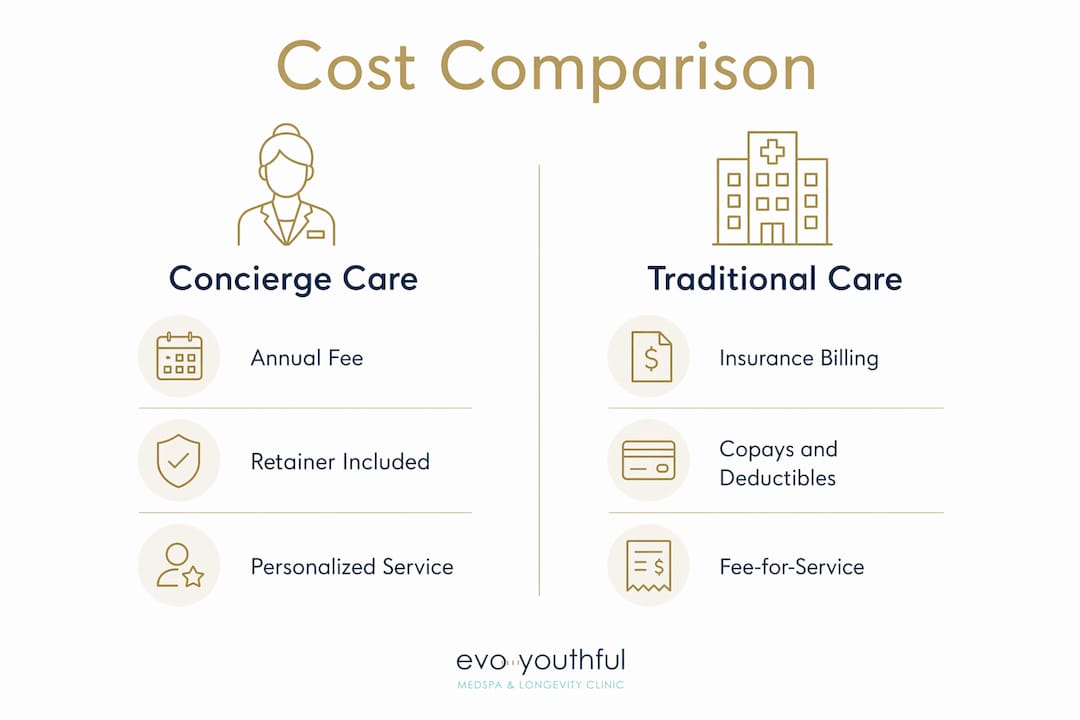
Concierge medicine requires an annual retainer fee ranging from $2,000 to $40,000, depending on the practice and the scope of services included. That range reflects real variation. A boutique urban practice serving executives charges very differently from a regional concierge physician serving a general adult population.
Traditional primary care bills through insurance on a fee-for-service basis. You pay copays, deductibles, and coinsurance, but you do not pay a membership fee. For healthy individuals with minimal medical needs, this model keeps out-of-pocket costs low. The tradeoff is the structural limitations described above.
A third model worth knowing is Direct Primary Care, or DPC. DPC practices charge monthly fees of $50–$150 and offer 30–45 minute visits with same or next-day access. Unlike concierge medicine, DPC does not bill insurance for primary care services at all. It is a lower-cost entry point into the high-access model, though it lacks some of the premium services concierge practices include.
A common misconception is that concierge medicine replaces health insurance. It does not. Concierge patients still maintain traditional insurance for hospitalizations, specialist visits, and major medical events. The retainer covers enhanced primary care access only. Additionally, some concierge practices bill insurance on top of the retainer for services that fall outside the membership scope, which can create unexpected charges if you do not clarify the billing structure upfront.
| Feature | Concierge medicine | Direct Primary Care | Traditional care |
|---|---|---|---|
| Annual cost | $2,000–$40,000 retainer | $600–$1,800/year (monthly fees) | Copays and deductibles only |
| Insurance billing | Yes, for services beyond retainer | No insurance billing for primary care | Yes, fee-for-service |
| Visit length | 30–60 minutes | 30–45 minutes | ~15 minutes |
| Panel size | 100–600 patients | Varies, typically small | 2,500+ patients |
| After-hours access | Often included | Often included | Rarely included |
Pro Tip: Before joining any concierge practice, request a written breakdown of what the retainer covers and whether the practice also bills your insurance separately. Unexpected dual billing is the most common financial surprise in this model.
How do these models differ in preventive care and care coordination?
Preventive care is where the structural advantages of concierge medicine become most clinically meaningful. Smaller patient panels enable longitudinal care, where a physician knows your history deeply enough to notice subtle changes over time. That depth supports earlier symptom detection and more timely intervention. In traditional care, a physician seeing 25 or more patients per day simply does not have the bandwidth for that level of attention.
Longer visits also change what a physical exam can accomplish. A 60-minute annual physical in a concierge practice allows time for a thorough review of labs, lifestyle factors, family history, and personalized health planning. A 15-minute visit in traditional care typically addresses the presenting concern and little else. The difference is not physician effort. It is time allocation built into the model.
Care coordination is another area where concierge medicine offers a structural edge. Concierge physicians often personally manage specialist referrals, follow up on test results, and communicate directly with other providers on your behalf. In traditional care, that coordination frequently falls to the patient, who may not know what questions to ask or which results require follow-up.
The benefits of this model for preventive health include:
- Comprehensive annual physicals with time for detailed lab review and personalized health planning
- Proactive screening recommendations tailored to your age, genetics, and risk profile
- Direct specialist coordination where your primary physician stays involved in the referral process
- Continuity of care built on a long-term physician-patient relationship that improves diagnostic accuracy over time
- Lifestyle and wellness integration that goes beyond treating symptoms to addressing root causes
Patients exploring integrative health care approaches will recognize these principles. The concierge model and integrative medicine share a common foundation: treating the whole person, not just the episode.
Who benefits most from concierge medicine vs traditional primary care?
No single care model is universally superior. Patient health needs, budget, and priorities determine which model delivers the most value for a given individual. Knowing where you fall on that spectrum makes the decision much clearer.
Traditional primary care is the right fit for:
- Healthy individuals with minimal medical needs who require only routine checkups and occasional acute care
- Patients with comprehensive insurance coverage who want to minimize out-of-pocket costs beyond premiums
- Individuals in areas with strong primary care access where wait times are shorter than the national average
- People who are comfortable with portal-based communication and do not require frequent physician contact
Concierge medicine delivers the most value for:
- Patients managing chronic conditions such as diabetes, cardiovascular disease, or autoimmune disorders who need frequent, detailed physician contact
- Individuals with complex medical histories who benefit from a physician who knows their full picture
- People who travel frequently or have demanding schedules and need flexible, rapid access to their physician
- Those prioritizing preventive health who want a proactive partner rather than a reactive provider
- Patients interested in vitality medicine and personalized wellness programs that go beyond standard primary care
Geographic and socioeconomic factors matter here too. Concierge medicine is concentrated in urban and suburban markets. Rural patients may have fewer options, and the annual retainer is a real financial barrier for many households. The DPC model, with its lower monthly fees, offers a middle path for patients who want better access without the premium price tag.
The honest question to ask yourself is this: how often do you actually need your doctor, and what happens when you cannot reach them quickly? Your answer tells you more about which model fits your life than any general comparison can.
Key Takeaways
Concierge medicine delivers better access and more personalized preventive care than traditional primary care, but the right model depends entirely on your health needs, budget, and how much you value physician availability.
| Point | Details |
|---|---|
| Panel size drives everything | Concierge practices serve 100–600 patients vs. 2,500+ in traditional care, which determines visit length and access. |
| Cost requires full picture | Concierge retainers run $2,000–$40,000 annually, but patients still need insurance for specialists and hospitalizations. |
| Preventive care improves structurally | Longer visits and smaller panels allow concierge physicians to detect issues earlier and coordinate care more actively. |
| Traditional care suits low-need patients | Healthy individuals with minimal medical needs get adequate care from traditional models at lower out-of-pocket cost. |
| Verify access and billing upfront | Concierge quality varies widely; confirm what direct access and billing structures mean before committing. |
What I’ve learned about concierge medicine after years in clinical practice
The growth of concierge medicine is not a trend driven by patient vanity. It reflects a real and documented failure of the fee-for-service system to reward the kind of care that actually keeps people healthy. Concierge medicine growth reflects systemic limits of insurance models that do not incentivize continuity or preventive outcomes. Physicians who move to concierge models often do so because they want to practice medicine the way they were trained, with time to think, listen, and plan.
What I have seen consistently is that the patients who benefit most are not necessarily the wealthiest. They are the ones who have been failed by rushed appointments. A patient with three chronic conditions who has spent years trying to coordinate their own care between specialists is a perfect candidate for concierge medicine. The retainer buys them a physician who actually manages their care rather than reacting to it.
That said, concierge medicine is not a solution for everyone, and I would caution against treating it as one. The model works when the physician is genuinely committed to the relationship and when the patient understands what the retainer does and does not cover. Transparency about fees and expectations is not a nice-to-have. It is the foundation of the entire arrangement.
My honest advice: if you are considering concierge care, interview the physician the same way you would interview a specialist. Ask about their philosophy, their panel size, their after-hours process, and their approach to preventive health. The answers will tell you whether you are looking at a genuine concierge practice or a traditional practice with a membership fee attached.
— Elizabeth Vogstrom, PA-C
Experience personalized care at evoyouthful in Wayzata, MN
If the principles behind concierge medicine resonate with you, evoyouthful in Wayzata, MN offers a care model built on the same values: personalized attention, proactive health management, and treatments tailored to your specific needs.

The EVO Inner Circle Membership provides enhanced access to evoyouthful’s full range of wellness and regenerative treatments, from bioidentical hormone replacement therapy to peptide therapy, all delivered with the individualized attention that standard clinic visits rarely allow. Whether you are managing hormonal imbalances, supporting cognitive health, or building a long-term wellness plan, evoyouthful’s team works with you as a partner, not a patient number. Schedule a consultation to explore what personalized care looks like for you.
FAQ
What is the main difference between concierge and traditional care?
Concierge medicine limits physician panels to 100–600 patients, enabling 30–60 minute visits and same or next-day access. Traditional primary care serves 2,500 or more patients per physician, resulting in 15-minute visits and wait times of 20–26 days.
Does concierge medicine replace health insurance?
No. Concierge patients still need traditional insurance for hospitalizations, specialist visits, and major medical events. The retainer fee covers enhanced primary care access only.
How much does concierge medicine cost per year?
Annual retainer fees range from $2,000 to $40,000 depending on the practice and services included. Direct Primary Care offers a lower-cost alternative at $50–$150 per month with no insurance billing for primary care.
Is concierge medicine worth it for healthy people?
Traditional care is generally sufficient for healthy individuals with minimal medical needs. Concierge medicine delivers the most value for patients managing chronic conditions, complex histories, or those who prioritize proactive preventive health management.
Can I use my HSA or FSA to pay concierge medicine fees?
HSA and FSA eligibility for concierge retainer fees depends on how the practice structures its billing and what services the retainer covers. Confirm with your concierge practice and benefits administrator before assuming the fee qualifies.
Recommended
Ready to Start?
Schedule a Consultation
Have questions about what you just read? Our team is here to help.