
Clinician Reviewed 3D Skin Analysis: Track Results with 0–100 Scores
Elizabeth Vogstrom, PA-C
evoyouthful Clinical Team
Clinician-reviewed 3D skin analysis uses multispectral, multi-angle scans to generate 0–100 scores you and your provider can track. Find when a clinic...
Clinician Reviewed 3D Skin Analysis: Track Results with 0–100 Scores
3D skin analysis combines multispectral imaging with AI software to build a three-dimensional map of your skin, complete with numeric scores for wrinkles, pigmentation, and texture. It gives patients an objective baseline and helps clinicians plan and track treatments with real data instead of guesswork. Think of it as a clinical assistant, though: the scan informs care, but a trained provider still has to interpret it.
TL;DR:
- 3D skin analysis uses multispectral imaging and AI to produce precise, quantifiable scores for skin concerns like wrinkles, pigmentation, and texture.
- It relies on controlled lighting, multi-angle captures, and standardized protocols to ensure reproducibility and accuracy over time.
- The technology measures detailed surface and subsurface features, with precision levels surpassing visual assessment, such as wrinkle depth within 12 microns.
- Clinicians use these scores to prioritize treatments based on skin damage and track progress objectively, but results still require professional interpretation.
- Consumer apps with single selfies offer rough, quick insights but lack the measurement stability and clinical validation of advanced 3D systems.
Table of Contents
- How Does 3D Skin Analysis Technology Work?
- What Skin Features Do These Scans Actually Measure?
- How Clinicians Use Scans and Where They Fall Short
- App Scan or Clinical Scan: Which One Do You Need?
- What Happens During a 3D Skin Analysis Appointment?
- How Scan Results Turn Into a Treatment Plan
- Who’s Behind This Guide and What Backs the Science
- When We Recommend a Scan and Why It Changes the Conversation
- See Your Skin Data With Evoyouthful’s Aura 3D Analysis
- Sources
- FAQ
How Does 3D Skin Analysis Technology Work?
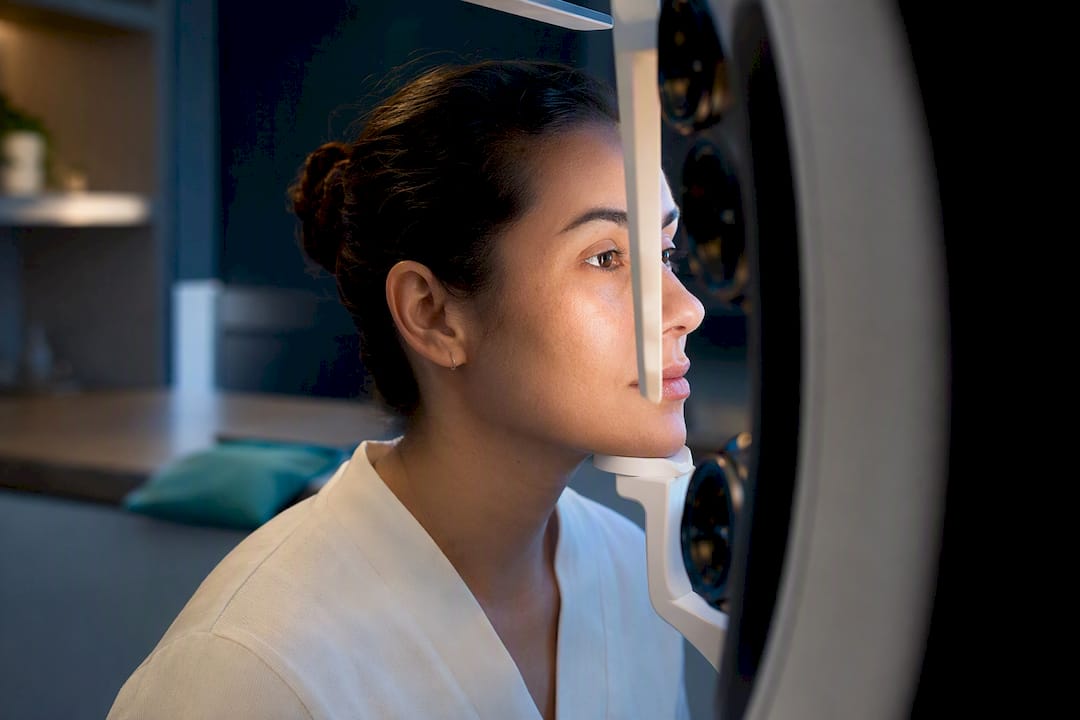
A clinical 3D scan starts with hardware most people never see at a drugstore skin-scanning kiosk. Systems typically use a fixed camera array paired with a head or chin rest, which keeps the face at a constant distance and angle so images from one visit can be compared accurately to the next. High-resolution sensors capture the skin in multiple passes under controlled lighting, since even a shift in room brightness can throw off comparisons over time. Clinics standardize this setup precisely because reproducible clinical-grade scans depend on strict environmental control — small deviations in lighting or head position show up as measurable, and misleading, differences in results.
The real depth comes from switching light sources. Advanced systems typically layer RGB (standard visible light), polarized light, and UV to visualize both surface texture and what’s happening underneath it, including sun damage, pigmentation, and vascular patterns invisible to the naked eye. Polarized light cuts through surface glare to reveal true skin tone and inflammation. UV light makes porphyrins (bacterial byproducts tied to acne) and sun damage fluoresce, exposing damage that hasn’t surfaced yet.
Turning flat images into a 3D model relies on established computer-vision methods:
- Stereo photogrammetry triangulates depth from multiple camera angles shot simultaneously.
- Structured light or fringe projection projects a pattern onto the face and measures how it distorts across contours.
- Tactile probes, like GelSight-style sensors, press against skin to capture fine surface texture at a near-microscopic level.
Once captured, software takes over: aligning images (registration), correcting for color and lighting inconsistencies, generating pixel-level masks that isolate specific concerns, and running AI models that convert all of it into scores a clinician can act on.
What Skin Features Do These Scans Actually Measure?
A 3D skin diagnostic doesn’t just take a nicer photo. It quantifies specific concerns and assigns numbers you can track over months or years. Common metrics include:
- Spots and pigmentation — count, size, and depth of sun spots or hyperpigmentation
- Wrinkles — location, length, and in advanced systems, depth
- Pores — size and visibility across zones of the face
- Texture — surface smoothness scored against population norms
- UV and brown spots — subsurface damage not yet visible to the eye
- Porphyrins — bacterial markers linked to acne activity
- Vascularity and redness — visible and subsurface blood vessel patterns
- Hydration and firmness — surface moisture and skin elasticity indicators
Most platforms translate these into 0 to 100 scores or severity scales, letting you see whether a metric improved 15 points after three months of retinoid use, for example, rather than relying on someone’s memory of “it looks better.” Haut.AI’s Face Analysis platform reports clinical-style outputs across 29 or more skin parameters, aiming for scoring that aligns with dermatological standards rather than a generic beauty-app grade.
Statistic Callout: A 2025 study on a GelSight-based handheld probe found it could measure wrinkle depth with a mean absolute error of about 12.55 microns compared to reference measurements. That’s a level of precision that goes well beyond what the eye, or a standard photo, can detect.
How Clinicians Use Scans and Where They Fall Short
Clinicians lean on scan data to decide what to treat first, not just what to treat eventually. A patient with a high UV-damage score but a low wrinkle score gets prioritized differently than one with the reverse. Scans also create a documented before-and-after record, which matters both for tracking real progress and for having an honest conversation about what a treatment actually changed.
Trust in these systems rests on three things: peer-reviewed validation, a repeatable capture protocol, and a clinician who reviews the output rather than a screen that spits out a verdict. A 2024 validation study on the Skinly handheld device found it produced accurate readings for facial age, wrinkles, tone, redness, and porphyrin levels when checked against lab-grade instrumentation, which is the kind of evidence that separates a clinical tool from a marketing gimmick.
That said, limitations are real:
- Lighting and positioning sensitivity can shift scores between visits if capture protocol isn’t followed exactly.
- Skin tone generalizability remains an active concern, since some AI models were trained on limited, non-diverse datasets.
- False positives happen, particularly with early-stage or subtle concerns, and AI without oversight can flag or miss things a trained eye would catch.
Experts studying AI in dermatology have been consistent on this point: these tools function as clinical assistants that improve consistency, not replacements for a clinician’s judgment.
Pro Tip: Always ask whether your results are reviewed by a clinician, not just generated by software, and request a side-by-side score comparison from your last visit so you can see actual change, not just a new number.
App Scan or Clinical Scan: Which One Do You Need?
A phone-based skin app and a clinic-grade 3D system solve different problems, even though both spit out a score. Consumer apps typically rely on a single selfie, a basic lighting check, and a fast AI read that gives you a rough sense of your skin that day. Developer platforms behind many of these apps, including Perfect Corp’s AI skin analysis tools, do enforce some capture-quality rules like framing and lighting minimums, but they’re still working from one uncontrolled image.
Clinical systems go further with multi-angle or full 3D capture, controlled lighting, and a provider who adds context your phone can’t. Multi-angle captures, sometimes called a “Face 180” approach, reduce blind spots and improve measurement stability compared to a single frontal shot.
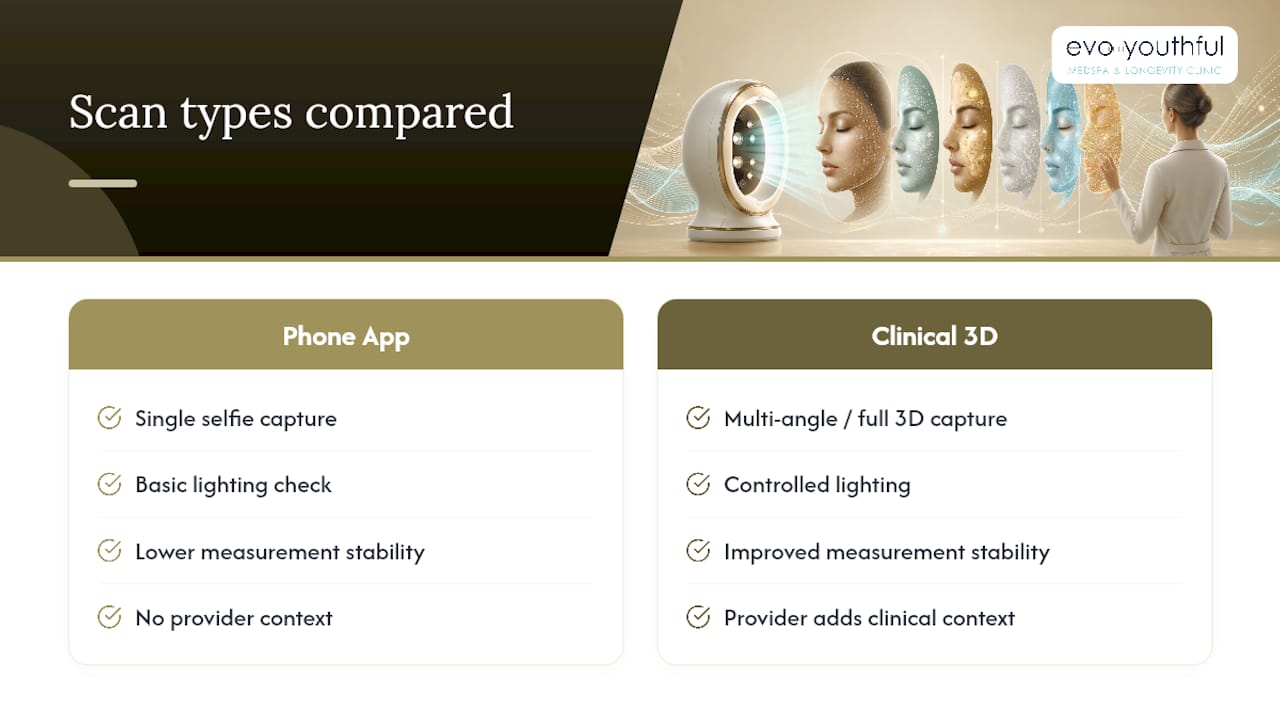
Use an app when you want a quick gut check between appointments. Book a clinical scan when you’re making a real decision, like starting a new device-based treatment or tracking results over several months, where accuracy and repeatability actually matter.
What Happens During a 3D Skin Analysis Appointment?
A scan session is short, structured, and mostly passive on your end. Here’s the typical flow:
- Prep and cleansing — makeup and skincare products are removed so the camera reads your actual skin, not a filter.
- Positioning — you rest your chin or head against a fixed support to keep the angle consistent.
- Multi-mode capture — the system cycles through RGB, polarized, and UV light in a matter of seconds per angle.
- Clinician review — a provider walks through your masks, overlays, and scores with you.
- Deliverables — you leave with (or receive digitally) a 3D model, annotated maps, a numeric score report, and specific treatment recommendations.
The capture itself usually takes 5 to 20 minutes. Pricing for advanced skin assessment varies widely by clinic and region, and in the United States it’s often bundled with a consultation rather than sold as a standalone fee, so ask your provider whether the scan is included in a treatment package or priced separately.
How Scan Results Turn Into a Treatment Plan
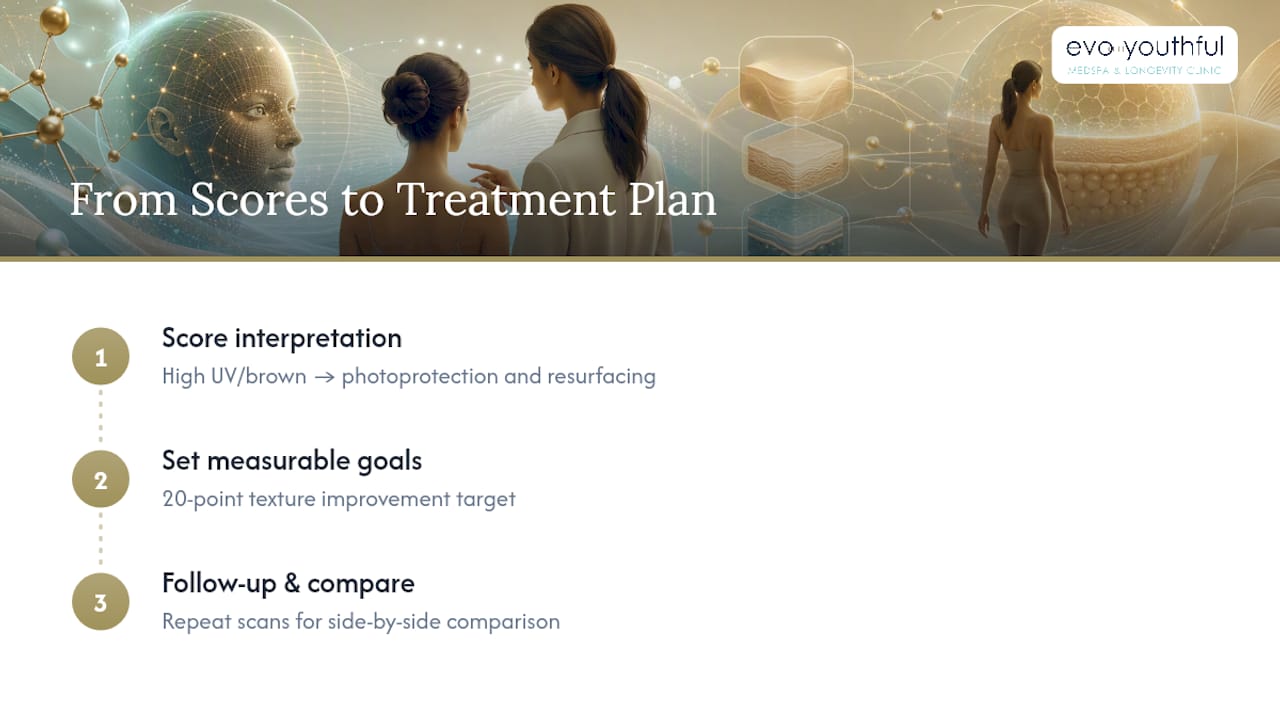
Scores only matter if they change what happens next in the treatment chair. A high UV-damage or brown-spot score often steers a plan toward daily photoprotection paired with targeted resurfacing, while a texture or firmness score that’s lagging might point toward a device-based approach instead. Recent research on 3D skin mapping for personalized dermatological care describes exactly this shift: using quantified data to model likely outcomes before committing to a treatment path.
In practice, clinicians set measurable goals, like a 20-point improvement in a texture score or a visible reduction in a hydration deficit, rather than vague “look better” targets. A concern like chronic dryness or lost plumpness shows up clearly on a hydration metric, which makes it easier to prove a moisturizing protocol is actually working. Follow-up scans then document whether the plan delivered, turning “I think it’s working” into a side-by-side comparison you and your provider can both see.
Who’s Behind This Guide and What Backs the Science
This article was written under the editorial review of Elizabeth Vogstrom, PA-C.
3D imaging can inform how treatments are sequenced across aesthetic and regenerative service lines, from injectables to plasma-based skin therapy. The underlying science has real backing: peer-reviewed work on handheld 3D probes has demonstrated micron-level accuracy in measuring wrinkle depth, and separate validation research on IoT-based skin devices confirmed accurate biophysical readings against lab instrumentation, evidence that this category of technology has moved well past marketing claims.
When We Recommend a Scan and Why It Changes the Conversation
We typically recommend 3D analysis for patients weighing a complex rejuvenation plan or tracking results across multiple device-based sessions, where a single before-and-after photo won’t tell the full story. A scored baseline changes the consultation itself: instead of guessing at priorities, we point to the data together. Even then, the scan supports our clinical judgment. It never substitutes for it.
— Elizabeth Vogstrom, PA-C
See Your Skin Data With Evoyouthful’s Aura 3D Analysis
Aura Skin Analysis pairs clinical-grade 3D imaging with a provider who reviews the results with you, not a kiosk that hands you a printout and sends you shopping. Where a phone app leaves you with a single score and no context, Aura gives you multispectral capture, quantified metrics, and a clinician who translates those numbers into a plan built around your skin’s actual priorities.

At your appointment, the scan itself takes minutes, and you’ll walk through your masks, scores, and recommendations face to face before deciding on anything. Many patients pair their scan with treatments like AgeJET plasma skin therapy or a broader look at skincare products suited to what the data actually shows. If you’re ready to see what your skin’s data says, book a consultation through evoyouthful’s Aura skin analysis page and get a plan built around your numbers, not a guess.
Sources
- Haut
- Skinly: A novel handheld IoT device for validating biophysical skin characteristics
- GelSight-based 3D skin reconstruction and wrinkle depth estimation (2025 DOI)
- 3D skin mapping for personalized dermatological treatment — Frontiers in Photonics (2025)
FAQ
How Much Does an Aura 3D Facial Analysis Cost?
Pricing for Aura Skin Analysis at evoyouthful isn’t published online, since it’s often bundled with a consultation or treatment package. Current pricing details are available directly through evoyouthful’s Aura skin analysis page.
How Much Does a Skin Analyzer Cost?
Costs vary enormously by device type, from consumer app subscriptions that cost little to nothing up to clinical-grade systems that clinics invest thousands of dollars in to run in-house. There’s no single market price because consumer tools and clinic-grade diagnostic equipment serve entirely different purposes.
What Is the Best Device for Skin Analysis?
There isn’t one universal “best” device, since accuracy depends heavily on capture conditions and clinician interpretation. Handheld probes validated in peer-reviewed research, like the Skinly device studied against lab instrumentation, show that smaller tools can still deliver clinically meaningful accuracy when paired with proper protocol and trained review.
What Is the Best Free AI Skin Analysis Tool?
Free AI skin analysis apps can give you a rough, single-photo snapshot of concerns like texture or visible spots, useful for a quick check between appointments. They don’t match the controlled lighting, multi-angle capture, or clinician review that a clinical 3D scan provides, so treat free app results as a starting point rather than a diagnosis.
How Does 3D Skin Analysis Differ From a Regular Skin Photo?
A regular photo captures a flat, single-angle image with no standardized lighting or measurement data attached to it. A 3D skin diagnostic uses multiple light modes and camera angles to build a measurable model with numeric scores, which is what makes tracking real change over time possible.
Recommended
Ready to Start?
Schedule a Consultation
Have questions about what you just read? Our team is here to help.