

155 Units, 31 Sites: Botox for Chronic Migraine Patients
Elizabeth Vogstrom, PA-C
evoyouthful Clinical Team
Evidence based guide to PREEMPT Botox for chronic migraine. Learn the 155 unit, 31 site protocol, what to bring, and insurance steps.
155 Units, 31 Sites: Botox for Chronic Migraine Patients
OnabotulinumtoxinA (BOTOX) is FDA-approved to prevent chronic migraine, defined as 15 or more headache days a month, and it works for a meaningful share of patients who qualify. Most people need two to three treatment cycles, roughly six months, before they can judge whether it’s helping. Side effects like neck pain and eyelid drooping are common but usually temporary, and most patients tolerate the treatment well.
TL;DR:
- Patients need to track at least 15 headache days per month with migraine features on eight of those days for three months to qualify for Botox treatment.
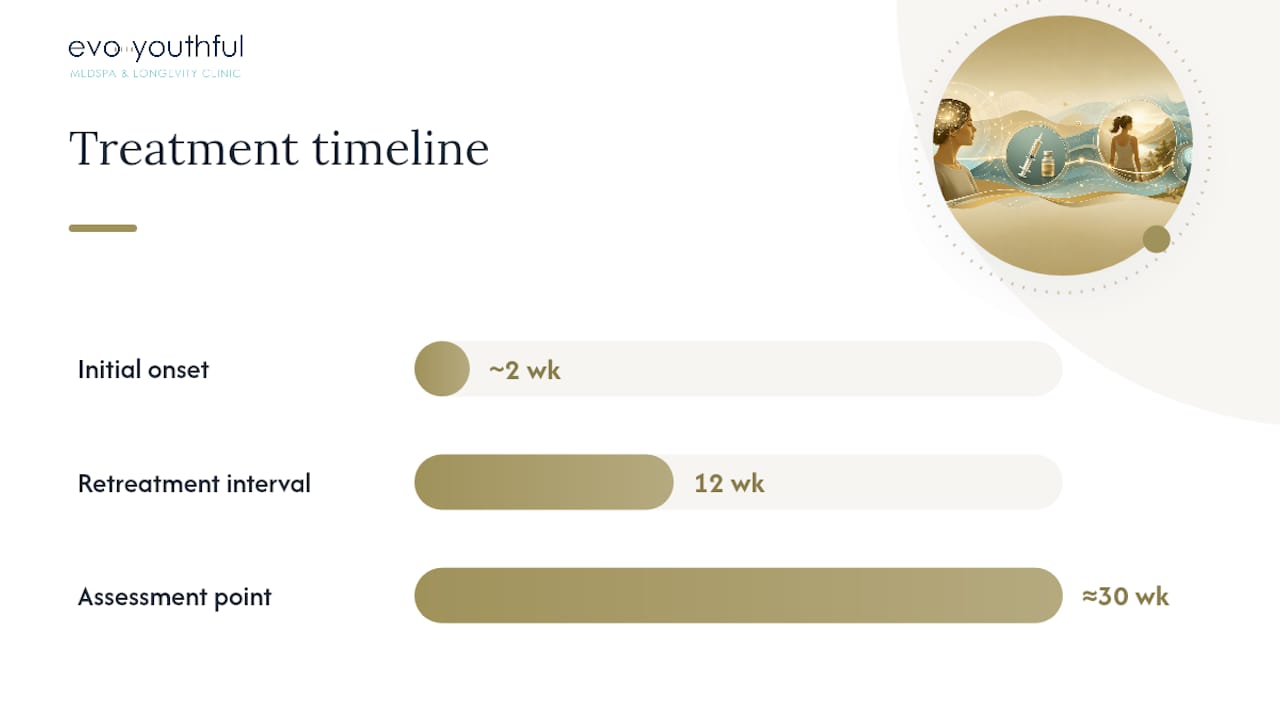
- Most patients require two to three treatment cycles, spaced 12 weeks apart, to see whether Botox effectively reduces migraine frequency.
- Insurance typically covers Botox only after demonstrating failure of two oral preventive medications and submitting detailed headache diaries.
- The standardized PREEMPT protocol involves 155 units injected at 31 fixed points across head and neck muscles during a 15-20 minute appointment.
- Side effects like neck pain and eyelid drooping are usually mild and temporary, but serious adverse reactions, though rare, require immediate medical attention.
Table of Contents
- What Is Botox for Migraines, and How Does It Work?
- Who Qualifies for Migraine Botox, and What Will Insurance Cover?
- What Happens During a Botox Treatment Appointment?
- How Effective Is Botox for Chronic Migraine Prevention?
- What Are the Side Effects of Botox for Migraines?
- How Does Botox Fit Into a Complete Migraine Treatment Plan?
- How Do You Choose a Qualified Botox Provider for Migraines?
- Who Provides This Guidance, and What Should You Expect From a Consult?
- What Should Patients Actually Prioritize When Considering Botox?
- Ready to Explore Botox Treatment at evoyouthful?
- Sources
What Is Botox for Migraines, and How Does It Work?
Botox for migraine prevention has nothing to do with smoothing frown lines, even though it’s the same molecule, onabotulinumtoxinA, used in both applications. The dose, injection pattern, and treatment goal are entirely different. Cosmetic Botox targets small facial muscles to soften wrinkles. Migraine Botox targets a broader map of head and neck muscles to interrupt pain signaling before a migraine cycle takes hold.
The mechanism isn’t fully settled, but the leading explanation is that onabotulinumtoxinA blocks the release of neurotransmitters, including CGRP and substance P, from peripheral nerve endings. Migraines involve sensitized pain fibers that fire too easily. By dampening that signaling at the source, Botox appears to raise the threshold for a migraine to start rather than treating one already in progress. That’s why it’s classified as a preventive, not a rescue treatment.
The FDA’s prescribing information restricts this indication to adults with chronic migraine, meaning headaches on 15 or more days per month, with each episode lasting four hours or longer. This distinction matters for eligibility. Episodic migraine, fewer than 15 headache days a month, is not an approved use, and insurers generally won’t cover it off-label.
Treatment follows a standardized approach known as the PREEMPT protocol, developed during the clinical trials that led to FDA approval. It specifies:
- Total dose: 155 units of onabotulinumtoxinA per session
- Injection sites: 31 fixed points
- Coverage area: 7 head and neck muscle groups, including the forehead, temples, back of the head, neck, and shoulders
- Frequency: Repeated every 12 weeks
This isn’t a treatment a provider improvises. The fixed map is part of what makes the evidence behind it reproducible across thousands of patients.
Who Qualifies for Migraine Botox, and What Will Insurance Cover?
Before booking a consult, it helps to know whether you’re likely to qualify and what your insurer will ask for. Coverage decisions hinge heavily on documentation, not just diagnosis.
- Confirm you meet the diagnostic threshold. You need a documented pattern of 15 or more headache days per month, with migraine features on at least 8 of those days, for a minimum of three months. A headache diary, even a simple daily log on your phone, is the single most useful thing you can bring to your first appointment.
- Show you’ve tried other preventives first. Most insurers require evidence that you’ve tried and failed at least two oral preventive medications, such as topiramate, propranolol, or amitriptyline, before approving Botox. The American Migraine Foundation notes this step-therapy requirement is standard across most payers.
- Expect a prior authorization process. Your clinic submits documentation to your insurer, and approval can take anywhere from a few days to several weeks. Many practices have staff dedicated to this paperwork because denials are common on the first pass.
- Ask about manufacturer assistance if you’re paying out of pocket. Botox’s manufacturer, AbbVie, runs a savings program for eligible patients, and clinics can point you toward it if your coverage falls through.
- Budget realistically if insurance doesn’t cover it. Without coverage, a single treatment session commonly runs into four figures, given the volume of medication and the specialized injection technique required. Costs vary by clinic and region, so ask for a written estimate before your first session.
Bring your headache diary, a list of every preventive medication you’ve tried (with dates and why you stopped), and your insurance card. That paperwork often determines whether your first request for approval succeeds or bounces back for more information.
What Happens During a Botox Treatment Appointment?
A migraine Botox appointment is quick and more procedural than most people expect. Before the injections begin, your provider will screen you for pregnancy, breastfeeding, allergies to any botulinum toxin product, and any neuromuscular conditions like myasthenia gravis, since these are contraindications the American Migraine Foundation flags as important counseling points.
Once cleared, the injection process itself follows the PREEMPT map precisely:
- 155 units total, divided into 0.1 mL (5 units) doses
- 31 individual injection points across the forehead, temples, back of the head, neck, and upper shoulder muscles
- Fine-gauge needles designed to minimize discomfort
- The full session typically takes 15 to 20 minutes, according to guidance from Cleveland Clinic
Most patients describe the injections as a series of quick pinches rather than a single painful event. Numbing cream or ice is sometimes offered, but anesthesia isn’t standard practice for this procedure.
Aftercare is minimal but specific. Providers typically recommend avoiding lying flat for about four hours after treatment, skipping strenuous exercise for 24 hours, and holding off on rubbing or massaging the injected areas, since this can theoretically spread the toxin beyond the intended muscles. You can drive yourself home and return to most normal activities the same day.
Pro Tip: Keep a simple headache log for the two weeks before and the four weeks after each treatment cycle. Not the app kind, just dates and severity. This single habit is what turns a vague “I think it’s helping” into documentation your provider and insurer can actually use.
Benefit isn’t usually instant. Most patients notice a change within days to a few weeks, though it’s common for the full effect to build gradually. Retreatment happens every 12 weeks, and most clinicians recommend committing to at least two to three cycles before deciding whether the treatment is working for you.
How Effective Is Botox for Chronic Migraine Prevention?
The evidence base here is unusually solid for a preventive migraine treatment, and it starts with the PREEMPT trials, the pair of randomized, double-blind studies that formed the basis for FDA approval. Compared with placebo, patients receiving onabotulinumtoxinA showed statistically significant reductions in the number of headache days per month, and a substantial share qualified as “responders,” meaning they saw a meaningful drop in headache frequency.
What the data shows: Pooled analyses and long-term open-label follow-up from the PREEMPT program found that benefits were sustained across repeated treatment cycles, and quality-of-life measures improved alongside the reduction in headache days, according to a peer-reviewed review of the PREEMPT program.
A few patterns are worth understanding before you set expectations:
- Response builds over time. Some patients feel a difference after their first session; others don’t see meaningful improvement until their second or third cycle. This is why most clinicians discourage judging the treatment after a single round.
- Real-world data backs up the trials. Longer-term observational research has tracked patients well beyond the original trial period, and separate analyses point to improved quality of life and reduced reliance on other healthcare services among people who stick with treatment, according to a clinical review of botulinum toxin therapy.
- Not everyone responds equally. A portion of patients see modest or no benefit, which is part of why ongoing headache tracking matters. It gives you and your provider objective grounds to continue, adjust, or pivot to a different preventive strategy.
- Access gaps persist. Trial data suggests efficacy holds up similarly across racial and demographic groups, but who actually gets offered and completes treatment varies, reflecting broader disparities in migraine care access rather than differences in how well the drug works.
The honest takeaway is that Botox isn’t a guaranteed fix, but among preventive options for chronic migraine, it has one of the more rigorously documented evidence trails, built on trial data from thousands of patients and real-world use.
What Are the Side Effects of Botox for Migraines?
Most side effects are mild, localized, and temporary, but a small number of patients experience something serious enough to stop treatment. Understanding the odds ahead of time makes the appointment far less unsettling.
The FDA label lists neck pain, injection-site pain, and headache as the most frequently reported effects, followed by eyelid ptosis (a temporary droop of the eyelid) in a smaller subset of patients. These tend to resolve within days to a few weeks as the toxin’s effect wears off in surrounding muscle tissue.
A small portion of patients in clinical trials discontinued treatment because of an adverse event, according to the FDA’s labeling data. That figure gives you a realistic frame: most people who start treatment tolerate it well enough to continue, but discontinuation for side effects isn’t rare enough to dismiss.
Rare but serious reactions require immediate medical attention:
- Difficulty breathing or swallowing
- Sudden, generalized muscle weakness beyond the injection area
- Unexpected vision changes
- Signs of an allergic reaction (hives, facial swelling)
These events are uncommon, but the FDA maintains a formal reporting channel, MedWatch, specifically because toxin spread beyond the injection site, while rare, is a recognized risk that needs tracking.
A lot of the milder, technique-dependent complications, like eyelid ptosis from toxin migrating into nearby muscles, show up less often when the injector has real experience with the PREEMPT protocol specifically, according to guidance from Cedars-Sinai’s neurology team. If you notice new weakness, drooping, or trouble swallowing after a session, contact your provider promptly rather than waiting for your next scheduled visit.
How Does Botox Fit Into a Complete Migraine Treatment Plan?
Botox rarely stands alone as a treatment strategy. Most neurologists and headache specialists position it as one layer within a broader preventive plan, often introduced after oral preventives haven’t provided enough relief, or used alongside newer options like CGRP inhibitors depending on your history and response.
A realistic plan usually includes:
- Preventive therapy (Botox, oral medications, or CGRP-targeted drugs) to reduce how often migraines occur
- Acute rescue medication for the migraines that still break through
- Lifestyle factors, including sleep consistency, hydration, and trigger tracking, that support whatever preventive treatment you’re on
Goals worth tracking include the reduction in monthly headache days, whether your quality of life is improving, and whether you’re relying less on emergency visits or urgent rescue medication. A headache diary remains the simplest tool for measuring all three.
Most providers recommend committing to two to three full cycles, roughly six to nine months, before deciding whether Botox is worth continuing. If you’re not seeing meaningful improvement by then, or if your migraines remain frequent and disabling despite treatment, that’s the point to ask for a referral to a headache specialist or neurologist who can reassess your full preventive strategy.
How Do You Choose a Qualified Botox Provider for Migraines?
Not every injector who offers Botox has real experience with the migraine-specific protocol. Cosmetic training and headache-focused training aren’t the same skill set, and the difference shows up in outcomes.
- Ask about PREEMPT-specific training. A provider should be able to describe the 31-site, 7-area protocol without hesitation, not just general Botox injection experience.
- Check for headache-specialty background. Providers who regularly treat migraine patients, rather than occasional cosmetic clients, tend to have sharper judgment about site-specific dosing adjustments.
- Confirm they document your response. A good clinic tracks your headache days cycle over cycle rather than relying on your memory alone.
- Ask how follow-up works. You should know your retreatment schedule and who to contact if side effects appear before you leave your first appointment.
- Watch for red flags. Be cautious of a provider who pushes cosmetic add-ons during a migraine consult without clinical justification, or who can’t clearly explain their injection mapping.
evoyouthful’s Botox and Dysport service page outlines the clinic’s neuromodulator protocols, and the guide to comparing local aesthetic clinics walks through the same vetting questions in more depth.
Pro Tip: At your consult, ask to see the injection map before treatment starts. A provider confident in the PREEMPT protocol will walk you through it without hesitation, and that conversation alone tells you a lot about their experience level.
Who Provides This Guidance, and What Should You Expect From a Consult?
This guide draws on the clinical expertise of Elizabeth Vogstrom, PA-C, whose practice focuses on medical aesthetics and wellness, including neuromodulator treatments for both cosmetic and therapeutic indications.
evoyouthful offers Botox and Dysport as part of its broader treatment menu, and the clinic’s approach to neuromodulators emphasizes injection precision and documented technique, the same factors research ties to fewer technique-dependent side effects. Patients considering Botox for TMJ and jaw tension can review the clinic’s approach on its TMJ and jaw tension service page, which reflects the same injection-mapping discipline used in migraine protocols.
A consult at evoyouthful covers your headache history, prior treatments tried, and a discussion of whether Botox or another approach fits your case. Bring your headache diary, a medication list, and your insurance information if you’re pursuing coverage. The clinic’s preventive medical aesthetics best practices guide outlines the safety standards applied across its injectable treatments.
What Should Patients Actually Prioritize When Considering Botox?
The conventional advice on Botox for migraines tends to oversell the timeline and undersell the paperwork. Patients hear “FDA-approved” and expect fast, obvious relief. What the PREEMPT data actually supports is a slower, cumulative benefit that often takes two or three cycles to fully assess, and that mismatch between expectation and reality is where a lot of patients give up too early.
If I had to name the single most overlooked factor in whether treatment succeeds, it’s documentation. Patients who track headache days before starting, and keep tracking through each cycle, make better decisions about whether to continue than patients relying on gut feeling. That habit also happens to be exactly what insurers want to see for prior authorization, so it solves two problems at once.
The other gap is provider selection. A lot of patients assume any Botox injector can perform this treatment competently. The 31-site protocol is specific, and technique genuinely affects both side-effect rates and outcomes. Ask about migraine-specific training before you ask about scheduling.
Combine trigger point injections’ documented role in neck-muscle tension with sound Botox technique, realistic expectations, and consistent tracking, and you have the actual formula behind the trial results, not the shortcut version.
— Elizabeth Vogstrom, PA-C
Ready to Explore Botox Treatment at evoyouthful?
If you’re weighing whether Botox makes sense for your migraine pattern, evoyouthful evaluates chronic migraine cases individually rather than applying a one-size-fits-all protocol. As a Wayzata-based medical aesthetics and wellness clinic, evoyouthful offers neuromodulator treatments, including onabotulinumtoxinA, alongside a broader range of options for patients managing pain, hormonal shifts, or cognitive concerns that sometimes accompany chronic headache conditions.

A consult here covers your headache history, prior preventive medications you’ve tried, and whether your documentation supports insurance prior authorization, so you walk out with a concrete plan instead of more questions. If migraines are affecting your sleep or focus, it’s also worth asking about the clinic’s brain health and cognitive function treatments, since chronic pain and cognitive strain often overlap.
Start by scheduling a consultation through the Botox and Dysport treatment page, where you can review the clinic’s neuromodulator approach and book a time that works for your schedule.
This article is general information, not a substitute for advice from a qualified doctor. Consult a qualified healthcare professional about your own circumstances before acting on anything here.
Sources
- DailyMed - BOTOX- onabotulinumtoxina injection, powder, lyophilized, for solution
- Treatment of chronic migraine with onabotulinumtoxinA: Development, insights, and impact - PMC
- Botox for Migraines - Cleveland Clinic
- Botox for Migraine | American Migraine Foundation
Recommended
Ready to Start?
Schedule a Consultation
Have questions about what you just read? Our team is here to help.